The Future of Jobs Report by the World Economic Forum predicts that artificial intelligence and automation will result in the loss of about 85 million jobs worldwide at the same time as generating 97 million new ones. However, this net increase of 12 million jobs is unlikely to bring much reassurance if most of the work you currently do can be carried out by machine learning models in just a few seconds.
The main issue that professionals will have to deal with in 2026 is not whether AI will take your job; the real issue is to determine which of the tasks associated with your position will be taken over by software and which human abilities as a result will become considerably more valuable?
Automation never replaces whole occupations all at once; instead, it eliminates tasks that are repeatable, predictable, and based on patterns. Once the cost of producing text, code, simple analysis, and routine visual materials has dropped to zero, economic value moves clearly to the areas where software is unable to intervene.
The following is an analysis of the six fundamental human abilities that artificial intelligence is unable to duplicate, an explanation of why these skills are becoming more highly valued in various industries, and advice on how you can reorganize your career to take advantage of this change.
TL;DR: 6 Irreplaceable Human Skills at a Glance
Human Skill | Why AI Fails at It | Roles & Fields Protected |
|---|---|---|
Critical Thinking & Complex Judgment | Models optimize for probability, not objective truth; they lack real-world consequence and liability. | Executive leadership, law, diagnostic medicine, system architecture |
Emotional Intelligence & Relational Trust | Algorithms simulate sentiment but cannot reciprocate empathy or build reciprocal social accountability. | B2B sales, people management, negotiation, clinical therapy, teaching |
Creative Direction & Cultural Taste | Machine learning recombines historical datasets; it cannot invent emergent aesthetics or read subtext. | Creative directors, brand strategists, product innovators, editorial leads |
Ethical Reasoning & Accountability | Software has no legal personhood, moral agency, or social vulnerability; it cannot bear liability. | Compliance, regulatory affairs, governance, public policy, risk management |
Adaptability in Novel Environments | Models degrade rapidly when confronted with "black swan" events outside their historical training data. | Supply chain crisis management, early-stage startups, investigative journalism |
Physical Dexterity in Unstructured Spaces | Sensorimotor coordination in non-standard physical environments remains computationally cost-prohibitive. | Skilled trades, specialized surgery, physical therapy, field engineering |
Why AI Struggles With Certain Human Skills
To understand where your career is safe, you must strip away marketing hyperbole and understand what modern AI actually is: probabilistic pattern recognition operating at massive computational scale.
Large language models (LLMs), diffusion models, and neural networks do not "know" things in the human sense. They extract features from historical data, calculate mathematical probabilities, and predict the next logical token, pixel, or action vector.
This architecture makes AI exceptionally capable at tasks with well-defined parameters, clear rules, and massive corpora of existing examples. It also creates three structural blind spots that software engineering cannot easily solve:
Accountability and Moral Agency: An algorithm cannot be fired, sued, stripped of its professional license, or held socially responsible for malpractice. True business authority requires an entity that bears the legal and social consequences of failure.
True Ambiguity: When an operational challenge presents incomplete, contradictory, or entirely unprecedented data, algorithmic confidence scores collapse or produce plausible-sounding hallucinations.
Social Hierarchy and Relational Trust: Human beings evaluate communication not merely by its informational content, but by the sender's status, vulnerability, shared history, and perceived intent. Code cannot form authentic human bonds.
According to research from the McKinsey Global Institute, fewer than 5% of occupations can be entirely automated using current technologies. However, approximately 60% of all occupations have at least 30% of constituent work activities that are technically automatable.

The professionals thriving in 2026 are not competing with machine intelligence on calculation speed or drafting volume. They are handing those tasks off to models and reallocating their working hours toward high-friction, deeply human skills.
1. Critical Thinking & Complex Judgment
Generative models are probabilistic not epistemic; they generate responses that appear correct on the basis of distribution curves even if the output is not factually accurate, logically coherent, or commercially viable in a given context.
Since artificial intelligence produces fluent output with constant confidence, the cost of coming up with the first answers has fallen to zero. As a result, the value of epistemic vigilance—the capacity to question assertions, pick up on subtle bias, examine assumptions, and then make a final judgment—has increased dramatically.
The Real-World Friction Point
Consider specialized legal technology platforms like Harvey or Casetext. These systems can ingest thousands of pages of discovery documents, cross-reference jurisdictional case law, and draft standard legal briefs in minutes. Yet, no corporate general counsel or court accepts an unreviewed AI filing. Malpractice liability remains squarely with the human attorney who signs the document.
The lawyer's economic value has transitioned from reading discovery files for twelve hours a day to applying nuanced judgment: Does this legal strategy alienate this specific judge? Is the cited precedent legally applicable but strategically disastrous given public sentiment around our brand?
The Salesforce State of Work 2025 report highlighted that 72% of global business leaders view human judgment as more critical to business resilience now than before the widespread deployment of generative software. When algorithms generate twelve plausible strategic pathways in four seconds, the executive who can identify the single path that will not trigger unintended secondary consequences becomes the most valuable person in the room.
To see how growing companies balance automated execution with human review, examine our AI Agentic Workflows for SMEs 2026 Report, which breaks down practical methods for maintaining human-in-the-loop oversight on high-stakes business systems.
2. Emotional Intelligence & Relationship Management
Natural language processing tools can analyze vocal pitch, parse facial micro-expressions, classify customer sentiment, and generate emotionally validated scripts. What they cannot do is reciprocate emotional vulnerability or assume social risk.
Human emotional intelligence (EQ) is not an algorithmic formula; it is a bio-social signaling mechanism. When a prospective client decides whether to sign an eight-figure enterprise software contract, they are not evaluating feature check-boxes alone. They are assessing the character, reliability, and social capital of the team pitching them. They are asking: Will this person take accountability if this rollout threatens my career?
The Real-World Friction Point
Digital behavioral health demonstrates this dynamic clearly. Applications like Woebot and Wysa utilize cognitive behavioral therapy (CBT) conversational frameworks to deliver automated support. Yet, clinical trials and usage patterns demonstrate that these platforms operate effectively as triage or supplementary tools between clinical encounters, not as substitutes for a licensed therapist. The therapeutic alliance—the felt sense of being heard by another conscious human being bound by ethical duty—is the core driver of patient improvement.
In corporate environments, the impact is measurable. Research published in Harvard Business Review tracking managerial performance found that managers scoring in the top quartile of emotional intelligence drove 23% higher team retention metrics compared to managers who relied heavily on automated dashboard tracking and standardized messaging.
High-EQ disciplines that software cannot cannibalize include:
Complex B2B Sales: Navigating conflicting stakeholder politics within client accounts.
People Leadership: Managing team burnout, coaching through conflict, and maintaining morale through operational restructuring.
Dispute Resolution: Mediation, high-stakes contract renegotiation, and labor relations.
Healthcare & Education: Compassionate bedside clinical care and personalized student mentorship.
3. Creative Direction & Original Taste
Artificial intelligence does not create out of a personal desire to express meaning; it synthesizes existing internet scrapings. It is intrinsically retrospective. It maps the mathematical mean of existing cultural assets and generates variations within those known vectors.
Because text, image, and audio generation tools have democratized technical execution, the internet is flooded with competent, technically proficient, entirely soulless generic content. When execution becomes commoditized, taste, curation, and distinct point of view become the primary differentiators.
The Real-World Friction Point
Global design houses and apparel brands like Nike, Apple, and Loewe deploy custom diffusion models to generate thousands of initial concept renders for industrial design, marketing storyboards, and packaging prototypes. Yet, none of these companies have replaced their human creative directors.
Software can generate ten thousand variations of a sneaker silhouette in an afternoon; it cannot decide which design captures the nascent cultural mood of a demographic, disrupts an oversaturated market, or honors brand heritage without looking derivative.
AI generates permutations (The Quantitative Work)
│
▼
Human taste selects, refines, and contextualizes (The Qualitative Work)
The Adobe Creative Economy Report 2025 revealed that 81% of surveyed creative professionals report that while generative tools dramatically increase their production velocity, human aesthetic direction remains the ultimate arbiter of project viability and commercial quality.
If your work involves setting aesthetic standards, framing brand narratives, or identifying non-obvious cultural connections, your value is growing. If your job was merely executing mechanical resizing, standard copywriting templates, or rote vector tracing, you must elevate your skill set to editorial leadership.
To master this transition in marketing contexts, review our operational guide on AI Content Marketing for Small Businesses 2026, which outlines how to delegate production tasks to machine models while retaining distinct, human-led creative vision.
4. Ethical Reasoning & Accountability
Algorithms process parameters; they do not possess moral agency. An automated system cannot weigh ethical trade-offs because it experiences no moral friction, lacks empathy, and cannot be subjected to legal sanction or personal culpability.
When an automated model makes a catastrophic error—such as denying medical coverage, shortlisting biased hiring profiles, or miscalculating corporate credit risk—it cannot stand in court, explain its moral framework, or accept accountability.
The Real-World Friction Point
The rollout of the European Union’s landmark Artificial Intelligence Act established sweeping, legally binding mandates for "high-risk" algorithmic deployments across the member states. The law strictly codifies that automated systems deployed in recruitment, credit scoring, law enforcement, and critical infrastructure must feature active, documented human oversight.
A corporate entity cannot point to an algorithm to deflect regulatory liability. If an automated model produces discriminatory outcomes, the corporate board and designated compliance officers face direct legal action and multi-million-euro penalties.
The Deloitte Global AI Ethics Survey 2025 found that 68% of enterprise consumers demand visible, verified human accountability when automated tools influence decisions that directly affect their personal finances, physical health, or employment status.
Organizations are actively expanding teams focused on algorithmic governance, corporate ethics, compliance verification, and risk management. The individuals who understand both technical system capabilities and macro-level moral, legal, and reputational hazards represent one of the most resilient talent segments in the current economy.
5. Adaptability in Genuinely Novel Situations
Machine learning models are historical systems. They generalize from what has already occurred, been written, indexed, and digitized. When the operating environment mirrors the training distribution, AI behaves with superhuman efficiency. When an unprecedented anomaly occurs—a true "black swan" event—algorithmic systems fail unpredictably.
Human beings, by contrast, possess general intelligence: the cognitive ability to synthesize disparate mental models, make intuitive leaps across unrelated disciplines, navigate structural chaos, and take decisive action when operating with zero historical precedent.
The Real-World Friction Point
Consider international supply chain operations during systemic global shocks. Academic research from MIT Sloan Management Review evaluating corporate responses to unprecedented logistical disruptions demonstrated that organizations reliant on rigid algorithmic predictive modeling suffered significantly longer operational paralysis than competitors led by cross-functional human response units.
The algorithmic models attempted to optimize based on historic shipping trends that were no longer relevant to border closures and port lockdowns. Human teams, however, were able to negotiate emergency ground-transport corridors, restructure bilateral supplier relationships via phone calls, and pivot production lines within days.
Historical Training Context ──► Machine Learning Excels (Optimization)
Unprecedented Context ──► Human Generalists Excel (Sensemaking)
The more pervasive AI becomes at standardizing and optimizing predictable conditions, the more organizations depend on adaptive human problem-solvers to rescue them when reality deviates from the model.
For founders and leaders building operational resilience against shifting technological and market environments, explore our strategic framework on the AI Adoption Roadmap for Small Business 2026.
6. Physical Dexterity & On-Site Presence
For decades, futurists predicted that cognitive work would be safe from automation while manual labor would be quickly conquered by mechanical robotics. The reality of 2026 has upended this assumption entirely.
Cognitive output—text, code, data analysis, visual composition—lives in digital environments where bit processing costs are negligible. Physical manipulation, conversely, encounters Moravec’s paradox: high-level reasoning requires very little computational power, but low-level sensorimotor skills require enormous, specialized, and energy-intensive computational effort.
Training a model to write a sonnet or summarize a legal brief requires a server cluster. Building an autonomous mechanical system that can step into an unmapped basement, visually identify corroded copper pipes behind insulation, maneuver tools in a cramped physical space, and adjust torque dynamically without cracking adjacent drywall remains one of the hardest problems in engineering.

The U.S. Bureau of Labor Statistics projects an 11% employment growth across specialized skilled trades through 2030, substantially outperforming growth estimates for routine white-collar administrative positions.
This resilience extends beyond traditional trades to all roles requiring fine motor adjustments, physical tactile feedback, and direct physical presence:
Clinical Medicine: Emergency room nurses, surgical specialists, and hands-on physical therapists.
Infrastructure Maintenance: High-voltage line mechanics, wind turbine technicians, and telecom field engineers.
Specialized Construction: Master carpenters, commercial HVAC specialists, and historic restoration masons.
Experiential Education: Early childhood educators and athletic performance coaches.
Comparison Table: Tasks AI Automates vs. Human Skills That Appreciate
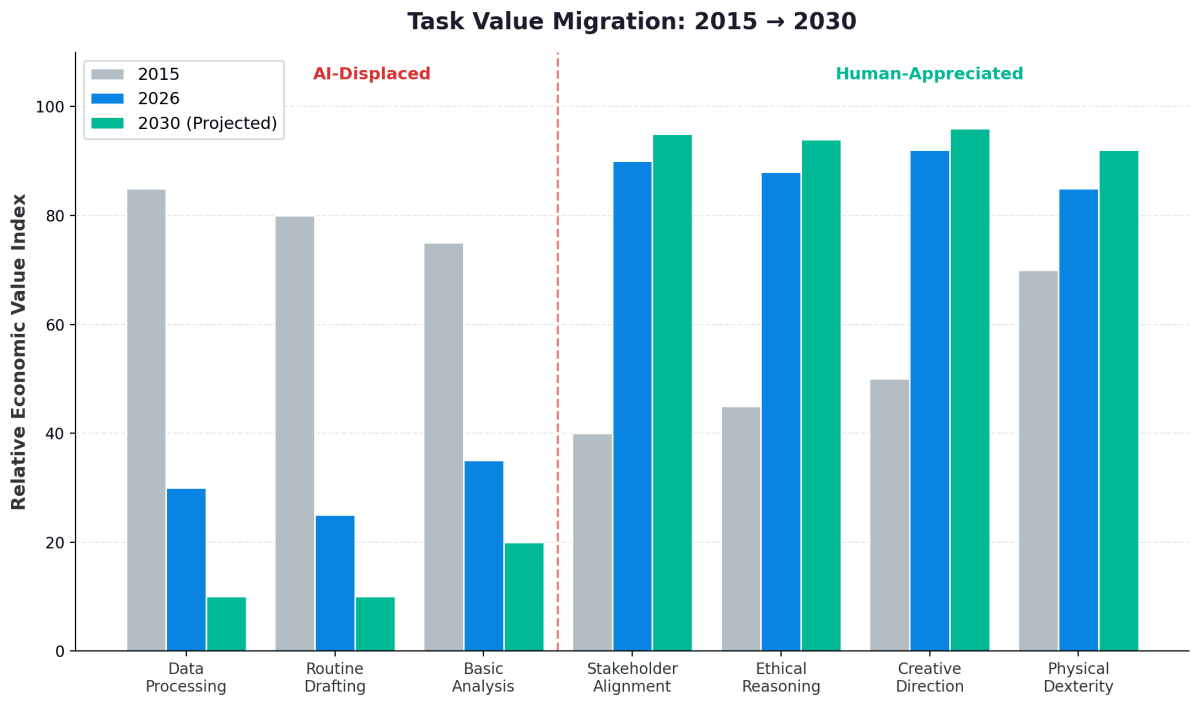
To identify the career exposure within your current industry, audit your daily calendar using this comparative breakdown:
Professional Domain | The Task AI Automates | The Human Skill That Appreciates |
|---|---|---|
Writing & Media | Compiling basic research, drafting informational articles, and formatting SEO copy. | Establishing original reporting, voice, deep investigative interviews, and editorial perspective. |
Data & Analytics | Cleaning messy datasets, running predictive regressions, and generating chart visual dashboards. | Framing commercial questions, challenging outliers, and identifying strategic trade-offs behind metrics. |
Operations & Admin | Calendar coordination, draft email dispatch, and routine workflow status updates. | Navigating cross-functional corporate friction, aligning conflicting goals, and leading organizational change. |
Customer Service | Resolving repetitive tier-one billing questions and troubleshooting technical documentation FAQs. | De-escalating volatile customer conflicts, repairing client trust, and managing enterprise retention. |
Design & Creative | Removing image backgrounds, rendering variations, and generating moodboards. | Defining cohesive brand systems, setting aesthetic directions, and crafting cultural context. |
Legal & Compliance | Document discovery indexing, standard NDA drafting, and jurisdictional case extraction. | Formulating litigation strategy, arguing before a jury, and assessing settlement risks. |
Healthcare | Parsing clinical history notes, evaluating radiological scans, and charting patient metrics. | Delivering difficult diagnoses with empathy, surgical dexterity, and shared clinical decision-making. |
Education | Generating quiz sets, grading standardized homework, and delivering foundational lectures. | Mentoring disengaged students, diagnosing psychological blocks, and coaching peer collaboration. |

What This Means for Your Career in 2026: The Strategic Playbook
Understanding which skills software cannot replicate is meaningless without an operational plan to restructure your career. If you are operating as an individual contributor, manager, or knowledge worker, execute this three-step defensive audit immediately.
1. Perform a Personal Task Audit
Take inventory of your work over the past four weeks. Divide your recurring responsibilities into two distinct categories:
Category A (Predictable Production): Drafting status memos, compiling routine performance slides, summarizing call transcripts, formatting spreadsheets, basic debugging.
Category B (Contextual Human Judgment): Managing difficult client conversations, negotiating team priorities, making calls on incomplete data, resolving cross-departmental deadlocks.
If Category A constitutes more than 40% of your billable hours, your professional leverage is deteriorating. Your immediate goal is to master modern tools to automate those tasks yourself. If you do not automate your internal Category A tasks, your executive leadership will eventually contract an external system or streamline your department to achieve the same result.
For solo practitioners and independent operators looking to offload routine operational load, reference our field guide on the Best AI Tools for Solo Founders.
2. Become the "AI-Augmented Generalist"
The market does not reward workers who unilaterally reject artificial intelligence out of professional pride, nor does it reward workers who abdicate their judgment to automated systems.
The most resilient professional profile in 2026 is the AI-augmented human operator:
They possess the technical literacy to orchestrate software agents, query models effectively, and automate mundane data processing.
They possess the deep domain expertise, critical taste, and structural skepticism necessary to immediately identify where the software’s output is flawed, legally problematic, or commercially naive.
They produce the raw output volume of a three-person team while delivering the nuanced judgment of a veteran director.
To accelerate this tactical shift in your daily routine, review our curated list of AI Productivity Tools That Save Time 2026.
3. Step Directly Into Accountability Gaps
Algorithms cannot take accountability. When software systems fail, corporate leadership does not want to read an audit log; they want to talk to the human leader who owns the outcome.
To protect your career:
Volunteer for the ambiguous initiatives: Step into projects that lack clean datasets, well-defined playbooks, or guaranteed returns.
Own the relationship layer: Insist on handling high-friction client calls, vendor escalations, and executive presentations in person or via live video rather than through asynchronous dashboards.
Put your signature on decisions: When presenting analysis supported by AI tools, do not simply pass along the model's recommendation. Stake your professional reputation on a clear, well-reasoned point of view: "The data suggests Path A, but taking into account our brand standing and regulatory shifts, I recommend Path B."
Frequently Asked Questions
Will AI replace all jobs eventually?
No. The total volume of human work is not a fixed pool that shrinks every time software improves. Economic history demonstrates that when automation collapses the cost of producing an essential resource, market demand for that resource—and the adjacent human services supporting it—expands exponentially.
While routine transactional roles will continue to consolidate, total employment will reorganize around human coordination, strategic governance, personalized care, physical maintenance, and creative direction.
Which jobs are safest from AI in 2026?
The most secure occupations sit on opposite ends of the physical-cognitive spectrum:
Unstructured Physical Environments: Plumbers, electricians, HVAC mechanics, construction supervisors, physical therapists, and surgical nurses.
High-Stakes Strategic & Relational Arenas: Corporate restructuring executives, specialized litigators, high-value enterprise sales directors, early-stage venture builders, and crisis management leads.
Roles characterized by repetitive digital tasks, rote data entry, junior copy production, and routine code formatting face severe, structural contraction.
What human skills should I develop to stay relevant?
Focus your personal professional development on four capabilities:
Epistemic Vigilance: The capacity to rapidly interrogate complex informational outputs for subtle logic gaps and hallucinations.
Relational Persuasion: Navigating internal corporate politics, negotiating with resistant stakeholders, and building lasting personal trust.
Systems Thinking: Synthesizing how changes in technology, supply chains, human psychology, and regulation impact an enterprise as a whole.
Operational Agility: The psychological comfort to abandon obsolete workflows and orchestrate new technological tools without hesitation.
Can AI replicate emotional intelligence?
AI models can simulate emotional intelligence by analyzing linguistic sentiment and generating empathic language patterns. However, simulation is fundamentally different from authentic emotional presence.
Human emotional intelligence relies on shared biological reality, social vulnerability, and mutual risk. In high-stakes settings—such as medical treatment decisions, enterprise leadership, therapy, and crisis negotiation—people demand an empathetic human counterpart who shares their vulnerabilities and can be held personally accountable.
Is creativity safe from AI automation?
Mechanical execution is no longer safe; original creative direction is. Generative tools have fully democratized the ability to render complex 3D scenes, write grammatically sound copy, and generate musical compositions from scratch.
Consequently, the commercial value of basic technical execution has collapsed. However, true creative leadership—the taste to recognize cultural nuance, connect unrelated emotional truths, establish brand identity, and define a distinct aesthetic—remains uniquely human.
What does the WEF say about AI and jobs in 2026?

The World Economic Forum highlights that while approximately 85 million routine operational roles are being phased out globally, 97 million new specialized positions are emerging concurrently.
The net expansion heavily favors professionals who understand how to partner with automated technologies while doubling down on human capabilities: analytical thinking, creative agility, active learning, leadership, and emotional resonance. The displacement risk does not threaten those who use AI; it threatens those whose daily output is easily replicated by it.
The Ceiling Is Still Human
Artificial intelligence has permanently elevated the baseline of human productivity. A single professional can now produce the volume of code, copy, and analysis that previously required a departmental committee.
When the floor is raised for everyone, basic technical competence ceases to be a competitive advantage. When anyone can generate a clean marketing plan or functional software architecture in thirty seconds by typing a prompt, the market ceases to pay a premium for that capability.
The value has migrated upstream. It now lives in the willingness to take a stand when the historical data offers no clear answer. It lives in the emotional resilience required to lead anxious teams through operational transitions. It lives in the physical hands that maintain our tangible infrastructure, and the creative courage to define what an organization should build next.
Automate every repetitive aspect of your daily work without hesitation. Use software to clear your schedule of computational trivia, rote drafting, and clerical logistics. Reclaim those hours, and invest them entirely into the human skills that software will never possess.
Recommended Next Steps for Your Business
Learn how forward-thinking small and mid-sized enterprises maintain human oversight across complex automated architectures in our AI Agentic Workflows for SMEs Report.
Systematically evaluate your organization's technical maturity and build sustainable human-machine workflows using our AI Adoption Roadmap for Small Business 2026.