
If you don’t answer immediately, there’s a high probability you will lose that customer to a competitor forever. In 2026, instant gratification is no longer a luxury but a baseline expectation, even for small businesses with only a handful of employees. However, traditional scaling methods are broken; hiring an overnight support team to monitor a blank dashboard is a massive financial drain.
Most conventional advice forces you to choose between cold, fully automated AI chatbots and expensive, limited human agents. In 2026, choosing a side is poor advice. The true winners are small businesses that deploy a hybrid system—using cutting-edge AI to handle easy, repetitive tasks at 1/30th of the cost, while preserving their human team's energy for the highly emotional, complex moments that build brand loyalty. This guide breaks down exactly how to balance both worlds to save money, remain legally compliant, and retain customers for life.
What AI Customer Service Actually Means in 2026
Old chatbots were frustrating. They followed rigid scripts. One wrong word and you were stuck in a loop: “Sorry, I didn’t understand that.”
Modern AI is completely different. It uses large language models – the same technology behind ChatGPT. It understands natural speech, remembers what you just said, and can look up live information from your website or shipping system.
Here are the main types of AI customer service today. Many small business owners don’t realize how many options exist.
AI Chatbots
Text‑based helpers on your website, WhatsApp, or social media. They don’t follow a script – they read your knowledge base (FAQs, policies, past tickets) and write a custom answer on the spot. Platforms like FastBots.ai let you train a bot in minutes.
AI Voice Agents
These replace terrible phone menus (“Press 1 for sales, press 2 for support…”). AI voice agents sound like a real person. They answer calls, book appointments, and capture leads with zero hold time.
AI Email Support
The AI reads incoming emails, figures out if the customer is angry or just curious, and drafts a personalized reply. Your human team just reviews and hits send.
AI Ticket Routing
When a message comes in – email, chat, social media – the AI reads it and sends it to the right person. Billing goes to accounts. A technical bug goes to your developer. This happens in seconds, not hours.
AI Knowledge Bases
A smart self‑service portal. Instead of searching through help articles, the customer types a question. The AI reads all your documents and gives a direct, conversational answer. According to Zendesk’s CX Trends report, 81% of customer experience leaders say easy access to structured knowledge significantly improves operational decision‑making.
AI‑Assisted Human Agents (Copilots)
This works behind your human team. As an agent chats with a customer, the AI listens. It suggests articles, recommends reply drafts, and even writes a summary of the conversation. According to a Zendesk survey, up to 73% of support agents say an AI copilot improves their daily effectiveness.
In practice: Many small e‑commerce stores discover that nearly half of their support tickets are just shipping updates and return questions. Once those are automated, owners finally get time back to focus on marketing and inventory.
Why Small Businesses Are Adopting AI Customer Support Faster Than Enterprises
Big companies have huge budgets, but they are slow. They have old software, endless compliance reviews, and too many approval layers. According to Intercom’s 2026 Customer Service Transformation Report, 89% of enterprise AI spending delivered almost no immediate return due to organizational chaos. Only 10% of enterprise customer service teams have successfully scaled AI.
Small businesses move fast. You can sign up for a no‑code AI tool today and have it running tomorrow. Here is why so many SMBs are adopting AI faster than the giants:
Lower operational costs – Support costs normally grow linearly: more customers = more hires. AI breaks that. Small businesses with fewer than 50 employees often see a 20–40% reduction in support costs almost immediately.
Staffing shortages – Finding good help is hard. For a solopreneur, answering “Where is my order?” 50 times a day steals time from building products. AI handles repetitive requests continuously, without adding staffing overhead.
24/7 availability – If a customer has a problem at 11 PM, they won’t wait until morning. AI agents provide continuous coverage with no overtime or shift‑rotation costs.
Instant multilingual support – Hiring a bilingual agent is expensive. Modern AI supports over 85 languages natively. It automatically translates the customer’s question and answers in their language.
No turnover – Customer support turnover often exceeds 30% per year. Replacing a trained agent costs 50–75% of their annual salary. AI agents never quit.
Before you start, run an AI workflow audit for small businesses to find the easiest, highest‑impact place to begin.
Chatbots vs Human Agents: The Core Differences
Here is how AI and humans compare side‑by‑side on the metrics that actually matter to a small business owner.
Feature | AI Chatbots & Voice Agents | Human Agents |
|---|---|---|
Availability | 24/7/365 – zero downtime | Limited to business hours or expensive shifts |
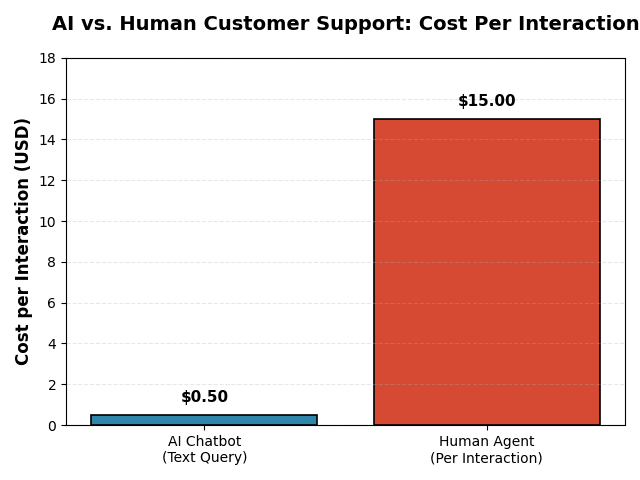
Cost per interaction | 0.25–0.25–0.70 (text) / 0.08–0.08–0.29 (voice minute) | 3.00–3.00–25.00 (fully loaded) |
Response speed | Instant (sub‑second) | Minutes to hours (queues, hold times) |
Scalability | Unlimited – thousands of conversations at once | Linear – 1 call or 4–6 chats per agent |
Empathy | Simulated – polite but not real | High – authentic emotional connection |
Problem solving | Limited to trained data and rules | Handles unscripted, creative, edge‑case problems |
Crisis management | Weak – can fail or hallucinate | Strong – de‑escalates anger, protects brand |
The financial case for AI is overwhelming. But numbers don’t tell the whole story. Trust is fragile. According to CMS Wire, 68% of consumers trust AI more if it sounds human, yet a survey found that 90% of consumers report a sharp drop in brand loyalty if they cannot reach a real person during a stressful issue.
When AI Chatbots Are the Better Choice
For simple, repetitive, transactional tasks, AI is faster, cheaper, and more accurate than a human. Here are the specific scenarios where AI wins – based on real SMB workflows.
FAQ Handling
Most customer questions are the same: “What are your hours?” “Where is my order?” “What is your return policy?” AI answers these instantly, containing 40–60% of all tickets without any human involvement.
Appointment Booking
A dental clinic or hair salon can use an AI voice agent to check calendar availability, book a time, send reminders, and handle cancellations. This reduces no‑shows without adding a receptionist.
Lead Qualification
Place an AI chatbot on your website. It asks visitors: “What’s your budget?” “When do you need this?” The AI logs the answers in your CRM and automatically pushes hot leads to your sales team’s calendar.
Order Tracking & Simple Transactions
A customer asks “Where is my package?” The AI checks the shipping API (Shopify, FedEx, USPS) and gives the tracking link. If they want a return, the AI can even generate a return label automatically.
After‑Hours & Overflow Support
If you miss a call at 10 PM, that lead is often gone forever. An after‑hours AI voice agent captures the inquiry, answers basic questions, and promises a human will follow up in the morning.
Real‑world results
Klarna: Their AI assistant handled two‑thirds of all customer chats in the first month – the work of 853 full‑time agents – contributing to a $40 million profit improvement.
HelloFresh: By deflecting routine logistics inquiries to AI, their annual human support costs dropped from 12millionto12millionto1.8 million, with stable customer satisfaction.
Cocoatech: Resolution time for basic technical inquiries fell from 8 hours to 5 minutes after deploying a conversational AI assistant.
Where Human Support Still Matters Most
Customer service is an emotional job. If you try to automate everything, you will destroy trust. Here is where you must use a human – no exceptions.
High‑Emotion Situations
A customer is furious because a birthday gift arrived broken. They don’t want a robot. They want validation and empathy. AI models don’t have feelings. According to CMS Wire, a tone‑deaf robotic response will make anger much worse.
90% of consumers say their brand loyalty drops sharply if human support is completely removed from the interaction pathway.
Complex, Non‑Routine Troubleshooting
When a customer encounters a unique bug that isn’t in the manual, AI will fail. These issues need lateral thinking, creativity, and sometimes cross‑department collaboration. Humans excel here.
Sensitive & Regulated Industries
Healthcare, legal, and financial services carry high risk. A medical bot that misrepresents drug interactions or an AI contract reviewer that hallucinates a fake precedent can lead to lawsuits and permanent loss of trust.
VIP & High‑Value Customers
For high‑ticket B2B clients or loyal big spenders, forcing them through a bot queue feels cheap. It signals that they aren’t valued. A human should lead every VIP interaction.
When Automation Goes Wrong (Real Lawsuits)
Air Canada: A passenger sued after the airline’s chatbot invented a fake bereavement fare policy. The court ruled that companies are legally responsible for their AI’s hallucinations.
DPD Delivery: A user tricked the support bot into swearing, criticizing the company, and writing anti‑corporate poetry. The incident went viral and caused massive brand damage.
The Best Strategy in 2026: Hybrid AI + Human Customer Support
The winning model is not AI or humans. It is AI and humans working together.
We call this the 3‑Layer Support Model:
AI handles speed – Every inbound message is first answered by AI. It resolves routine Tier 1 tickets instantly.
Humans handle trust – If the customer is angry, the issue is complex, or the customer asks for a person, the AI immediately escalates. The human gets the full conversation history so the customer never repeats themselves.
Experts handle strategy – A small number of senior team members train the AI, review its performance, and handle the most sensitive VIP or crisis cases.
How a Hybrid Workflow Runs in Real Life
AI Interception – A customer calls or chats. The AI parses the request, checks sentiment, and verifies identity.
Autonomous Resolution – If it’s a simple question (“Where is my order?”), the AI solves it and closes the ticket.
Context‑Rich Escalation – If the AI detects negative sentiment or complexity, it routes the interaction to a human agent – along with the full transcript and customer profile.
AI‑Enabled Human Resolution – The human opens the ticket. An AI Copilot instantly suggests the best policy, drafts a reply, and summarizes the customer’s frustration. The human focuses on empathy and problem‑solving.
This hybrid model changes the job of a support agent. They no longer answer the same question 50 times a day. Instead, they handle complex issues and train the AI. According to Intercom, 84% of service organizations are now adjusting their hiring profiles to match this shift.
To implement this smoothly, follow an AI adoption roadmap for small businesses.
Decision Framework: Should Your Business Use AI, Humans, or Both?
Not every business is the same. Use this matrix to find your starting point.
Business Type | Recommended Approach | Why |
|---|---|---|
Solo Creator / Solopreneur | Mostly AI‑Led | You need to focus on creation. Let AI handle basic admin and sales questions. |
Ecommerce Brand | Hybrid (70% AI / 30% Human) | AI handles tracking and returns. Humans handle angry customers and high‑value cart issues. |
Healthcare / Dental Practice | Human‑Led Hybrid | AI books appointments and sends reminders. Humans handle triage and sensitive conversations. |
Consulting Agency | Human‑First | AI qualifies leads and schedules. Humans lead every client relationship directly. |
Local Service (Plumber, Electrician) | AI for Intake | AI captures after‑hours emergency calls and schedules appointments. |
Five Questions to Ask Yourself
Repetition: Are more than 60% of my tickets the same ten questions? → Automate those.
Emotion: Are my customers often stressed, anxious, or angry? → Lead with humans.
Availability: Do I get valuable leads at 2 AM? → Deploy an AI receptionist.
Ticket value: Is each customer worth thousands of dollars? → Use a human.
Complexity: Does solving the issue require navigating old, disconnected systems? → Use a human.

The Hidden Costs of Poor AI Customer Service
Saving money on payroll is great. But a broken AI setup can cost you more than it saves.
Trust erosion – 75% of consumers report frustration when a bot fails to resolve an issue. 63% say their last chatbot interaction did not solve their problem. Those customers quietly switch to a competitor.
Human verification costs – If you must pay a human to check every single AI response, you lose the speed and cost benefits.
Legal liabilities – Following the Air Canada ruling, you are legally responsible for what your chatbot promises. If it offers an unauthorized refund, you must honor it.
Brand commoditization – If every interaction feels cold and robotic, your brand becomes a cheap commodity. You lose the “personal touch” that makes small businesses special.
How Small Businesses Can Implement AI Customer Support Successfully
Do not just turn on a bot and walk away. That will break. Follow this step‑by‑step process.
Step 1: Audit your past tickets.
Review the last 90 days of support requests. Find the one most common, lowest‑complexity question (e.g., “What is your shipping time?”).
Step 2: Clean your data.
Update your FAQ, policy pages, and manuals. Remove old prices and outdated rules. The AI is only as smart as the data you give it.
Step 3: Choose a tool and connect it.
Pick a platform like eesel AI or FastBots.ai. Connect it to your website, helpdesk (Zendesk), and CRM (Shopify). For solopreneurs, explore the best AI tools for solopreneurs first.
Step 4: Write explicit natural language instructions.
Tell the AI what to do in plain English:
“If a customer asks for a refund on an item older than 30 days, politely say no and offer a 10% store credit.”
“If a customer mentions ‘acute pain’ or ‘emergency’, immediately route to a human triage nurse.”
Step 5: Configure supervision – Review Mode.
Do not let the AI talk to live customers alone. Set it to Review Mode. The AI drafts a reply, but a human must approve it before sending.
Step 6: Run bulk simulations.
Test the AI on thousands of old, archived tickets. Compare its answers to what your human team actually wrote. Measure accuracy and hallucination risks.
Step 7: Go live and monitor.
Launch on one channel (e.g., web chat). Have a manager watch live transcripts for the first few weeks. Ensure the “talk to a human” button works perfectly. Once CSAT scores stabilize, expand to more ticket types.
Common Mistakes Businesses Make With AI Customer Service
Avoid these traps – they are the fastest way to destroy customer goodwill.
Replacing humans too early – You need humans to handle edge cases, angry customers, and system outages.
Creating “Bot Jail” – Hiding the option to speak to a human creates extreme frustration. The hand‑off path must be prominent and effortless.
Using messy training data – Training AI on unverified forums or outdated manuals guarantees hallucinations.
Failing to disclose AI interaction – Tricking customers into thinking they are talking to a real human erodes trust instantly. Transparency is a loyalty driver.
Ignoring conversation logs – If you don’t review chat logs, you won’t know when the AI is giving wrong answers.
The Future of AI Customer Service Beyond 2026
This technology is evolving fast. Here is what is coming – and what you need to prepare for.
Memory‑rich hyper‑personalization – AI will remember that you bought a blue sweater six months ago and suggest matching accessories, without you logging into your account.
True multimodal support – A customer will start with a text on WhatsApp, upload a photo of a broken product, then switch to a voice call – all in the same thread, never repeating themselves.
Proactive service – AI will track live behaviour (e.g., a customer hesitating on the checkout page) and pop up with a solution before they submit a ticket.
The EU AI Act compliance cliff (August 2, 2026) – According to the EU AI Act, emotion recognition AI becomes classified as “high risk”. You must inform customers that you are analyzing their voice or text sentiment. Employee‑facing emotion monitoring is already banned in the EU. Fines can reach €15 million or 3% of global turnover.
Frequently Asked Questions
Are AI chatbots replacing human customer service agents?
No. According to Intercom, only 20% of companies have reduced human staff because of AI. 55% kept headcount the same. AI simply handles rising volume so humans don’t burn out.
What percentage of customer support can AI automate?
Most AI systems fully resolve 40–60% of routine Tier 1 tickets (tracking, password resets, standard returns). Mature deployments can automate up to 80% of structured tickets.
Do customers prefer humans or AI chatbots?
It depends. 51% prefer AI for simple, fast tasks. But 75% get very frustrated if a bot fails to solve their problem. Most people want a seamless hybrid – start with AI, get a human when needed.
Is AI customer service cheaper for small businesses?
Yes. AI costs 0.25–0.25–0.70 per text query. A human costs 6.00–6.00–25.00 per interaction. That cost difference is one reason small businesses are adopting AI support so quickly.
What industries should avoid fully automated support?
Healthcare, legal services, financial wealth management, and high‑ticket B2B consulting. The legal and safety risks of AI hallucinations are too high.
What is the best hybrid customer service model?
The Crawl‑Walk‑Run model. AI acts as the front desk, resolving Tier 1 tickets. Humans supervise, review drafts, and step in for anger or complexity.
Conclusion
The businesses that win in 2026 will not be the ones replacing humans with AI.
They will be the businesses using AI to make human relationships scale.
AI gives you speed, availability, and cost control. Humans give you trust, empathy, and crisis management. A hybrid system gives you both.
Start small. Audit one repetitive workflow. Clean your data. Keep the “talk to a human” button obvious. And let the AI handle the boring stuff, so you and your team can focus on the conversations that truly matter.
This article originally appeared on Distrya. For a step‑by‑step guide, see our AI adoption roadmap for small businesses and best AI tools for solopreneurs.