
Executive Summary — Key Findings
The global AI agent market reached $7.84 billion in 2025 and is projected to hit $52.62 billion by 2030, growing at a CAGR of 46.3% (Salesmate/IDC, 2026)
79% of companies report AI agents are already being adopted within their organizations (Accelirate, 2026)
66% of companies using AI agents have seen measurable productivity gains (Accelirate, 2026)
Early adopters report 20–30% faster workflow cycles and significant cost reductions in back-office operations (Salesmate, 2026)
40% of enterprise applications are expected to contain task-specific AI agents by end of 2026 (IDC via Accelirate)
SMEs are often better positioned than larger organizations to adopt agentic AI because they face fewer legacy system constraints (Girlings, April 2026)
Key Statistics at a Glance (2026)
Metric | Figure | Source |
|---|---|---|
Companies with AI agents in production | 57% | |
Companies reporting measurable productivity gains from AI agents | 66% | |
Enterprise apps expected to include AI agents by end of 2026 | 40% | |
Faster workflow cycles reported by early adopters | 20–30% | |
AI agent market size in 2026 | $9.14 billion | |
Projected AI agent market size by 2030 | $52.62 billion | |
Companies planning to increase AI budgets due to agentic AI | 88% | |
Time to deploy an agent on modern no-code platforms | 15–60 minutes |
AI agentic workflows are changing how small businesses run. Instead of automating one task at a time, these systems take on multi-step processes and handle them from start to finish. For small business owners in 2026, that means more time spent on work that actually needs a human. This report explains what agentic workflows are, who is using them, and how you can start today.
What Are AI Agentic Workflows?
An AI agentic workflow is a system where an AI completes a series of connected tasks on your behalf, without you having to guide it step by step. You set a goal, and the AI figures out the steps, takes action, and keeps going until it is done. Think of it less like a calculator and more like a reliable assistant who takes a job and sees it through.
Traditional Automation vs Agentic Workflows
Here is a simple way to see the difference:
Traditional Automation | Agentic Workflow |
|---|---|
Follows fixed rules | Works toward a goal |
Does one task at a time | Handles multiple steps |
Needs human to start it | Runs on its own |
Never learns or adapts | Gets better over time |
Key Terms Made Simple
Autonomous AI: An AI that can make decisions and take actions on its own, without waiting for you to press a button at each step.
Multi-Step Orchestration: The ability to chain together several tasks in the right order, so nothing falls through the cracks. For example, getting a lead, qualifying them, and booking a meeting are three steps that can be linked automatically.
Large Language Models (LLMs): The AI engines behind tools like ChatGPT or Claude. They understand plain language, which means you can give them instructions in everyday English rather than code.
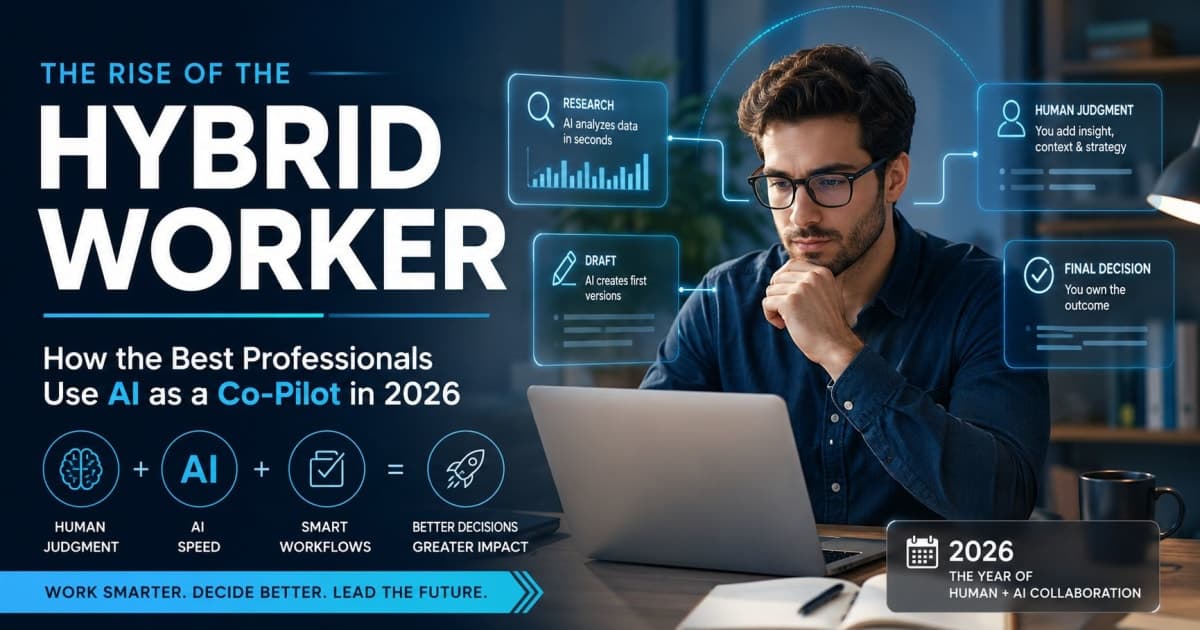
AI Co-Worker Model: A way of working where AI handles the routine parts of a job while you focus on judgment calls, relationships, and strategy. The AI does the grunt work. You make the important decisions.
Why 2026 Is the Inflection Point
The cost of running AI has dropped dramatically. Just two years ago, building an automated workflow required expensive developers and months of work. Today, many platforms let you set one up in a weekend, even if you have no technical background. That has opened the door for small businesses in a way it never was before.
The technology has also become much easier to use. Most AI tools now plug into the software you already use, whether that is your email, your accounting system, or your customer database. You are not starting from scratch. You are adding intelligence to the tools you already depend on.
At the same time, the pressure to do more with less has not gone away. Wages are up. Hiring is harder. Customers expect faster responses. Small businesses that once relied on adding headcount to grow are now looking for smarter ways to scale without increasing payroll.
And here is the one factor that tends to move businesses fastest: your competitors are already starting. Businesses that adopt these tools early are building advantages in speed, cost, and customer experience. Waiting another year means catching up rather than getting ahead.
These changes build on broader AI automation adoption trends in 2026.
Who's Actually Using This in 2026? (Real Data)
Adoption is accelerating faster than most forecasts predicted. According to G2's Enterprise AI Agents Report, 57% of companies already have AI agents in production, 22% are in pilot stage, and 21% are still in pre-pilot — meaning the majority of businesses are now past the experimentation phase.
Accelirate's 2026 agentic AI statistics put the numbers in sharper focus: 79% of companies report active AI agent adoption within their organizations, and 66% of those companies have seen measurable productivity gains. Enterprise application integration is following closely — 40% of enterprise apps are expected to include task-specific AI agents by the end of 2026.
For SMEs specifically, the picture is particularly promising. As Girlings noted in their April 2026 SME analysis, smaller businesses are often better positioned than large enterprises to adopt agentic AI — they carry less legacy system debt and face fewer internal bureaucratic barriers to change.
The departments seeing the most activity are Sales, Customer Support, Finance, and Operations. These are areas with high volumes of repetitive, rule-based tasks and clear, measurable outcomes — which makes them natural starting points for agentic automation.
The results are real. Early adopters consistently report 20–30% faster workflow cycles, with the largest gains coming from back-office operations like invoice processing, claims handling, and customer query routing. The AI agent market is projected to reach $9.14 billion in 2026, a figure that reflects genuine enterprise spending, not speculative forecasts.
What separates businesses seeing real ROI from those that are not is not budget — it is specificity. Businesses that pick one high-volume, well-defined process and automate it thoroughly outperform those that attempt broad, shallow deployment across multiple areas at once.
Real Examples — How Small Businesses Use Agentic AI
Sales Example
Imagine a small software company with two salespeople. Before AI, each rep spent hours every week searching for leads, looking them up, crafting emails, and updating the CRM. Now, an agentic workflow handles all of it. The AI scans for leads that match the ideal customer profile, qualifies them based on company size and behavior, sends a personalized first email, follows up automatically, and books a meeting when someone responds. By the time a rep gets involved, the lead is warm and the meeting is already on the calendar. The reps spend their time selling, not searching.
Finance Example
A small retail chain used to have a bookkeeper spending two days a month reconciling invoices and chasing late payments. Now an AI workflow pulls in invoices as they arrive, matches them against purchase orders, flags anything that does not line up, and sends payment reminders to customers on a set schedule. The bookkeeper reviews a summary report instead of doing the work line by line. Month-end close went from two days to half a day.
Customer Support Example
A home services company was struggling to keep up with support tickets across email and their website chat. They set up an AI workflow that reads each incoming ticket, categorizes it, and resolves common issues automatically by pulling from a knowledge base. More complex issues get routed to the right team member with context already attached. After every resolved ticket, the workflow checks whether the knowledge base needs updating. The support team now handles a third more tickets with the same number of people.
Many businesses build these using practical AI tools already delivering ROI.
What Tools Do You Actually Need?
You probably do not need to buy much that is new. Most modern business software already has AI built in or available as an add-on. Start with what you have before adding anything new.
That said, here are the categories of tools SMEs are actually using in 2026, with real examples:
For connecting your existing tools together (no-code automation):
Platforms like Make (formerly Integromat), Zapier, and n8n let you build agentic workflows visually without writing code. You pick a trigger, define the steps, and the system handles the rest. These are the fastest starting points for most SMEs.
For AI-native agentic workflows:
Tools like Taskade, Relevance AI, and Lindy.ai are built specifically for multi-step agentic tasks. They give you more control over decision logic and how the AI handles exceptions — useful once you have outgrown basic automation.
For sales and CRM automation:
HubSpot and Salesforce both launched native AI agent features in 2025–2026 that handle lead qualification, follow-up sequencing, and meeting booking inside your existing CRM.
For customer support:
Intercom's Fin agent and Zendesk AI can resolve a large share of common support tickets autonomously, routing complex cases to humans with full context already attached.
For finance and back-office:
Tools like Vic.ai (invoice processing) and Digits (financial monitoring) handle the repetitive parts of bookkeeping and reporting, with human review built into the workflow by design.
According to Salesmate's 2026 AI agent trends analysis, around 80% of IT teams already use low-code tools, and building a basic agent on most modern platforms now takes 15 to 60 minutes rather than months of development work.
The honest starting point: pick the tool that connects to the software your team already uses every day. Do not rebuild your tech stack to accommodate AI. Find AI that fits around what you already have.
Not Everything Is Perfect — The Real Risks
Over-automation is a real risk. If you automate too much too fast, you can end up with a system that runs smoothly but produces the wrong outcomes. Always build in checkpoints where a human reviews what the AI has done before it affects customers or finances.
Data privacy matters too. AI systems that connect to your customer data, emails, or financial records need to be set up carefully. Make sure you know where your data is stored, who can access it, and what the vendor's policies are before you hand over sensitive information.
Shadow AI is a growing problem. Employees sometimes start using AI tools on their own, outside of any official system. That can create security gaps and inconsistency. Set a clear policy on which tools are approved and how they should be used.
Integration headaches are common. Many businesses find that their tools do not talk to each other as smoothly as advertised. Build in time for testing before you rely on a new workflow in a live environment.
Compliance is easy to overlook. Depending on your industry, there may be rules about how AI can be used in customer communications, financial decisions, or data handling. Check before you automate something that touches a regulated area.
This divide shows who benefits and who falls behind in the AI shift.
Humans Still Matter — Here's Why
AI is your assistant. You are still the boss.
No AI can replace good judgment. When a difficult customer situation arises, when a supplier relationship needs careful handling, when you face a decision that carries real risk, you need a human in that seat. AI can prepare you with information and options. It cannot weigh what matters most to your business and your values.
Ethics is another area where humans are essential. An AI will execute the instructions it is given. It does not have a conscience or consider the broader impact of a decision. You do. That responsibility does not go away just because a machine is helping.
Creativity and client relationships are deeply human. Your clients work with your business because they trust you and the people on your team. They want to feel heard, not processed. AI can handle the routine parts of the relationship, but the personal connection has to come from a real person.
Accountability is also yours. When something goes wrong, which it will, a customer or regulator will look to you, not an algorithm. Keeping humans in the loop means you stay in control and can fix problems before they grow.
The most valuable capabilities remain the human skills that remain competitive in 2026.
How to Start (Simple Steps)
Getting started with agentic AI does not have to be complicated. Here is a practical checklist to guide you:
Find the boring tasks. Look for work your team does repeatedly that follows a clear pattern. Data entry, follow-up emails, invoice processing, and scheduling are good starting points.
Pick one area where multiple tools need to talk to each other. Cross-tool friction, like copying data from one system to another, is exactly where automation saves the most time.
Try one department first. Do not try to automate everything at once. Pick the team with the clearest pain point and start there. Learn what works before expanding.
Add human review checkpoints. Before any automated workflow touches a customer or moves money, make sure a person reviews the output. Start tight, then loosen controls as you build confidence.
Measure the results. Track time saved, errors reduced, and customer satisfaction before and after. You need real numbers to know if it is working.
Scale gradually. Once one workflow is running well, apply the same approach to the next area. Build on what you know rather than jumping to complex systems all at once.
Where This Is Going — 2026 to 2028
The pace of change is not slowing down. Over the next two years, expect to see 30 to 50 percent of routine business decisions handled automatically. This includes things like reordering inventory, routing customer requests, adjusting pricing based on demand, and flagging compliance issues before they become problems.
AI will increasingly feel like a team member rather than a tool. Instead of running a workflow in the background, it will join your processes as an active participant, asking clarifying questions, adapting based on context, and learning from past decisions.
The gap between businesses that have adopted AI and those that have not will widen. Early adopters are already operating leaner and faster. As the tools improve, that advantage compounds.
You will also see more industry-specific AI. Rather than generic tools, there will be systems built specifically for trades businesses, retail shops, professional services firms, and healthcare practices. The learning curve will get shorter as the tools become more tailored to how you actually work.
Quick Answers to Common Questions
What is an AI agentic workflow in plain English?
It is an AI system that takes a goal, breaks it into steps, and completes those steps from start to finish on its own. Instead of automating one task, it handles a whole process, like finding a lead, reaching out, and booking a meeting, without you managing each step.
How are small businesses actually using this in 2026?
The most common uses are in sales outreach, customer support, and back-office tasks like invoicing and scheduling. Businesses are using these workflows to handle the repetitive parts of their operations so their teams can focus on the work that requires human judgment.
What return on investment can I expect?
Results vary depending on the size of your operation and which processes you automate. Most businesses see cost reductions of 20 to 40 percent in automated areas and productivity gains within the first three months. The key is starting with a high-volume, repeatable process where time savings add up quickly.
Is this technology safe for my business?
It can be, if you set it up carefully. Use reputable vendors, understand where your data goes, and always keep a human in the loop for decisions that affect customers or finances. Start small, test thoroughly, and expand only when you are confident the system is working correctly.
Will this replace my employees?
Probably not, but it will change what they spend their time on. AI handles the repetitive, predictable parts of a job. Your team still handles judgment calls, relationships, and anything that requires real understanding of context. Most business owners find that AI makes their existing team more capable, not redundant.
What does the research actually say about SME AI adoption in 2026?
The data is more positive than most SME owners expect. According to G2's Enterprise AI Agents Report, 57% of companies already have AI agents running in production — not in pilot, but in live operations. Accelirate's 2026 statistics show 66% of those companies have seen measurable productivity gains. For SMEs specifically, research from Girlings (April 2026) highlights that smaller businesses are often better positioned than large enterprises to adopt agentic AI because they face fewer legacy system constraints and can move faster on implementation decisions.
How long does it actually take to set up an agentic workflow for a small business?
Much less time than most people assume. On modern no-code platforms like Make, Zapier, or Relevance AI, building a basic agentic workflow now takes between 15 and 60 minutes, according to Salesmate's 2026 AI agent trends report. A more complex workflow connecting multiple tools — like a full sales outreach sequence that qualifies leads, sends emails, and books meetings — typically takes one to three days to set up and test properly. The bigger time investment is not building the workflow but identifying the right process to automate first and testing it thoroughly before going live.
Final Thoughts
Agentic AI is no longer a future technology. It is available now, it works, and it is affordable for businesses of all sizes. The businesses making the most of it are not the ones with the biggest budgets. They are the ones that picked a real problem, tried a practical solution, and built from there.
If you run your business well, AI gives you a way to run it even better. It handles the routine. You handle what matters. That is not a new idea. It is just now possible in a way it never was before.
Start small. Keep humans in charge. Build on what works. That is the whole playbook.