AI is not quietly hunting people. It is quietly hunting tasks.
Every year, new tools appear that promise to work faster, cheaper, and smarter than humans.
In 2026, software tools can write emails, summarize documents, design images, and analyze numbers faster than any human. This change is already visible in offices, schools, and online work around the world. But they still cannot take real responsibility, earn deep trust, or stand in front of a confused group and say, “This is the decision—and I will own the result.”
At Distrya, our editorial team studies how AI is actually used inside companies, schools, and public systems. One pattern appears again and again: people who define themselves only by tools become replaceable. People who define themselves by capabilities—judgment, ethics, trust, and real‑world problem solving—remain valuable even as tools change.
In 2026, job titles are temporary labels. Human skills last much longer.
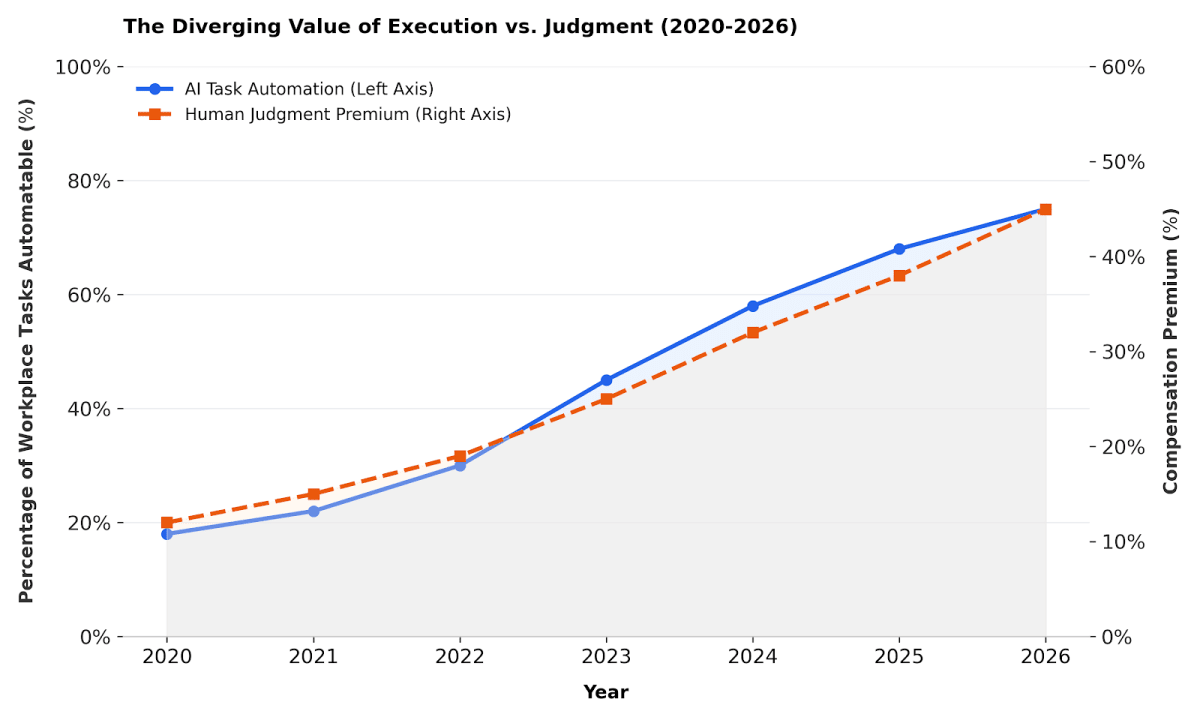
This isn't theoretical. As the chart below shows, market demand for these exact capabilities has surged on a steep, consistent upward trajectory:
Why Job Titles Are Becoming Less Relevant in the AI Era
This shift is already happening quietly across many industries, not in the distant future.
AI breaks work into small pieces and then rearranges those pieces constantly. A single role today may include automation setup in the morning, human conversation at midday, and decision review in the evening. One simple job title can hide many different skills.
Because of this fast task re‑bundling, the idea of a fully “AI‑proof job” is fragile. A title that feels safe today can change next year when software takes over part of the work. What survives these changes is not the title, but the skill set behind it.
When people invest only in learning one tool or one narrow task, they risk being replaced as soon as that task becomes automated. When they invest in skills that move across roles—thinking, deciding, communicating, adapting—they stay useful even when their work changes.
What AI Is Good At — and Where It Consistently Fails
AI is excellent at pattern execution. It can repeat the same type of action millions of times without getting tired. It can also make predictions based on past data and optimize for clear goals like speed, cost, or clicks.
But prediction is not the same as responsibility. When a decision harms someone, society does not blame the software. It looks for a human who approved, ignored, or misused it.
AI also struggles with moral consequences. It can tell you what is most efficient, but it cannot decide what is right when values conflict—such as fairness versus profit, or safety versus speed.
Finally, AI can simulate human language and behavior, but simulation is not lived experience. It has never taken a personal risk, felt regret, or carried long‑term responsibility. That gap is why humans are still needed to decide what should happen, not just what can happen.
The Human Skill Stack That Survives Automation
These skills are not trends or buzzwords. They are basic human abilities that modern AI still cannot replace and that continue to grow in value as automation increases.
Judgment in High‑Uncertainty Situations
Real decisions rarely come with complete information. Data may be missing, people may disagree, and outcomes may be irreversible. Human judgment is the ability to choose a direction anyway—by weighing risks, values, and long‑term impact.
AI can suggest options. A human must decide which trade‑offs are acceptable and take responsibility for the result.
Ethical Ownership and Consequence
Powerful tools require someone to answer for their effects. Ethical ownership means understanding risks, questioning outputs, and stopping a system when harm is likely.
Around the world, laws and regulations already require humans to remain accountable for decisions involving AI. A machine can explain how it produced an answer. It cannot explain why that answer is morally acceptable.
Social Trust and Emotional Calibration
People trust people, not systems. Trust grows when someone listens carefully, explains clearly, and treats others with respect—especially in stressful situations.
Emotional calibration is the skill of sensing how others feel and adjusting communication to reduce conflict and build cooperation. This ability is critical in leadership, negotiation, education, and care, and it cannot be automated.
Physical‑World Adaptation
The real world is messy and unpredictable. Environments change, tools break, and situations do not repeat exactly.
Humans can adapt using sight, sound, touch, and experience to solve problems in physical spaces. Many hands‑on and field‑based challenges still require human flexibility that AI systems struggle to match.
Strategic Framing (Not Execution)
AI can execute tasks very well. Humans decide which tasks matter.
Strategic framing means defining the problem: what success looks like, who is affected, and which risks are acceptable. Humans set direction. AI supports execution.
Cross‑Domain Sense‑Making
Modern problems cross many areas at once—technology, economics, culture, and law. Humans are good at connecting these domains and forming one clear picture.
AI can summarize information from each area. Humans decide what the combined picture means and what action makes sense.
The economic data reveals a defining split in value, visualized in the divergence chart below:

How These Skills Actually Get Built (Not Learned)
These skills do not grow mainly from watching videos or collecting certificates. They grow through experience.
Working with more experienced people helps you see how real decisions are made. You learn how others handle uncertainty, admit mistakes, and stand by difficult choices.
Exposure to ambiguity is also important. When every task has a clear answer, judgment does not develop. Situations with unclear goals and limited information build decision strength.
Decision‑making practice matters. Making small but real choices—and seeing their outcomes—teaches more than endless preparation. Reflection after each decision helps skills grow.
Responsibility often comes before confidence. People become capable by owning outcomes early, in safe and limited ways, and learning quickly from the results.
Why These Skills Map to AI‑Resilient Careers
Skills do not exist alone. They appear through real work.
Judgment, ethics, trust, adaptability, strategy, and sense‑making show up across many fields and roles. They are the foundation behind work that remains valuable even as tools change.
For concrete examples of how these human skills appear in real‑world paths, see our guide on AI‑proof careers in 2026, where we connect these abilities to current opportunities.
The Real Question Is Not “Which Job Is Safe?”
Jobs will continue to change. New titles will appear, old ones will fade, and AI will keep absorbing routine tasks.
Skills, however, can move with you. Each difficult decision, honest conversation, and real problem solved strengthens your ability to adapt again.
People who focus on building human skills do not survive just one wave of automation. They learn how to adjust to every wave that follows.
The better question for 2026 and beyond is not “Which job is safe?” It is “Which human skills am I strengthening, no matter what tools come next?”
FAQ
These questions reflect what readers across different countries and education levels most often ask about AI and work.
Are skills more future‑proof than careers?
Yes. Job titles change quickly, but human abilities like thinking, communication, ethics, and leadership remain valuable across many roles and technologies.
Can AI ever replace human judgment?
AI can support judgment with data, but humans are still required to make value‑based decisions and take responsibility for outcomes.
What skills should students focus on in 2026?
Students should develop thinking, communication, ethical reasoning, emotional awareness, and the ability to work with AI tools without blindly trusting them. For students, practical guidance on using these tools effectively can be found in our resource on the best AI tools for students in 2026.
Why do some professionals thrive while others get automated?
Those who thrive use AI to handle routine tasks and focus their time on judgment, relationships, strategy, and problem solving. Those who rely only on repeatable tasks are easier to replace. A deeper look at this dynamic is explored in our analysis of AI jobs at risk and future-proof paths.
About this analysis
Distrya publishes research‑driven explainers on AI, work, and technology adoption, focusing on how real people adapt to rapid change. For a broader look at how these changes are unfolding across sectors, you can explore our overview of how artificial intelligence is changing every industry.