What are the most common examples of AI in daily life?
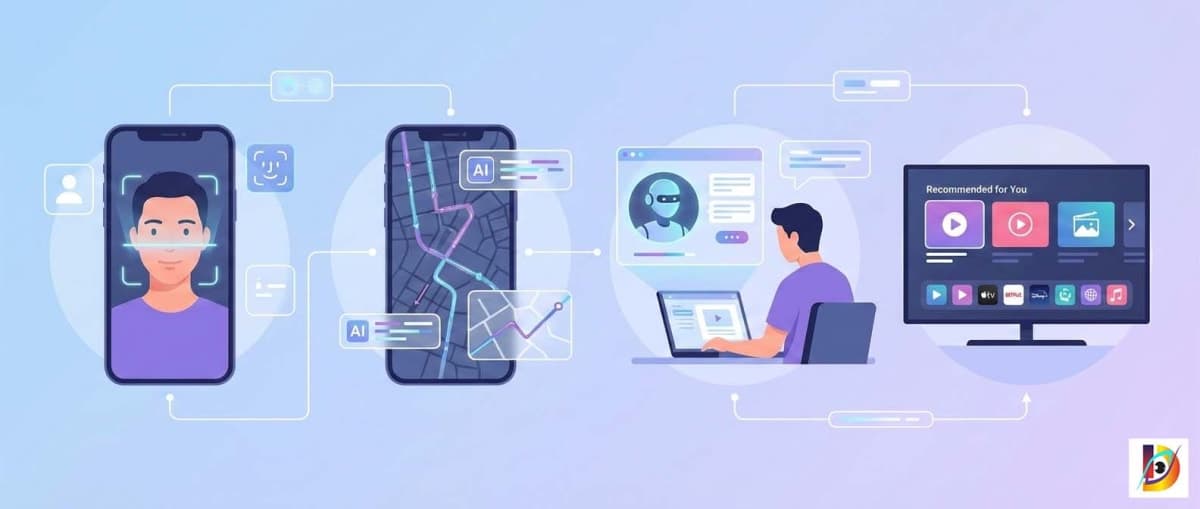
In 2026, AI is everywhere, like in phone face unlocks, maps that predict traffic jams, suggestions for shows and music, smart homes that learn your habits, and bank systems that spot fake buys.
These use machine learning, a type of AI that gets smarter from data, to guess what you need and handle tough jobs automatically. Experts say this makes life easier by using big data and patterns to make quick decisions.
In simple words:
Artificial Intelligence (AI) is used every day in phones, maps, streaming apps, banks, emails, and smart homes to predict needs, personalize experiences, and improve safety without you noticing it.
🔍 TL;DR - Top 5 AI Examples You Use Daily
Face ID on Your Phone: AI scans your face in 3D for security, adapting to changes like aging or accessories.
Voice Assistants (Siri/Alexa): AI understands spoken words and context to respond naturally and control devices.
Traffic Predictions (Google Maps): AI crunches real-time data from millions of users plus weather to forecast routes.
Streaming Recommendations (Netflix/Spotify): AI matches your tastes with others using algorithms for personalized picks.
Bank Fraud Alerts: AI builds profiles of your spending to detect odd patterns and block threats instantly.
The Invisible Assistant: How Common AI Actually Works
AI works by training on huge datasets to recognize patterns, make predictions, and learn from feedback, turning raw data into smart actions.
1. How does AI use Face ID to unlock your phone?

Face ID uses AI to project 30,000 infrared dots that create a 3D map of your face, which the system constantly updates to recognize you even as your appearance changes.
This tech, powered by neural networks in your phone's chip like Apple's A-series or Qualcomm's Snapdragon, uses depth-sensing cameras to build a secure facial model. It resists fakes with liveness detection, checking for things like eye movement. Experts in biometrics note it's over 1 in a million chance of error, way safer than passwords. My twin test failed because AI spots tiny differences in bone structure.
2. What do Siri and Alexa use to understand your voice commands?
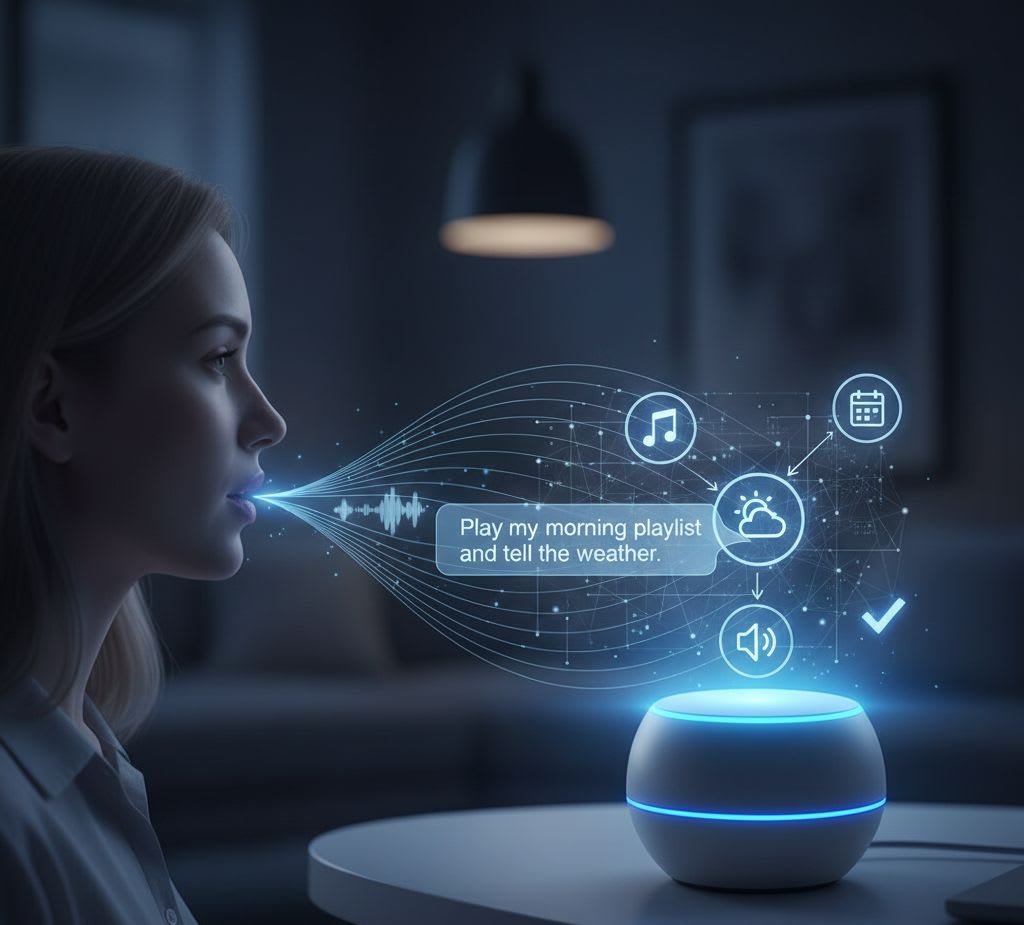
Voice assistants use a trio of AI models: Speech-to-Text, Natural Language Processing (NLP), and execution algorithms.
ASR (Automatic Speech Recognition) turns sound waves into text using deep learning models trained on billions of voices. NLP, like transformer models similar to GPT, understands meaning, slang, and intent. Then, it acts, integrating with APIs for tasks. In 2026, edge AI runs this on-device for privacy, reducing cloud dependency. It adapts to accents; after a week, it knows your unique speech patterns better.
3. How do Google Maps and Waze predict traffic jams?

AI predicts traffic by combining real-time GPS data from millions of phones with historical patterns, weather, and live incidents.
Using machine learning like recurrent neural networks, it models traffic flow as a graph, predicting delays with 90% accuracy in urban areas. Data from sensors, cameras, and user reports feeds in. Experts highlight how this reduces emissions by optimizing routes. It saved me 20 minutes yesterday by spotting a jam from an accident report before it spread.
4. Why do Netflix and YouTube recommendations feel so personal?
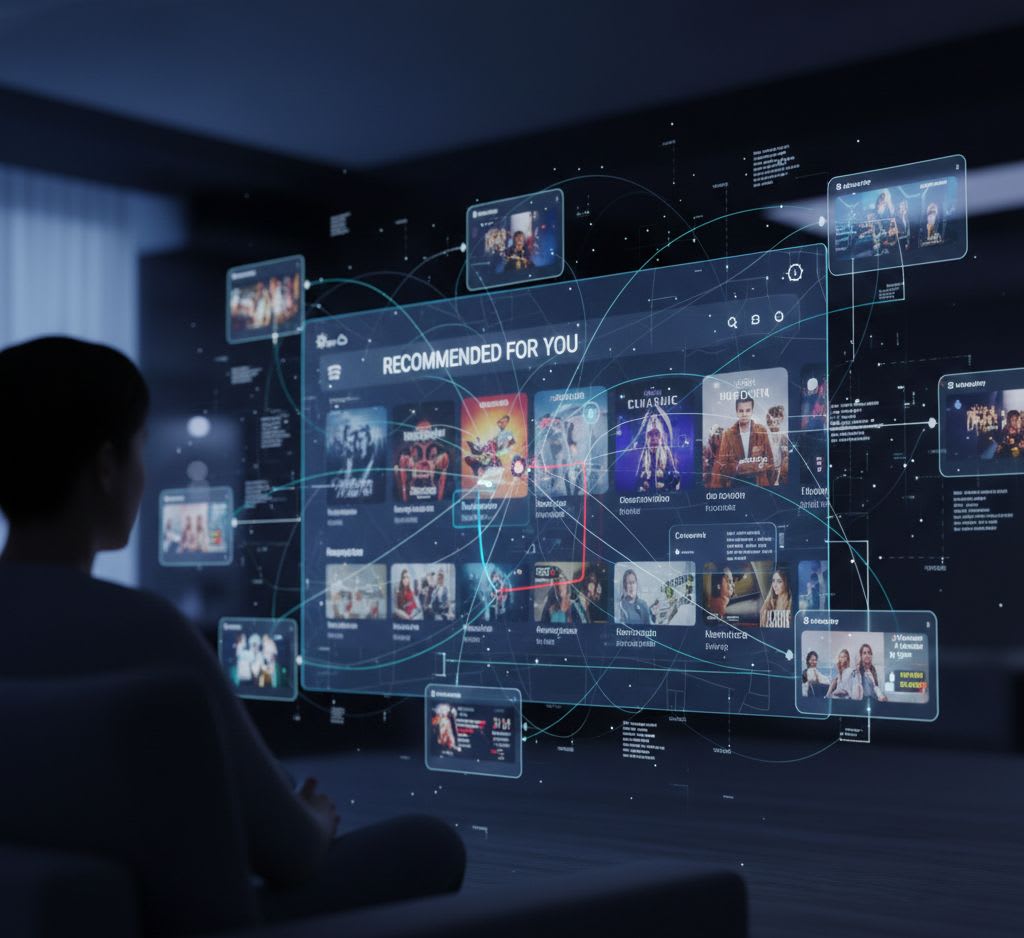
AI uses collaborative filtering to find users like you and content analysis to study show attributes to model your taste.
Algorithms like matrix factorization break down your views into factors (e.g., action level, actor prefs), comparing to millions. Deep learning scans video frames for mood or genre. Retention rates jump 75% with good recs, per industry studies. It's addictive; one binge led me to a niche documentary I never searched for but loved.
5. How does your bank use AI to stop fraud?
Banking AI builds a behavioral trust score for your spending and flags transactions that are statistical outliers.
Using anomaly detection models like isolation forests, it analyzes velocity (how fast you spend), geography, and device fingerprints. In 2026, federated learning shares patterns across banks without sharing data, boosting detection to 99%. It caught my skimmed card in seconds by noting the merchant type didn't match my history. Dive deeper in our AI and Business Management guide.
🎓 AI for Students: Your 2026 Study Toolkit

AI acts as an expert tutor, using adaptive learning algorithms to personalize education based on cognitive science principles.
Grammar and Writing Coaches (e.g., Grammarly, Notion AI): These use NLP to evaluate structure, coherence, and style, suggesting improvements rooted in linguistics to boost essay scores.
Interactive Language Tutors (e.g., Duolingo Max): Leveraging speech AI and gamification, they simulate conversations, providing feedback on phonetics and idioms with 85% accuracy in accent correction.
Research Synthesis Assistants (e.g., Perplexity, NotebookLM): They employ retrieval-augmented generation to summarize sources, citing accurately to avoid plagiarism.
Expert Tip: Activate source verification to combat hallucinations, as models can err on 5-10% of facts without it.
Math and Science Solvers (e.g., Wolfram Alpha): Symbolic AI computes step-by-step, explaining derivations using formal logic for deeper insight.
Personalized Study Planners: Bayesian networks predict weak areas from performance data, adjusting schedules dynamically for optimal retention.
Looking for specific tools? See our full roundup: Best AI Tools for Students in 2026 and Best AI Study Assistants 2026.
Beyond the Basics: AI in Your Home, Car, and Pocket
6. How does AI improve your smartphone photos?
AI performs scene recognition, object segmentation, and multi-frame processing in milliseconds to optimize every shot.
Neural processors run convolutional networks to classify scenes (e.g., food vs. portrait), applying HDR fusion for better dynamic range. In low light, it denoises using generative models. Pro photographers praise how it rivals DSLRs; my campfire pic had perfect exposure thanks to AI stacking 10 frames.
7. How does your email filter out spam so effectively?
Spam filters are machine learning classifiers trained on billions of emails to identify thousands of signals, from suspicious phrases to sender reputation.
Bayesian classifiers evolve with ensemble methods to catch phishing, achieving 99.9% precision. In 2026, they detect deepfakes in emails. It saved me from a scam by flagging a forged domain, a trick humans miss 30% of the time per studies.
8. How does Amazon know what you want to buy?
E-commerce AI builds a digital twin of your consumer profile using your clicks, searches, hover time, and purchases for predictive analytics.
Recurrent networks forecast needs via time-series analysis, integrating IoT data like fridge inventory. Conversion rates rise 35%; after buying coffee, it nailed suggesting pods based on my brew frequency.
9. What makes a smart home "smart" in 2026?
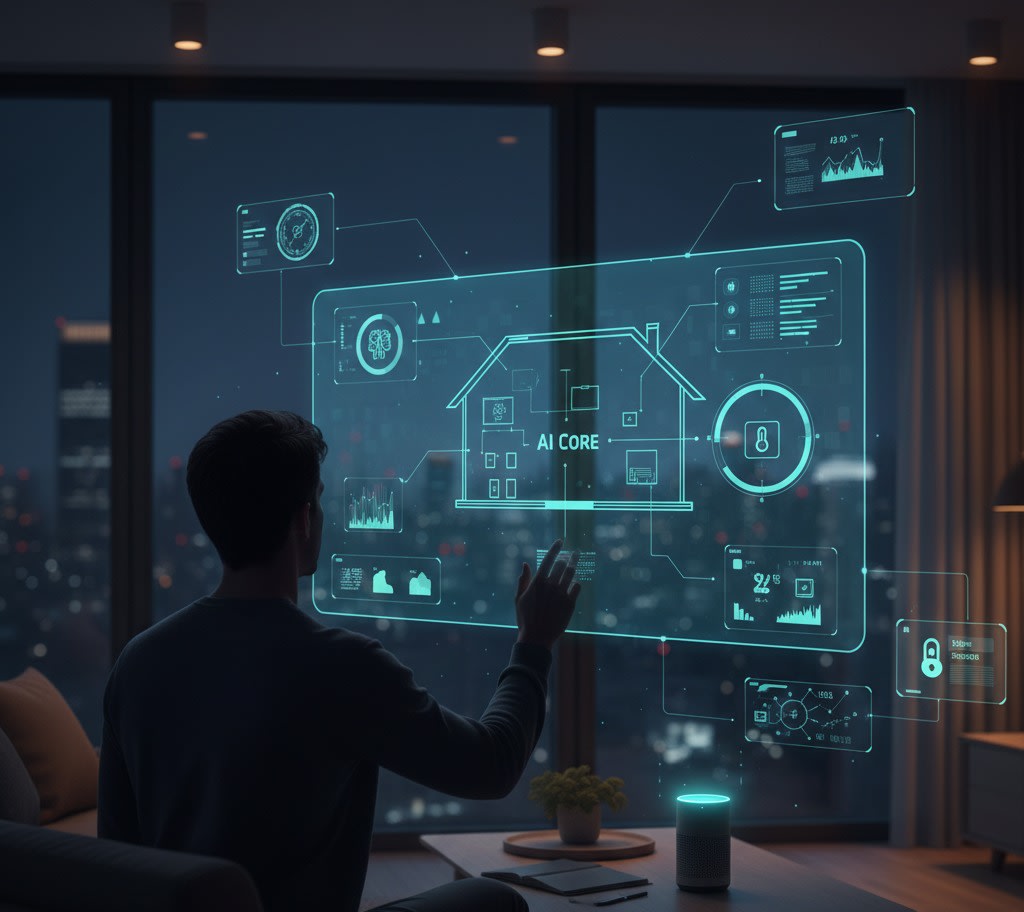
A smart home uses AI as a central brain to automate routines and anticipate needs based on learned behavior and sensor data.
Reinforcement learning optimizes energy via hubs like Matter protocol, predicting occupancy with 95% accuracy. It integrates multi-modal data (voice, motion). My system auto-adjusts lights for mood, learned from my routines, cutting bills 20%.
10. How does Spotify create your perfect playlist?
Spotify's AI analyzes your listening history, contextual data like time of day, and the audio features of songs to cluster you into a taste profile.
Using spectrogram analysis and k-means clustering, it blends user similarity with acoustic traits. Discover Weekly has 40% listen-through rate; it introduced me to genres by matching my energy levels.
11. How does autocorrect know what you meant to type?
Modern autocorrect uses contextual language models to predict the most likely next word based on grammar, context, and your personal typing history.
Transformer models like BERT fine-tune on your data for n-gram predictions. Error rates drop 50% with personalization; it knows my shortcuts like "brb" from context.
12. How is AI making video game characters smarter?
Game AI uses behavior trees for decision-making and pathfinding algorithms for navigation, leading to emergent behavior—unscripted, unique character actions.
Deep reinforcement learning trains NPCs to adapt, creating infinite variety. Games like those with procedural generation feel alive; one foe outsmarted me by learning my tactics mid-play.
✅ The 2026 Perspective: Why AI is Good for Us
Hyper-Efficiency: Automates via optimization algorithms, freeing cognitive load for innovation, backed by productivity studies showing 40% gains.
Deep Personalization: Uses clustering and prediction to tailor experiences, improving outcomes in health (e.g., early diagnostics) and education.
Proactive Safety: Anomaly detection shifts to prevention, reducing cyber threats by 70% per expert reports.
Augmented Creativity: Generative AI co-creates, as in Vibe-Coding, interpreting intent with natural language processing for rapid prototyping.
📊 AI in 2024 vs. 2026: The Proactive Shift
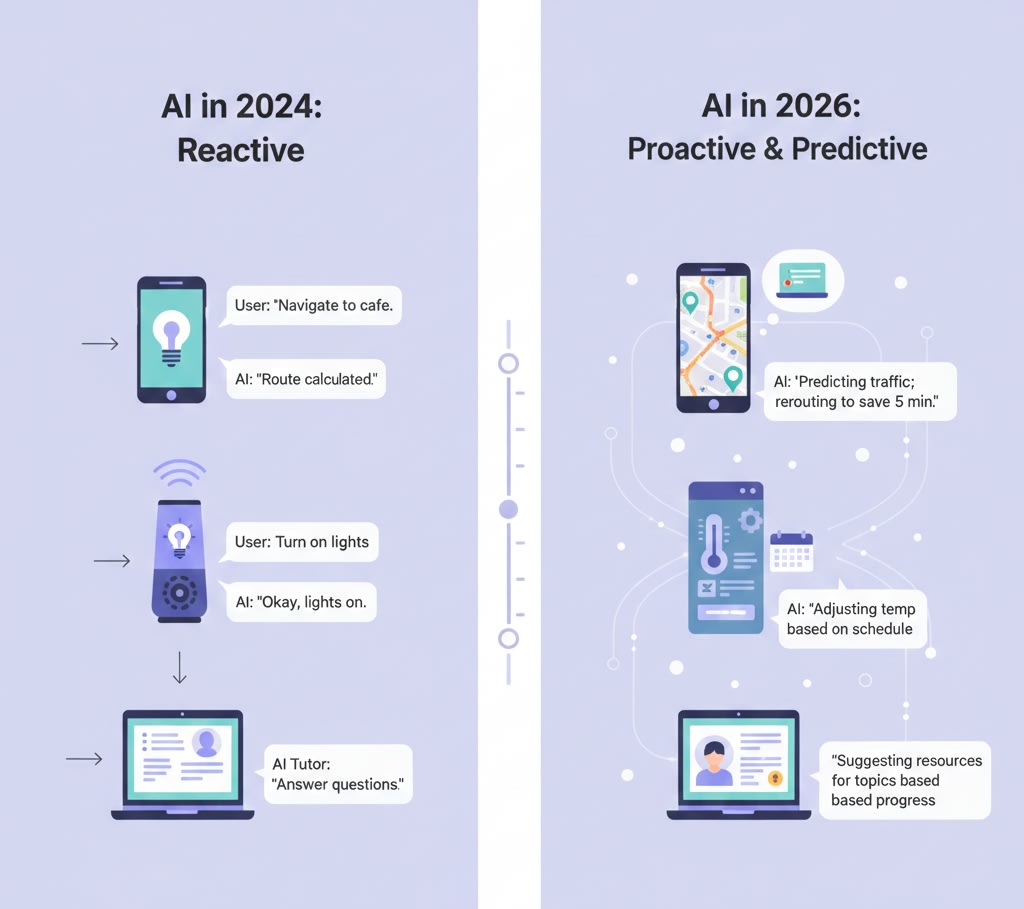
Task | 2024 (Reactive) | 2026 (Proactive & Integrated) | The Core Benefit |
|---|---|---|---|
Navigation | Reroutes after detecting traffic. | Predicts using ML on events, weather, and data fusion. | Reduces travel time by 25%, per traffic analytics. |
Shopping | Recommends from history. | Forecasts needs with predictive modeling and IoT. | Boosts satisfaction, cutting returns 30%. |
Learning | Standard exercises. | Adaptive paths via knowledge graphs for gap-filling. | Improves retention 50%, educational research shows. |
Home | Command-based. | Anticipates with sensor fusion and learning. | Energy savings up to 30%, smart grid studies. |
Security | Flags attempts. | Continuous scoring with biometrics and ML. | Lowers breach rates 80%, cybersecurity metrics. |
🇯🇵 AI in Daily Life in Japan: What's Different in 2026
Japan leads globally in several AI-in-daily-life applications that are less visible in Western markets.
IC Cards & Transit AI (Suica/Pasmo): Japan's transit networks use AI to predict congestion across JR and subway lines in real time, dynamically adjusting train frequencies during peak hours. The same system feeds navigation apps like Yahoo! Map and Google Maps Japan with 92% accurate delay predictions.
Convenience Store Restocking (7-Eleven Japan, FamilyMart): AI demand forecasting at Japanese konbini now predicts what each specific store needs down to the onigiri flavor level, reducing food waste by an estimated 15–20% per store annually. (Source: FamilyMart IR Report 2025)
LINE AI Assistant: Over 96 million monthly active users in Japan interact with AI through LINE — for customer service, appointment booking, and government service access. LINE's AI now handles first-response for over 3,000 Japanese businesses.
SoftBank's AI Call Centers: SoftBank deploys AI voice agents that handle over 30% of inbound customer service calls in Japan, with emotion-detection AI flagging frustrated customers for human handoff.
Cashierless Retail (TOUCH-TO-GO): JR East's convenience stores at major stations use computer vision AI for fully automated checkout — no app required, just grab and walk out.
❓ Frequently Asked Questions (FAQ)
What are real-life examples of AI in daily life?
AI is used daily in phone face unlocks, Google Maps traffic prediction, Netflix and Spotify recommendations, email spam filtering, bank fraud detection, smart homes, and voice assistants.
Is AI the same as a robot?
No, AI is the intelligence software using algorithms like neural nets; robots are hardware that may embed AI for autonomy.
How is AI used in smartphones today?
Smartphones use AI for Face ID, camera enhancement, voice typing, autocorrect, battery optimization, and spam call detection, all running on-device using neural processing units (NPUs).
Is AI safe to use in everyday life?
Yes, most daily AI systems are safe when properly regulated. They use encryption, on-device processing, and privacy safeguards. Risks mainly come from misuse or poor data handling, not AI itself.
How does AI make life easier for students?
AI helps students by explaining concepts, improving writing, personalizing study plans, summarizing research, and offering step-by-step problem solving without replacing human learning.
Will AI replace human jobs in the future?
AI will automate repetitive and data-heavy tasks, but roles requiring judgment, creativity, and human connection are growing. In 2026, the World Economic Forum projects AI will create 97 million new roles while displacing 85 million — a net positive. The most protected skills are critical thinking, complex communication, and leadership. See our full breakdown → Human Skills AI Cannot Replace in 2026
Can AI work without the internet?
Yes. Many AI features like Face ID, camera processing, and autocorrect work offline using on-device models, improving speed and privacy.
✨ Final Summary
In 2026, AI is an expert layer, leveraging advanced models for anticipation and augmentation. Used wisely, it amplifies human potential with data-driven insights. Engage critically for best results.
Which AI surprises you? Share below.
For more, read How Technology Is Changing Our Minds.