
Introduction
Artificial Intelligence (AI) is no longer just a buzzword—it is quietly powering the world's most successful businesses. From Netflix's recommendation engine, which drives over 80% of streamed content, to the efficiency of global logistics and the precision of digital advertising, AI is fundamentally reshaping how businesses think, market, and grow.
For entrepreneurs, business leaders, and marketing professionals, understanding AI's practical applications is now a critical component of strategy. In an economy driven by data and personalization, falling behind is not an option.
This guide provides a clear, actionable overview of what AI is, how it is applied in business management, the mechanics of AI marketing, and the broader societal benefits, complete with links to relevant tools and deep dives from our Technology Blog.
What Is Artificial Intelligence (AI)?
Artificial Intelligence (AI) refers to the development of computer systems capable of performing tasks that typically require human intelligence. These tasks include learning from data, recognizing complex patterns, understanding and generating language, and making decisions.
This capability is powered by core technologies:
Machine Learning (ML): Algorithms that improve automatically through experience.
Natural Language Processing (NLP): Enables machines to understand and interact using human language.
Computer Vision: Allows machines to derive meaning from visual inputs like images and video.
Predictive Analytics: Uses data, statistical algorithms, and ML techniques to identify future outcomes.
In essence, AI enables machines to think, learn, and adapt.
What Is AI in Business Management?
AI in business management involves leveraging artificial intelligence to enhance planning, optimize operations, inform leadership decisions, and track performance. It shifts the paradigm from intuition-based to insight-driven strategy.
Key benefits include:
Analyzing vast datasets in real-time.
Proactively identifying risks and untapped opportunities.
Streamlining workflows and resource allocation.
Enhancing the accuracy of long-term strategic planning.
This foundational shift is why AI literacy is becoming as essential as traditional business acumen.
How Is AI Used in Business? Practical Applications
AI has moved from theoretical to practical, embedding itself in nearly every business function.
1. Strategic Decision-Making
AI models analyze market trends, consumer behavior, and financial data to provide a robust foundation for corporate strategy. For instance, Amazon's demand forecasting algorithms reduce inventory costs by over 10% while ensuring product availability. This moves decision-making from reactive to predictive, as explored in our article on What is Business Intelligence (BI)?
2. Operations and Automation
From inventory management to logistics scheduling, AI automates routine, high-volume tasks. This not only reduces costs but also minimizes human error, freeing teams to focus on innovation and complex problem-solving.
3. Enhanced Customer Service
AI-powered chatbots and virtual assistants provide instant, 24/7 customer support. They handle common inquiries, streamline issue resolution, and collect valuable service data—all while significantly reducing operational overhead.
4. Human Resource Management
AI transforms HR by efficiently screening resumes, matching candidate profiles to job requirements, and even analyzing factors that influence employee retention.
AI in Marketing: Driving Personalization and Precision
AI marketing is the application of artificial intelligence to automate, personalize, and optimize marketing efforts. It enables a deep, real-time understanding of the customer journey.
Key Applications in Marketing:
Hyper-Personalized Marketing: AI delivers individually tailored product recommendations, email content, and ad copy, dramatically increasing engagement and conversion rates.
Dynamic Customer Segmentation: Algorithms automatically group customers based on real-time behavior, demographics, and purchase intent, allowing for laser-focused campaigns.
Predictive Sales Analytics: AI forecasts future customer behavior, helping businesses anticipate demand, identify high-potential leads, and optimize inventory.
Intelligent Content Creation: AI assists marketers with everything from generating SEO-optimized blog ideas to crafting compelling ad copy. For those creating content, tools like our AI Humanizer can help refine AI-generated text to sound more natural.
How AI Is Transforming Marketing & Business Growth
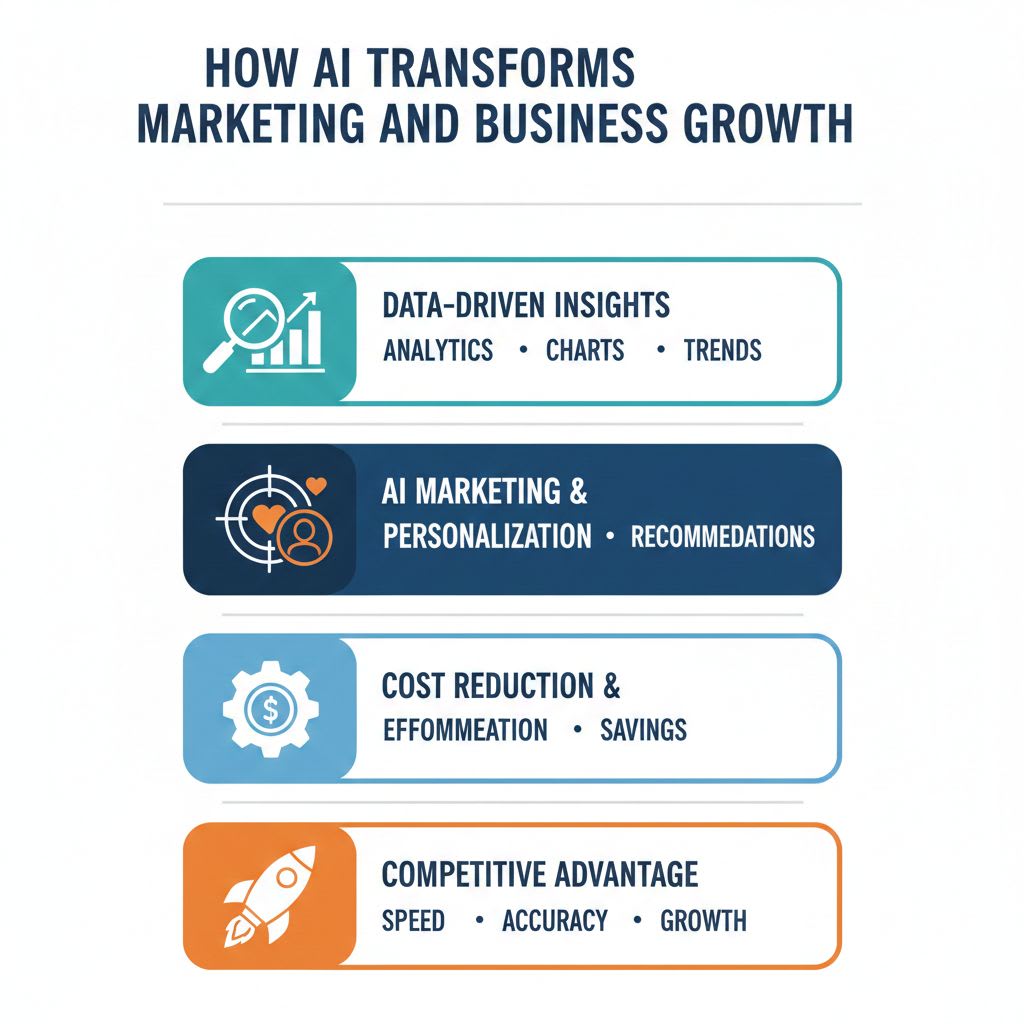
AI is a catalyst for a new type of growth—smarter, more efficient, and deeply customer-centric.
Data as a Strategic Asset
AI transforms raw data into clear, actionable insights at unprecedented speed, enabling businesses to pivot and adapt to market changes almost in real-time.
The Personalization Advantage
By treating customers as individuals, businesses foster stronger loyalty and higher lifetime value. Personalized experiences are no longer a luxury but a baseline customer expectation.
Operational Efficiency at Scale
Automation of manual processes reduces costs, minimizes errors, and allows human talent to concentrate on strategic, creative, and relational tasks that drive real value.
Securing a Competitive Edge
Early adopters of AI build significant advantages in speed, cost structure, and customer insight, creating formidable barriers for slower-moving competitors.
For more advanced strategies on leveraging technology for growth, explore our insights on High-Leverage Startup Growth Hacks.
Benefits of AI for Businesses
The advantages of AI integration are measurable and impactful:
Increased Productivity: Automation of repetitive tasks boosts overall workforce efficiency.
Improved Accuracy: Data-driven decisions significantly reduce costly errors.
Deeper Customer Insights: AI uncovers nuanced patterns in customer behavior and preferences.
Scalable Operations: AI systems can manage increasing complexity without proportional cost increases.
Enhanced Profitability: Gains in efficiency and customer conversion directly improve the bottom line.
How AI Benefits Society
The impact of AI extends far beyond corporate balance sheets, offering profound societal benefits when developed and deployed responsibly.

Job Transformation and Creation
While AI automates routine tasks, it simultaneously creates demand for new roles in AI management, data analysis, and strategic oversight, shifting the workforce toward more creative and complex problem-solving.
Breakthroughs in Healthcare and Education
AI aids in early disease detection through advanced image analysis and enables personalized learning pathways for students, making vital services more effective and accessible.
Fueling Economic Innovation
AI lowers barriers to innovation, allowing startups to compete with established players and fostering the creation of entirely new products, services, and industries.
Smarter Public Services
From optimizing traffic flow and energy grids to improving disaster response, AI helps governments operate more efficiently and serve citizens more effectively.
Frequently Asked Questions (FAQ)
What is Artificial Intelligence (AI) in simple words?
AI is technology that allows machines to learn from data, think intelligently, and make decisions similar to humans.
How is AI used in business management?
AI is used to analyze data, automate operations, improve decision-making, manage customers, optimize supply chains, and enhance overall business performance.
What is AI marketing?
AI marketing uses artificial intelligence to personalize marketing campaigns, predict customer behavior, automate advertising, and improve conversion rates.
Can AI help small businesses?
Yes. Affordable AI tools allow small businesses to automate tasks, improve marketing efficiency, and compete with larger companies.
Does AI replace human jobs?
AI replaces repetitive tasks, not human creativity or leadership. It creates new job roles and improves the quality of existing work.
Is AI safe for society?
AI is safe when used responsibly with strong ethical guidelines, transparency, and data protection measures.
Ethical and Responsible Use of AI
With great power comes great responsibility. Sustainable AI adoption is built on ethical foundations:
Privacy and Security: Robust protection of user data is paramount.
Transparency and Explainability: Understanding how AI systems make decisions builds trust.
Bias Mitigation: Proactive efforts are required to ensure AI systems are fair and equitable.
Ethical AI is not a constraint; it is a critical component of long-term success and public trust.
Conclusion
Artificial Intelligence is fundamentally reshaping the landscape of business and society. It empowers smarter decisions, fosters genuine customer relationships, and enables a new paradigm of efficient growth.
Your immediate next step? Identify one repetitive process in your marketing or operations—whether it's customer segmentation, content brainstorming, or data analysis—and explore how an AI tool, like our Data Insight analytics platform, could automate and enhance it. The fastest way to understand AI's impact is to apply it to a real challenge.
For forward-thinking professionals, engaging with AI is essential. Explore more resources on our Blog, experiment with practical AI Tools, and consider how these technologies can be integrated responsibly into your strategy. The future belongs to those who can effectively partner human creativity with machine intelligence.