

A definitive, ROI‑first guide for business leaders who care about hours saved, costs reduced, and revenue protected — not AI hype.
Executive Reality Check (Read This First)
Most AI investments do not pay off.
Despite record spending, 56% of CEOs report zero measurable ROI from AI in the past 12 months (PwC Global CEO Survey, Jan 2026). Deloitte, McKinsey, Workday, and Fed/St. Louis research converge on the same conclusion: task-level productivity gains are real, but enterprise-level value capture is rare and fragile.
At a macro level, this gap is now visible:
Generative AI users save ~5–6% of weekly work hours on average (St. Louis Fed / OpenAI / Anthropic),
Yet aggregate productivity impact remains ~0–1% so far, with most gains dissipating through rework, substitution, or non-economic use of time (Penn Wharton, 2025–2026).
This guide is written for the minority who want to beat both the organizational and macro paradox.
You will not find inflated averages, vendor-driven promises, or "plug-and-play" fantasies here. You will find:
Where AI actually saves time in 2026
Why 37–40% of those gains are often lost to rework and review (Workday, 2026)
Which tools can deliver positive ROI — and under what conditions
How disciplined teams convert time saved into margin, throughput, or growth
Key Takeaways
66% of organizations report AI-driven productivity gains — but only ~20–30% convert them into financial impact (Deloitte, McKinsey).
Task-level speed improvements of 14–55% are common, yet 37–40% of time saved is lost to fixing low-quality AI output (Workday, 2026).
Automation and orchestration deliver the highest and most reliable ROI; generic chat tools rarely do.
High-performing companies demand proof of value within 60–90 days and redesign workflows, not just add tools.
This guide ranks AI productivity tools by likelihood of delivering measurable ROI in real organizations, not by popularity.
The Top AI Productivity Tools in 2026 (Quick Reference)
Before diving into the full ROI analysis, here is the short answer for readers who need a fast recommendation:
Tool | Best For | Typical ROI | Free Tier |
|---|---|---|---|
Zapier | Workflow automation between apps | 2–5× | Yes (limited) |
Make (Integromat) | Complex multi-step automations | 2–5× | Yes |
Otter.ai | Meeting transcription and summaries | 1.5–3× | Yes (300 mins/mo) |
Notion AI | Notes, docs, and project organization | 1.5–2× | Paid add-on |
Power BI + AI Insights | Data analysis and business decisions | 2–4× | Yes (limited) |
Jasper | Marketing content at scale | 1–3× (with governance) | No |
Fireflies.ai | Meeting notes and CRM sync | 1.5–3× | Yes |
The honest summary: Workflow automation tools (Zapier, Make) deliver the most reliable ROI because they eliminate steps entirely. Meeting tools (Otter, Fireflies) save time consistently but rarely transform a business alone. Content tools (Jasper) only pay off with strict human review. Full analysis and ROI conditions for each category are below.
For a practical walkthrough of implementing these tools step by step, see our AI Adoption Roadmap for Small Business. To calculate your specific ROI before committing, use our AI ROI Calculator 2026.
Why the AI Productivity Paradox Is Getting Worse
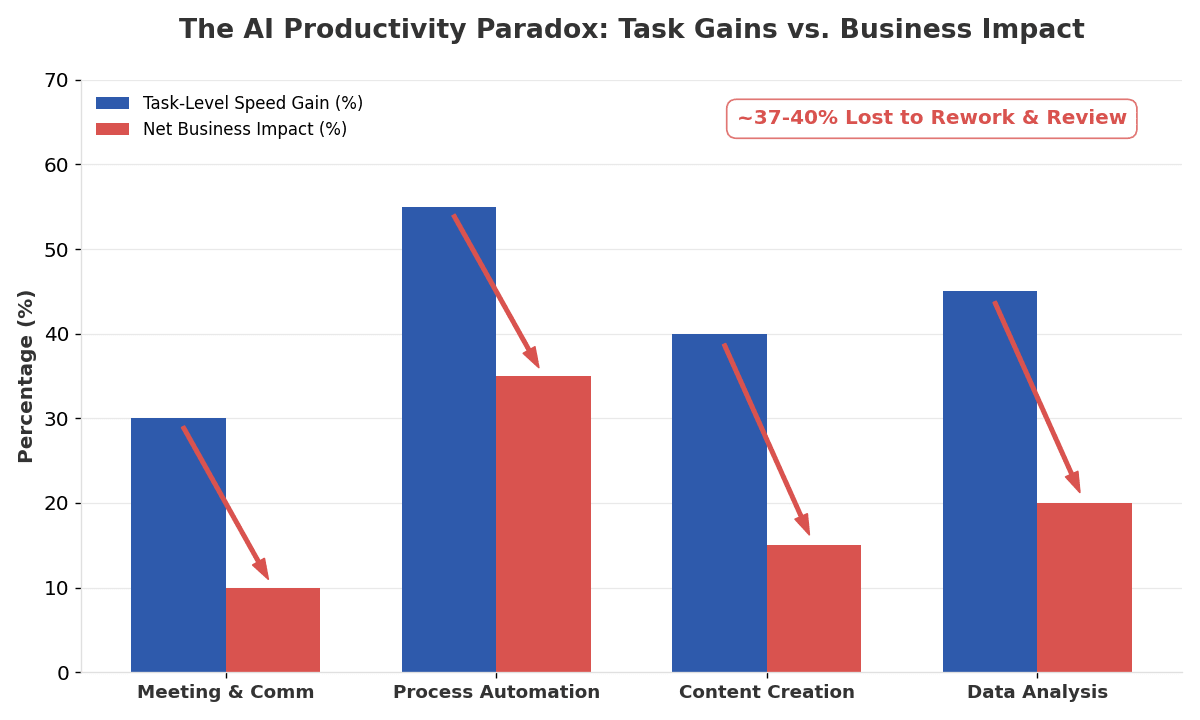
From hands-on implementation reviews across operations, sales, marketing, and finance, one pattern dominates 2026:
AI makes tasks faster, but businesses fail to turn that speed into profit.
Common causes:
AI assists work instead of eliminating steps
Poor data quality creates downstream rework
No workflow redesign — AI is bolted onto broken processes
"Workslop": low-quality AI output that requires heavy review
Lack of ownership: no one accountable for ROI
McKinsey estimates only ~6% of companies capture outsized AI value, primarily because they redesign workflows end-to-end and scale what works.
This growing gap between task speed and financial impact is what analysts now call the AI productivity paradox in 2026.
The ROI Selection Framework: Business Buyer’s Checklist
Treat AI like infrastructure, not software experimentation.
Selection Factor | Key Question | High-ROI Indicator |
|---|---|---|
Integration | Does it connect to our CRM, PM, BI, support, and finance systems? | Native integrations, APIs, webhooks |
Time to proof | Can this show measurable value in ≤90 days? | Pilot metrics tied to hours/cost |
Automation depth | Does it remove steps or just assist users? | End-to-end workflow automation |
Rework risk | How much human correction is required? | Structured outputs, validation rules |
Governance | Can we enforce review and access controls? | RBAC, audit logs, approval flows |
Measurement | Can we track ROI at workflow level? | Time, cost, error-rate dashboards |
Scaling economics | Does cost scale with value, not headcount? | Usage- or volume-based pricing |
Hard rule: If a tool cannot save 3–5 hours per user per week in a specific workflow, it will not pay for itself.
Justifying Budget for AI Productivity Tools (Enterprise ROI Expectations)
When decision-makers ask, “What ROI can we expect?”, the realistic benchmark for enterprise AI productivity tools is 2×–5× ROI within 6–12 months, provided workflows are redesigned using structured AI business management strategies and time savings are converted into financial outcomes.
Typical enterprise expectations:
Payback period: 6–12 months
Net time savings: 3–5 hours per user per week
ROI failure rate without workflow redesign: >50%
The AI Productivity Stack by Proven ROI Category
1. Meeting & Communication Efficiency
Typical ROI: 1.5–3× (reliable but capped)
Tools like Otter.ai and Fireflies.ai consistently save time, but rarely transform businesses alone.
Realistic impact:
30–90 minutes saved per user per week
Reduced misalignment and follow-ups
Works best when: summaries flow directly into CRM, task systems, or project plans.
2. Process & Workflow Automation (Highest ROI)
Typical ROI: 2–5× for most teams; 6–10× only for top performers
Zapier and Make deliver value because they eliminate work entirely.
High-impact use cases:
Lead routing and enrichment
Onboarding and approvals
Finance and reporting workflows
Reality check: Many pilots stall. ROI only materializes when teams:
Automate complete workflows
Assign ownership
Retire manual steps
3. Content Creation & Marketing (High Risk, Medium Reward)
Typical ROI: 1–3× after rework costs
Jasper and Canva AI are effective only under strict governance.
Workday data shows ~40% of AI-generated content time savings are lost to editing.
Mandatory rule: AI produces drafts. Humans approve.
4. Data Analysis & Decision Intelligence
Typical ROI: 2–4× through faster decisions
Power BI with AI Insights helps leaders ask better questions faster.
Value comes from decision velocity, not prettier dashboards.
5. Specialized Agentic AI (Emerging, Experimental)
Typical ROI: 1–3× today; higher potential only in tightly bounded domains
Agentic AI represents a real shift — from assistance to execution — but in 2026 it remains early-stage and fragile.
Where agents show early promise:
CRM hygiene and lead triage (e.g., Zapier Agents, Salesforce Einstein task agents)
Tier‑1 support classification and routing
Transaction reconciliation and exception detection
Why most agent pilots fail:
Over-broad scope
Poor data quality
No clear escalation logic
Agents succeed only when:
Scope is tightly bounded
Escalation rules are explicit
Humans retain final authority
Gartner projects 40% of enterprise applications will embed task‑specific agents by end‑2026 (up from <5% in 2025), but large‑scale, repeatable ROI remains unproven.
Treat agents as operational experiments, not core infrastructure — yet.
Mini‑Case: Automation That Actually Paid Off
A mid-sized B2B services firm automated lead intake, qualification, CRM updates, and reporting using workflow orchestration.
Results after 9 months:
~28,000 hours removed annually
Payback in ~7.5 months
Growth without adding headcount
Why it worked: full workflow ownership, integration, and monthly ROI audits.
The Only Implementation Blueprint That Works
Step 1: Pick One Painful Workflow
Repetitive. High-volume. Measurable.
Step 2: Baseline Ruthlessly
Time, cost, error rate — before AI.
Step 3: Pilot for 60–90 Days
Kill it if ROI doesn’t materialize.
Step 4: Govern Hard
All AI output reviewed before client or regulatory exposure.
Step 5: Convert Time into Value
Saved time must become reduced headcount, higher throughput, or faster revenue — or it evaporates.
Final Verdict: AI Rewards the Disciplined
AI productivity tools can deliver real value — but only for organizations willing to measure obsessively, redesign workflows, and accept uncomfortable truths.
The 2026 reality is clear:
Most companies will continue to see task gains without business impact
Rework, poor data, and lack of ownership will erase much of the promise
Only a small minority — ~6–10% — will consistently convert AI into EBIT, margin, or growth
Those winners share common traits:
They automate entire workflows, not fragments
They kill pilots that fail ROI tests
They force time savings into the P&L
They govern AI output like any other operational risk
Treat AI as operational infrastructure, not a magic assistant, and it can compound in value.
Ignore the paradox — and you will become another zero‑ROI statistic.
If a workflow is low-volume, poorly defined, or lacks clean data, AI will almost always destroy value rather than create it.
Indicative sources referenced throughout: PwC Global CEO Survey (2026), Deloitte State of AI (2026), McKinsey State of AI (2025–2026), Workday Global Productivity Report (2026), Gartner Enterprise Software Forecasts (2026), St. Louis Fed / Penn Wharton productivity analyses.
FAQs
What are the best AI productivity tools in 2026 for real ROI?
Workflow automation tools like Zapier and Make deliver the highest ROI (2–5× typical), followed by meeting tools (Otter.ai, Fireflies.ai) and governed content tools (Jasper, Canva AI). Focus on integration, governance, and measurement to convert time saved into profit.
Do AI productivity tools actually save time and money in 2026?
Yes, but with caveats: Users save ~5–6% of weekly hours (~2–3 hours), yet 37–40% is lost to rework. Only disciplined teams redesign workflows and govern output to achieve net 3–5 hours/user/week and positive ROI.
Why do most AI investments fail to deliver ROI in 2026?
56% of CEOs report zero measurable ROI (PwC 2026). Common issues: assisting instead of automating, poor data quality, no workflow redesign, and "workslop" requiring heavy fixes. Winners redesign end-to-end and measure obsessively.
How can I choose AI tools with high ROI for my business?
Use the ROI checklist: Prioritize native integrations, ≤90-day proof, end-to-end automation, low rework risk, strong governance (RBAC/approvals), and usage-based pricing. Hard rule: Must save 3–5 hours/user/week in a specific workflow.
What is the AI productivity paradox and how to avoid it?
Tasks speed up 14–55%, but enterprise value is rare due to rework, no ownership, and bolted-on processes. Avoid by starting with one measurable workflow, baselining ruthlessly, piloting 60–90 days, governing strictly, and forcing saved time into headcount reduction or revenue growth.