AI automation for small businesses is no longer experimental — it's operational. In 2026, the question isn't whether your business should adopt AI, but how far behind you already are if you haven't.
OpenAI now holds an 88% adoption rate among SMBs. Fifty-five percent of small businesses are actively increasing their technology budgets this year. And yet only 11% have embedded AI deeply enough to actually transform their operations — creating the defining competitive divide of 2026.
This guide breaks down the real adoption data, honest ROI benchmarks, and the three automation trends separating businesses that save minutes from those that save days. Whether you're a solopreneur or running a 100-person firm, here's what's actually working.
This is the year AI transitioned from a "nice-to-have" experiment to a "must-have" operational necessity. The digital infrastructure is mature, and the data is definitive. We are no longer asking if small businesses will adopt AI, but how they are using it to drive efficiency, manage costs, and compete with much larger players. For a broader look at how artificial intelligence is reshaping entire sectors, see our guide on how AI is changing industries in 2026.
In this comprehensive guide, we analyze the latest adoption data, break down realistic return on investment benchmarks, and explore the trends defining AI automation for small to medium-sized enterprises in 2026. Whether you are a solopreneur or a firm with 100 employees, this post provides a roadmap to navigate the Autonomous Era.
AI Adoption Rates for Small Businesses in 2026
To understand where we are going, we must look at the hard data defining the present. The narrative of 2026 is one of maturity. The experimental phase is over; the execution phase has begun.
Widespread Adoption Across the Board
Adoption rates have officially crossed the chasm from early adopters to the early majority. According to procurement data from Ramp, OpenAI maintains an 88% adoption rate among SMBs, indicating that AI tools are now standard operational equipment for businesses of all sizes.
The Acceleration of Technology Spend
Despite economic uncertainties, small businesses are voting with their wallets. The Clutch 2026 report reveals a significant trend: 55% of small businesses plan to increase their technology spending this year. This investment is not frivolous; it is driven directly by customer expectations (55%) and the pursuit of ROI and cost savings (42%).
The "Great Divide" in Usage
However, there is a critical nuance in the data that top analysts are highlighting. The British Chambers of Commerce reports that while 35% of SMEs are now actively using AI, there is a widening gap between "users" and "operationalizers."
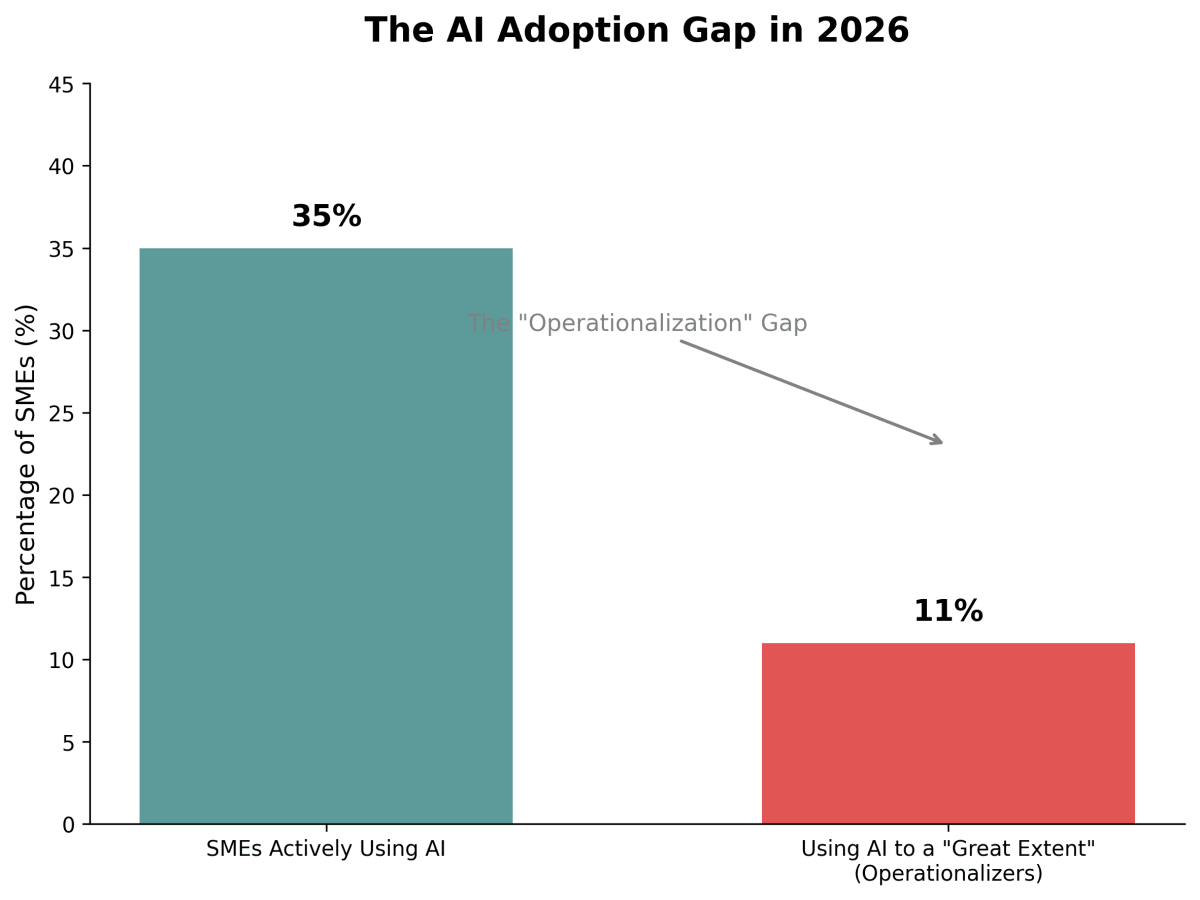
Only about 11% of businesses report using AI to a "great extent" to automate or streamline operations. This creates a competitive divide: those who merely use AI save minutes; those who operationalize it save days. For a closer look at which specific tools deliver these efficiencies, read our breakdown of AI productivity tools that actually deliver ROI in 2026.
Department | Reported Efficiency Gain | Primary Time Saved | Cost Impact |
|---|---|---|---|
Customer Service | 95% of requests completed in <5 mins | Ticket resolution | Reduced headcount needs |
Marketing | 40% faster campaign launch | Content creation | Lower agency spend |
Internal IT/HR | 30-70% (Agentic AI) | Ticketing & scheduling | Scalability without hiring |
Operations | 1,500+ hours/month (firm-wide) | Data entry & reporting | Resource reallocation |
Why Data is the New Battleground for Small Businesses
If you look at the top-ranking analyses from industry analysts like IDC and Techaisle, a common theme emerges: Data is the fuel, and AI is the engine. In 2026, you cannot have one without the other.
Many competitor articles gloss over the gritty details of why some AI projects fail. The answer is almost always "bad data."
Moving from Fragmented to Unified
In the past, small businesses operated with siloed data—sales figures in one spreadsheet, customer emails in another, and inventory logs in a notebook. In 2026, this is a death sentence for AI integration.
The Problem: Disconnected data sources are cited as a top business challenge by 62% of technology leaders. AI cannot automate a process it cannot see. If your customer service AI cannot access your inventory database, it cannot tell a customer if an item is in stock.
The Solution: Successful SMEs are investing in integrated platforms (like unified Customer Relationship Management systems) to create a "single source of truth." Integration tools such as Zapier and native platform connectors make this achievable without custom development. This allows AI agents to act intelligently and autonomously. For a beginner-friendly explanation of how AI processes this data, see what AI is and how it works.
The Rise of Sovereign Data Intelligence
Techaisle predicts that small businesses will prioritize control over their data. In 2026, it is not just about having data, but about ensuring it is clean, secure, and structured for AI inferencing (the process of AI making predictions or decisions) rather than just storage.
Top AI Automation Trends for SMEs in 2026
What does AI look like for the average small business today? It is no longer just a website chatbot. Here are the trends redefining the landscape.
1. The Rise of Agentic AI
This is perhaps the most significant shift in 2026. We are moving from Generative AI (which creates content) to Agentic AI (which takes action).
What it is: AI agents that can perform multi-step workflows independently. Instead of just drafting an email for review, an agentic AI can schedule the meeting, update the CRM, and send a follow-up note without human intervention.
Impact: Inc. Magazine notes that companies are reporting 30-70% efficiency gains in departments like finance, human resources, and support by deploying these autonomous agents. For a deeper look at which agentic tools are leading the market, refer to our roundup of AI tools small businesses are quietly relying on in 2026.
We've published a dedicated report on agentic workflows for SMEs that goes deeper on implementation.
2. The "SuperWorker" or "Augmented Worker"
Forget the myth that AI eliminates jobs. In the 2026 SMB, AI creates "SuperWorkers." Employees leverage AI to handle repetitive tasks, allowing them to focus on strategy, creativity, and relationship building. This augmentation is key to retention, as workers value modern tools that reduce burnout. Curious about which human capabilities remain irreplaceable? Read these human skills beat AI in 2026.
3. AI-Driven FinOps
As AI usage scales, so do the costs. IDC highlights Financial Operations as an emerging must-have discipline for SMBs in 2026. Businesses are no longer buying just one subscription; they are managing consumption-based AI services. Smart SMEs are implementing cost-management practices to ensure their digital investments do not erode their profit margins.
AI ROI Benchmarks for Small Businesses in 2026
To build trust and authority, we must move beyond vague promises and look at the numbers small businesses are actually seeing.

While ROI varies by industry, here are the benchmarks reported by analysts and users in 2026:
Customer Service: Businesses implementing AI-driven service desks report that 95% of self-service requests are completed in under five minutes. This translates to lower staff overhead and higher customer satisfaction.
Marketing Efficiency: AI as a "marketing sidekick" is reducing campaign launch cycles. SMEs using GenAI for content and omnichannel branding report the ability to execute campaigns at a fraction of the previous cost. For a dedicated guide on this, explore what AI marketing is and how small businesses use it.
Operational Time Savings: A 40-person IT services firm recently reduced internal ticket processing time by 62% after deploying AI triage agents, effectively recovering dozens of engineering hours per week.
Hardware ROI: Investment in AI-ready infrastructure (like edge-enabled servers and smart point-of-sale systems) allows businesses to analyze data in real-time, leading to faster decision-making on the sales floor.
Use our AI ROI Calculator to estimate what these benchmarks could mean for your specific business size and sector.
How to Adopt AI in Your Small Business
Reading trends is one thing; applying them is another. Here is how to move from being a passive observer to an active competitor in the AI race.
Step 1: Audit Your Operations
Do not start with the tool; start with the pain point. Where are you losing hours?
Consider: Payroll administration, IT ticketing, calendar management, or customer support.
Action: List the top three repetitive tasks that drain your team's energy. These are your prime automation targets.
Step 2: Prioritize Data Hygiene
Before subscribing to a new AI tool, ensure your existing data is clean and unified.
Action: Integrate your disconnected applications. If your sales and marketing teams use different platforms, integrate them under a single CRM umbrella. This ensures the AI you deploy has accurate information.
Step 3: Start with Integrated Tools
Resist the urge to duct-tape together dozens of standalone AI apps our tested breakdown of the 6 AI tools for small businesses shows exactly which platforms are delivering real results.. Look for platforms you already use that have AI features built-in. Modern CRM platforms such as Salesforce or HubSpot now embed AI-driven workflow automation directly into their ecosystems, reducing complexity and cost. For a broader look at how AI integrates into business management, see AI and business management.
Step 4: Upskill Your Team
The best AI tool fails if your team does not know how to use it. Invest in "AI literacy." Teach your employees prompt engineering and critical evaluation of AI outputs.
Step 5: Measure and Optimize (FinOps)
Track your AI spending and the time saved. If an AI tool is not delivering measurable ROI within a reasonable timeframe, pivot. Use the FinOps methodology to maintain visibility into your cloud and AI costs. And if you are looking for budget-friendly options, our list of the best free AI tools in 2026 is a great starting point.
Is AI Automation Right for Your Small Business?
The data is clear: AI automation is no longer a competitive advantage; it is the price of entry. Small businesses are embracing this shift not because it is trendy, but because it works. By focusing on clean data, realistic ROI benchmarks, and the rise of Agentic AI, you can position your business not just to survive, but to thrive.
The gap is widening between those who experiment with AI and those who embed it into their operations. The question is no longer if you will adopt AI, but how well you will do it. Start building your AI-ready foundation today.
Frequently Asked Questions
What is the difference between Generative AI and Agentic AI?
Generative AI creates content (like drafting an email). Agentic AI takes action based on that information. For example, GenAI writes a draft reply to a customer, while Agentic AI sends the reply, updates the customer database, and schedules a follow-up task automatically.
How much does AI cost for a small business in 2026?
Costs vary widely. There are affordable add-ons to existing software for $20-$50 per user per month, as well as more complex custom automations. The key trend is "FinOps," meaning businesses actively manage AI consumption to control costs. For real-world examples of AI in action, see how AI is used in daily life and business.
Should SMBs build custom AI agents or rely on SaaS platforms?
For most small businesses, SaaS platforms with embedded AI are the faster, safer route. They require no development overhead and include built-in compliance. Custom builds make sense only for businesses with unique proprietary processes and dedicated technical staff.
Do I need to be a tech expert to use AI?
No. Most AI tools are now embedded in the software you already use, like your CRM, HR platform, or email client. You do not need to code; you need to know how to apply the tools to your daily tasks.
What are the biggest risks of AI for small businesses?
The primary risks include data privacy (feeding sensitive info into public AI models), fragmented tech stacks (using too many disconnected tools), and "shadow AI" (employees using unapproved tools). Mitigation requires clear governance and employee training.
Is AI adoption worth it for a very small team (1-5 employees)?
Absolutely. For micro-businesses, AI acts as a force multiplier. It can handle after-hours customer queries, automate social media posting, manage bookkeeping, and draft proposals—effectively acting as a virtual team member. To understand which roles might evolve, read our analysis of AI-proof careers and future skills.
What is agentic AI and how do SMEs use it?
Agentic AI goes beyond generating content — it takes autonomous multi-step actions like updating your CRM, sending follow-ups, and scheduling meetings without human input. SMEs are reporting 30–70% efficiency gains in HR, finance, and support departments by deploying these agents.
What is FinOps for small businesses?
FinOps (Financial Operations) is the practice of tracking and optimizing your AI and cloud spending. As SMBs scale AI usage across multiple tools, FinOps ensures costs don't outpace the efficiency gains. It involves monitoring consumption-based pricing, cutting unused subscriptions, and tying every AI spend to a measurable output.