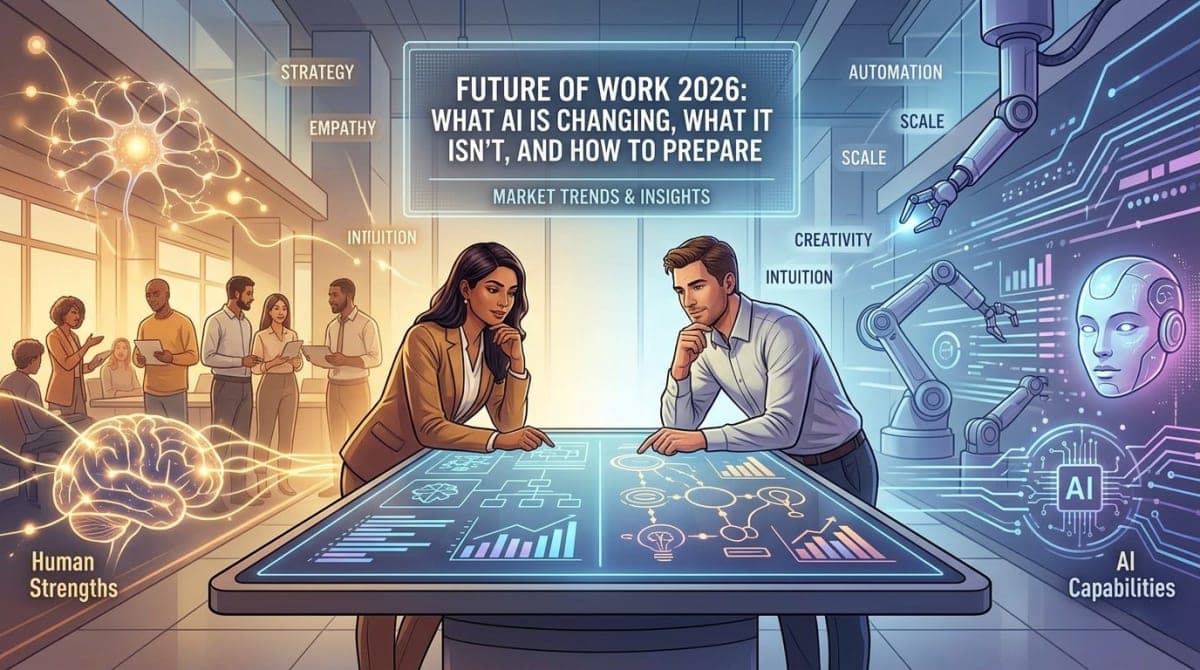
In 2026, the real career divide is no longer technical vs. non‑technical. It is judgment vs. execution.
AI systems now draft reports, analyze data, generate marketing copy, and automate workflows at scale. Yet across industries, one pattern is becoming clear: as automation expands, uniquely human capabilities are increasing in value.
Recent data show that human capabilities such as adaptability, critical thinking, and leadership remain in high demand in 2026, even as technical skills evolve. LinkedIn research indicates that about 75% of employers prioritize people skills alongside AI literacy. At the same time, more than 1.3 million new roles combining AI fluency with human judgment have emerged globally in recent years. The signal is clear: technical execution is being commoditized, while human oversight, ethical reasoning, and strategic thinking command a premium.
This guide explains which careers offer the strongest long‑term resilience through 2026 and beyond—and why. These roles are not "AI‑proof" because technology is absent. They are resilient because AI supports them, but cannot replace their human core.
What Are AI‑Proof Careers in 2026?
AI‑proof careers in 2026 are roles where performance depends on empathy, ethical judgment, creativity, leadership, complex decision‑making, or physical adaptability. AI can assist tasks inside these jobs, but it cannot replace responsibility, trust, or moral reasoning.
For a deeper analysis of the underlying skill foundation behind these roles, see our companion breakdown of the human capabilities driving long‑term value.
The AI Paradox: More Automation, More Human Value
Automation is accelerating. But as routine execution becomes cheaper and faster, value shifts toward:
• Choosing what matters
• Making irreversible decisions
• Building trust in uncertain conditions
• Orchestrating humans and systems together
A regional hospital in Japan recently deployed AI triage systems to reduce administrative load. Diagnostic speed improved. Yet patient satisfaction scores rose only after senior nurses were given greater authority to make judgment calls in ambiguous cases. The technology optimized workflow; human leadership restored trust.
This pattern is repeating across industries.
1. Healthcare & Caregiving: Empathy Under Pressure
Healthcare remains one of the most AI‑augmented but human‑dependent fields.
AI can interpret scans and predict risk patterns. It cannot deliver bad news with emotional calibration, navigate family conflict during treatment decisions, or take ethical responsibility for trade‑offs.
Why it’s resilient:
• Ethical decision‑making under uncertainty
• Emotional intelligence in high‑stress environments
• Real‑time adaptation to patient response
Career paths:
• Nurse Practitioner or Clinical Specialist
• Mental Health Therapist
• Geriatric Care Manager
In aging societies, demand is structural—not cyclical.
2. Education, Training & Coaching: Motivation and Meaning
AI personalizes content. Humans build belief.
Corporate training markets are shifting toward high‑touch leadership coaching. In classrooms, adaptive software supports instruction, but teacher‑student rapport remains the strongest predictor of engagement.
A corporate L&D director at a Southeast Asian fintech firm reported that AI reduced preparation time by 40%, yet executive coaching demand doubled. Leaders wanted interpretation—not just information.
Why it’s resilient:
• Inspiration and persuasion
• Emotional calibration
• Adaptive communication
Career paths:
• Corporate Learning Strategist
• Executive Coach
• Specialized Skills Trainer
3. Human Resources & People Operations: Culture as Infrastructure
AI screens resumes. Humans build culture.
As organizations scale automation, psychological safety and internal trust become competitive advantages.
Why it’s resilient:
• Conflict mediation
• Cultural judgment
• Ethical workforce governance
Career paths:
• Chief People Officer
• Employee Experience Designer
• DEI Strategist
The strategic evolution of HR into "People Science" makes high‑level interpersonal capability a structural asset.
4. Leadership, Consulting & Strategic Advisory: Decision Authority
AI produces analysis. Leaders make commitments.
When a European manufacturing firm adopted predictive automation across supply chains, consultants were not hired to configure software—they were hired to manage stakeholder resistance and realign executive incentives.
Why it’s resilient:
• High‑stakes judgment
• Stakeholder coalition building
• Narrative framing in ambiguity
Career paths:
• Change Management Consultant
• Strategic Advisor
• Governance or Board Member
As McKinsey’s automation research shows, the greater the technical complexity, the higher the premium on human judgment.
5. Complex Sales & Customer Success: Trust Economics
Chatbots handle simple inquiries. Enterprise deals depend on relational intelligence.
High‑value sales roles now revolve around long‑term partnership, recovery of at‑risk accounts, and understanding unspoken business pressures.
Why it’s resilient:
• Negotiation under tension
• Empathetic listening
• Strategic co‑creation
Career paths:
• Enterprise Account Director
• Customer Success Executive
• Strategic Partnerships Lead
In B2B environments, trust often determines revenue stability more than price.
6. Creative & Strategic Marketing: Meaning in an Age of Sameness
AI generates content. Humans generate context.
As generative tools flood markets with competent output, originality and cultural insight become differentiators.
A regional apparel brand in South Asia saw engagement rise after shifting from AI‑generated campaign variations to human‑led cultural storytelling tied to local festivals. Automation improved efficiency; human insight drove relevance.
Why it’s resilient:
• Cultural interpretation
• Strategic framing
• Brand authenticity
Career paths:
• Creative Director
• Brand Strategist
• UX Researcher
7. Skilled Trades & Advanced Technical Craft: Physical Adaptability
Robotics excels in controlled environments. The real world is rarely controlled.
Data center expansion, renewable energy installations, and infrastructure upgrades are increasing demand for high‑skill trades.
Why it’s resilient:
• Physical dexterity
• Situational judgment
• Real‑time problem solving
Career paths:
• Master Electrician (Data Centers/Renewables)
• Advanced Manufacturing Technician
• Building Science Specialist
Shortages in skilled labor are structural in many developed economies.
The Hybrid Strategy for 2026
The goal is not to compete with AI on execution speed. It is to integrate AI into your workflow while strengthening uniquely human capability.
A practical framework:
Baseline AI literacy — use tools for drafting, summarizing, data organization.
Select one core human strength — empathy, negotiation, ethical reasoning, systems thinking.
Demonstrate integration — show how AI enhances your judgment rather than replaces it.
This hybrid positioning aligns with current labor market data trends and reduces long‑term displacement risk.
FAQ
Are any careers completely safe from AI?
No. Tasks inside every career will evolve. Resilience depends on how central human judgment and trust are to performance.
Will AI replace jobs or tasks?
Primarily tasks. Roles that consist mostly of repeatable execution face higher automation exposure.
Do I need to become technical to stay relevant?
You need functional AI literacy, not deep engineering expertise. Strategic human capability remains the differentiator.
Which skills are most protective in 2026?
Ethical judgment, emotional intelligence, strategic framing, influence, adaptive learning, and physical-world problem solving.
Conclusion
The future workforce is not divided between humans and machines. It is divided between professionals who rely only on execution and those who cultivate judgment, trust, and strategic capability.
AI will continue absorbing routine work. The professionals who advance are those who define problems, take responsibility for outcomes, and build durable human trust.
In 2026 and beyond, the most secure careers are not those untouched by AI—but those strengthened by the human skills AI cannot replicate.