Will AI Replace Your Job in 2026? What the Data Shows
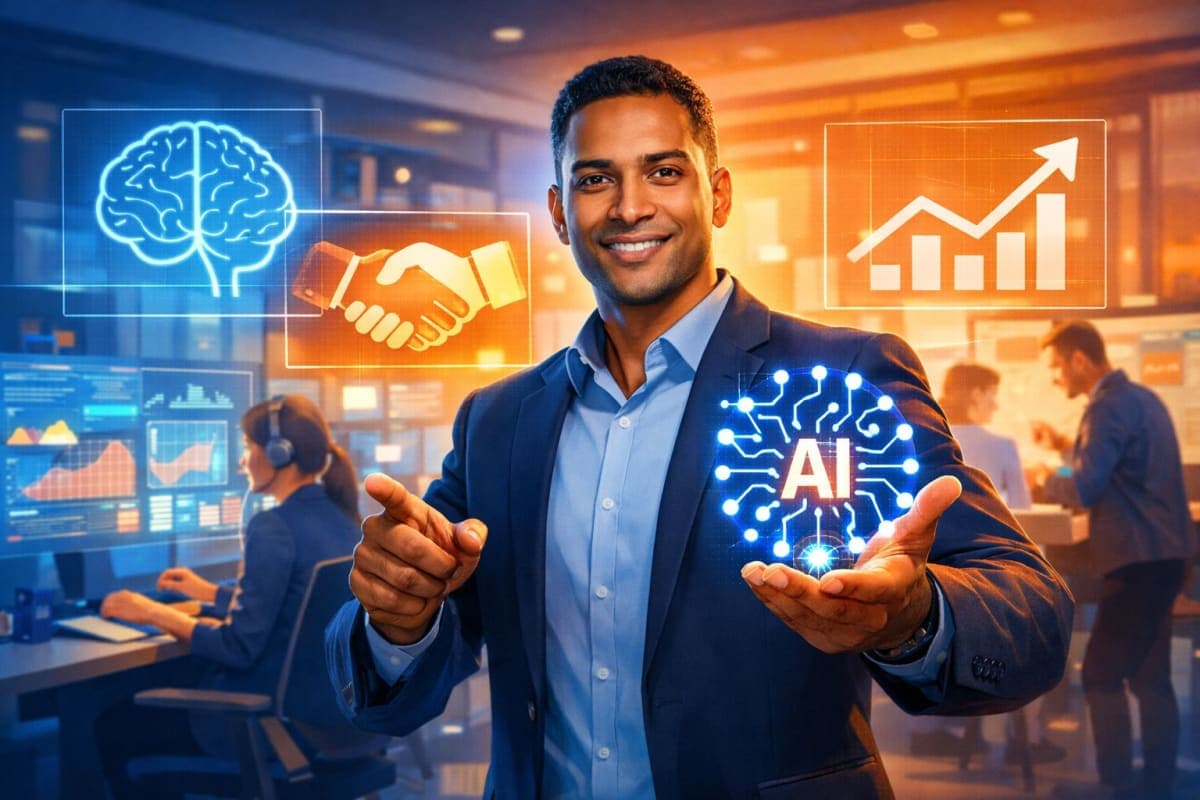
The fear of AI taking jobs is widespread, but the 2026 data tells a different story: AI doesn't terminate roles—it transforms tasks. While AI handles drafts, data analysis, and routine coding, humans retain what's irreplaceable: strategic judgment, emotional intelligence, and creative leadership.
According to the World Economic Forum's 2025 Future of Jobs Report, AI creates more opportunities than it eliminates. The numbers are clear:
- 8% job displacement (92 million roles)
- 14% job creation (170 million new roles)
- Net result: 78 million new jobs by 2030
This 7% net growth reveals the 2026 reality: your career isn't ending; it's evolving from task-doer to strategic partner with AI.
TL;DR:
AI changes tasks, not entire jobs. High-risk roles are repetitive. Secure roles need human skills (empathy, creativity). Future-proof with: Critical Thinking, Emotional Intelligence, AI Literacy. 5-Step Plan: Audit tasks, build hybrid skills, create portfolio, get micro-credentials, grow your network.
How AI Changes Work: Automation vs. Augmentation
AI's impact manifests in two primary ways:
Automation: The removal of repetitive, rule-based, and predictable tasks (e.g., data entry, standardized report generation).
Augmentation: The enhancement of human capabilities, making professionals faster, more informed, and more strategic in their judgment, creativity, and complex problem-solving.
The World Economic Forum projects that 44% of workers’ core skills will be disrupted between 2023 and 2028. In practical terms, this means that roughly two-thirds of jobs will change significantly by 2030, but most will be redesigned rather than eliminated, driven by AI and data-led transformation.
Real-World Examples of AI Augmentation in 2026
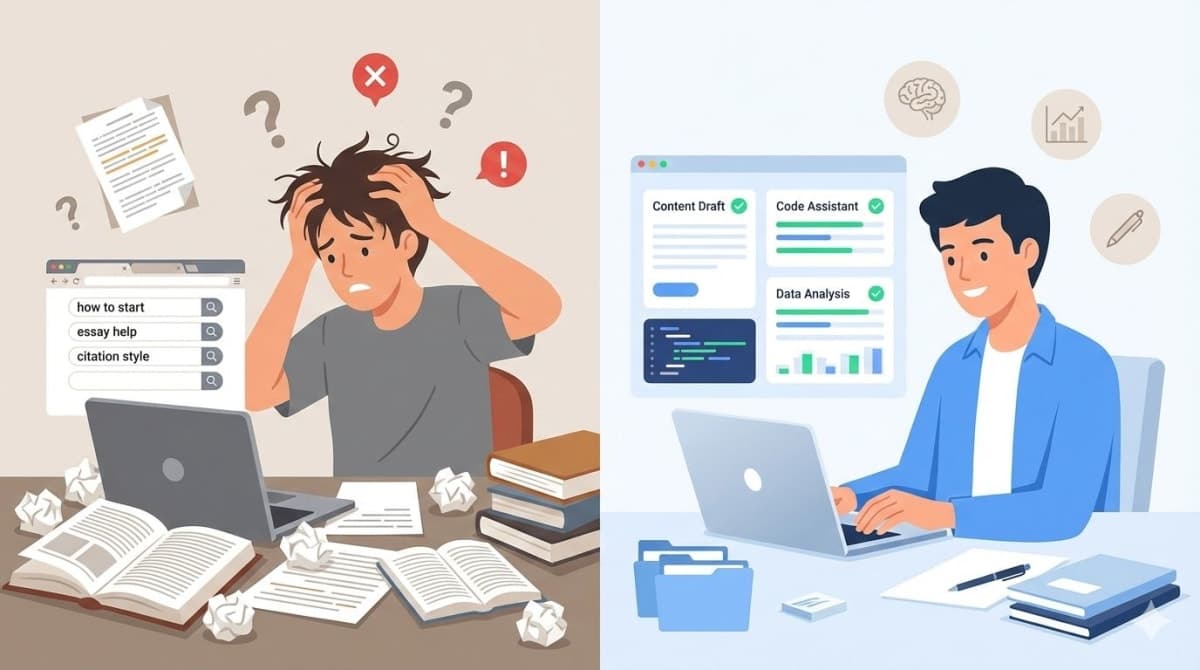
Office work: AI drafts documents, summarizes meetings, and analyzes spreadsheets; humans focus on decisions, negotiation, and coordination.
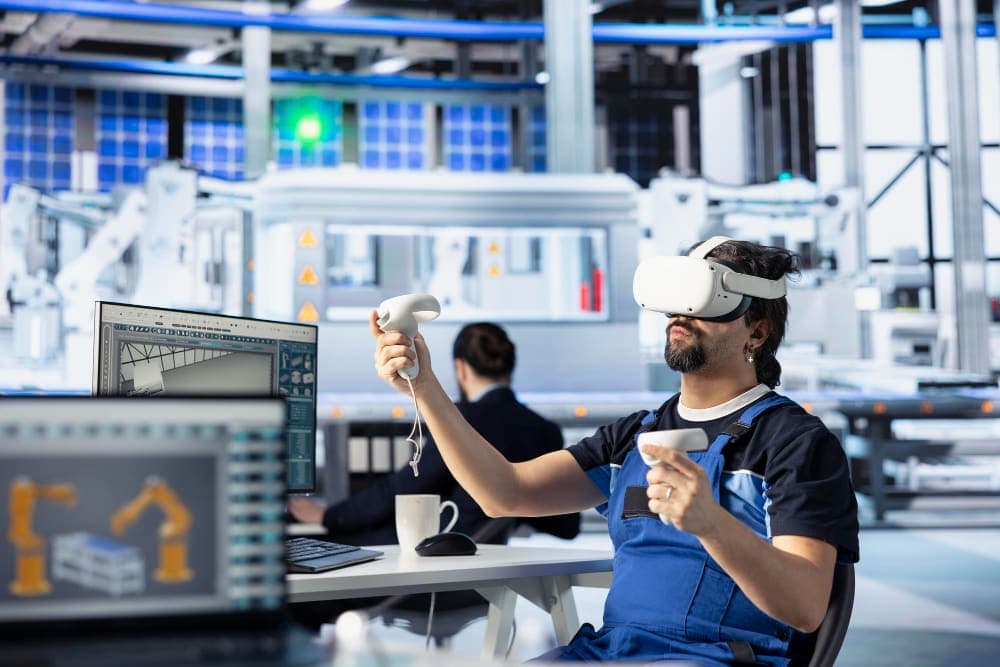
Manufacturing: Robots handle repetitive assembly; technicians troubleshoot, optimize systems, and ensure quality.
Creative work: AI generates ideas and rough drafts; humans add originality, emotion, and cultural meaning.
Jobs Most at Risk from AI Automation in 2026
Roles with high exposure contain a high volume of tasks that are repetitive, data-heavy, and rule-based—areas where current AI excels with high accuracy and lower cost.
Job Role | 2026 Risk Level | Primary Reason for AI Exposure | The Path Forward for Workers |
|---|---|---|---|
Data Entry Clerk | Very High | AI can process and validate large datasets instantly with near-perfect accuracy. | Demand sharply declines; urgent need to upskill into data analysis, governance, or systems management. |
Telemarketer / Scripted Sales | Very High | Advanced voice AI can conduct personalized, scripted conversations 24/7. | Role is largely replaced by AI agents; shift to high-touch relationship management and complex sales strategy. |
Routine Customer Support (Tier 1) | High | AI chatbots and voice assistants effectively resolve ~80% of routine inquiries. | Role evolves into handling complex escalations, emotional customer care, and proactive relationship management. |
Basic Content Writer (Template-Based) | Medium-High | LLMs generate competent first drafts for product descriptions, basic news, and SEO articles rapidly. | Focus shifts to strategic content planning, high-level editing, brand storytelling, and creative direction. |
Junior Developer (Boilerplate Code) | Medium-High | AI coding assistants (e.g., GitHub Copilot) automatically generate standard code blocks and debug common errors. | Career path emphasizes system architecture, innovative problem-solving, and managing AI development tools. |
Core Insight: These roles are not vanishing overnight, but entry-level demand is contracting. Long-term career viability depends on adding higher-level strategic, creative, or interpersonal skills that AI cannot replicate.
The Safest Careers in 2026: The Irreplaceable Human Edge
Safety from AI is less about your industry and more about the nature of your tasks. Careers that are growing and secure rely heavily on intrinsically human capabilities.
Job Category | Why AI Cannot Fully Replace It | 2026-2030 Outlook | How AI Serves as a Augmentation Tool |
|---|---|---|---|
Healthcare Practitioners (Nurses, Surgeons) | Requires complex physical dexterity, empathy, and real-time ethical judgment in unpredictable situations. | Strong Growth | AI assists with diagnostic suggestions, patient monitoring analytics, and robotic surgical precision. |
Skilled Trades (Electricians, Plumbers) | Demands adaptive problem-solving in unique, unstructured physical environments. | Stable-Strong Demand | AI-powered diagnostic tools and AR glasses can provide schematics and repair instructions on-site. |
Human-Centered Professionals (Teachers, Therapists, Social Workers) | Built on deep interpersonal trust, emotional intelligence, and personalized motivation. | Strong Growth | AI helps create personalized learning/care plans, handles administrative burdens, and identifies patterns in client progress. |
Creative & Strategic Leaders (Original Artists, Senior Managers) | Depends on visionary creativity, cultural context, navigating ambiguity, and inspiring human teams. | Stable-Growing | AI is used for idea generation, data-driven performance insights, and automating routine administrative leadership tasks. |

Top 7 Future-Proof Skills for an AI-Era Career
Mastering these skills will make you a synergistic partner to AI, not a competitor.
Critical Thinking & Judgment: The ability to evaluate AI outputs, identify bias or error, and make the final strategic call.
Emotional Intelligence (EQ): Skills in empathy, building trust, resolving conflict, and motivating teams—cornerstones of human collaboration.
AI Literacy & Prompt Crafting: Knowing the capabilities and limits of major AI tools and skillfully communicating with them to produce high-quality outputs.
Adaptability & Continuous Learning: The mindset and ability to continuously upskill and adapt to new tools, workflows, and job requirements.
Creative Problem-Solving: Synthesizing information in novel ways and designing solutions for problems without predefined answers.
Interdisciplinary Knowledge: Combining expertise from different fields (e.g., biology + data science, ethics + engineering) to innovate in ways AI cannot.
Effective Communication & Storytelling: Translating complex AI-driven insights into compelling narratives that persuade and align human stakeholders.
For deeper insights on where human skills create the strongest career advantages, see our companion guide, 7 AI-Proof Careers in 2026: Jobs Where Human Skills Win. It provides a detailed breakdown of resilient professions in healthcare, education, skilled trades, and other fields, complete with actionable data and career paths that leverage empathy, creativity, and complex judgment—the very capabilities that define professional security in this new era.
The New AI-Era Jobs You Can Aim For
The disruption also creates unprecedented opportunity. Millions of new roles are emerging, many of which do not require advanced computer science degrees.
AI Integration Specialist: Professionals who bridge the gap between technology and business, helping teams adopt and effectively implement AI tools into existing workflows.
AI Output Editor & Humanizer: Experts who refine, fact-check, and inject brand voice, creativity, and emotional resonance into AI-generated content (text, code, design).
AI Ethics & Governance Officer: Ensures AI systems are deployed fairly, transparently, and without harmful bias, addressing growing regulatory and social concerns.
Human-Machine Team Manager: A new form of leadership focused on optimizing collaboration between human employees and AI agents, managing hybrid workflows.
Your 5-Step Action Plan to Future-Proof Your Career in 2026
Conduct a Personal Task Audit: Objectively list your weekly tasks. Identify the 30-50% that are repetitive and rule-based—these are prime for AI augmentation. This clarifies your upskilling focus.
Develop "Hybrid" Expertise: Don't just learn AI in a vacuum. Learn to apply a specific AI tool (e.g., ChatGPT for writing, an analytics platform) directly to your current professional domain (e.g., marketing, engineering, HR).
Build a "Proof of Concept" Portfolio: Actively use AI to create sample work. For example, if you're in marketing, use AI to draft a campaign brief and then showcase your human-led strategy and creative edits.
Pursue Micro-Credentials: Enroll in short, focused courses on platforms like Coursera or LinkedIn Learning for skills like "Prompt Engineering," "AI for Business," or "Data Literacy."
Cultivate Your Human Network: Intentionally strengthen relationships and seek mentors. In an AI-driven world, the human network for collaboration, advice, and opportunity becomes more valuable than ever.
Conclusion: Your Human Edge Is Your Career Advantage
The narrative for 2026 is one of partnership, not obsolescence. AI will handle an increasing share of computation and administration, but this massively amplifies the value of quintessentially human skills: empathy, creativity, strategy, and ethics.
The workers at greatest risk are not those in any particular job title, but those who resist adapting. By strategically leveraging AI as a tool and deliberately cultivating your irreplaceable human strengths, you don't just secure your career—you position yourself to lead in the new economy.
Start this week: Pick one AI tool related to your field and one future-proof skill from the list above. Dedicate 30 minutes a day to practice. The future belongs to the adaptable hybrid professional.
FAQs
Will AI replace jobs in 2026?
No. In 2026, AI primarily automates tasks, not entire jobs. Most roles are augmented, not eliminated.
What is the negative impact of artificial intelligence on employment?
AI displaces repetitive tasks, contracting entry-level demand for roles like data entry clerks and telemarketers, requiring urgent worker upskilling.
How many jobs will AI replace by 2050?
Projections focus on transformation. By 2030, the WEF forecasts 8% displacement (92M jobs) but 14% growth (170M new jobs), suggesting a net increase, not replacement, by 2050.
If AI takes over all jobs, what will humans do?
Based on 2026 data, this is not the trajectory. Humans focus on strategy, creativity, and empathy—skills AI cannot replicate.
What jobs will AI replace by 2030?
Jobs AI will replace or significantly reduce by 2030: Data Entry Clerks, Telemarketers, Routine Customer Support (Tier 1), Basic Template-Based Content Writers.
How many jobs will AI replace by 2026?
Exact 2026 figures are not isolated. The trend leads to the WEF's 2030 projection: 8% of current jobs (92 million globally) may be displaced.
What are the positive and negative impacts of AI on employment?
Positive: Creates new jobs (AI Integration Specialist, Ethics Officer), augments productivity.
Negative: Displaces routine tasks, requires rapid reskilling.
What jobs will AI not replace?
AI will not replace: Nurses, Surgeons, Electricians, Plumbers, Teachers, Therapists, Original Artists, Senior Managers—roles needing physical dexterity, empathy, or complex judgment.
What jobs will AI replace by 2040?
By 2040, AI will further transform roles with predictable analysis: certain diagnostic aides, routine legal/accounting tasks, and middle-management coordination, augmenting more than replacing.
This guide was meticulously researched and crafted by the Distrya Team, leveraging data from the World Economic Forum, McKinsey, and OECD to provide authoritative insights for your career future.