The Rise of the Hybrid Worker: How the Best Professionals Use AI as a Co-Pilot in 2026
Not long ago, the conversation about AI at work orbited a single, anxious question: “Will it take my job?” That fear hasn’t vanished, but a quieter, more practical shift has taken root inside the most productive teams. Walk through any co-working space or sit in on a cross-functional standup in 2026, and you’ll see a different dynamic. Nobody is waiting for AI to replace them. They’re just already using it—to write, to code, to analyze, to decide. Not as a crutch, but as a co-pilot.
The professionals who thrive aren’t the ones who run fastest from automation. They’re the ones who figured out how to run with it. That’s the hybrid worker model, and it’s reshaping what it means to be a knowledge worker. According to Microsoft’s 2025 Work Trend Index, the share of knowledge workers using generative AI on the job has nearly doubled in the past year, yet the gap between using AI and using it well remains wide. This article unpacks how the best people in marketing, engineering, sales, finance, and beyond are fusing human judgment with machine speed—and how you can do the same without losing the instincts that make you valuable.
The hybrid worker model is evolving beyond the first generation of AI writing assistants and chat-based copilots. By late 2026, the conversation increasingly includes AI agents, tool-connected assistants, AI-supported software development, and automated workflows that can carry out multiple steps toward a defined goal.
This evolution changes the question professionals need to ask. Instead of simply asking whether AI can generate a useful answer, they must ask whether it can complete a task reliably, whether it has permission to take the required actions, how its results will be verified, and when a human must intervene.
More capable AI systems can help professionals move from isolated tasks to connected workflows. An assistant might summarize customer feedback, identify recurring complaints, prepare a report, and suggest next steps. In a more automated workflow, it might also update a project-management record or prepare a response for approval. The important distinction is that generating an answer is not the same as safely executing an action.
For hybrid workers, the opportunity is to combine this growing execution capability with human expertise, clear boundaries, and responsible oversight. The goal remains unchanged: use AI to reduce repetitive work while reserving human attention for judgment, relationships, creativity, and decisions that carry meaningful consequences.
Key Takeaways
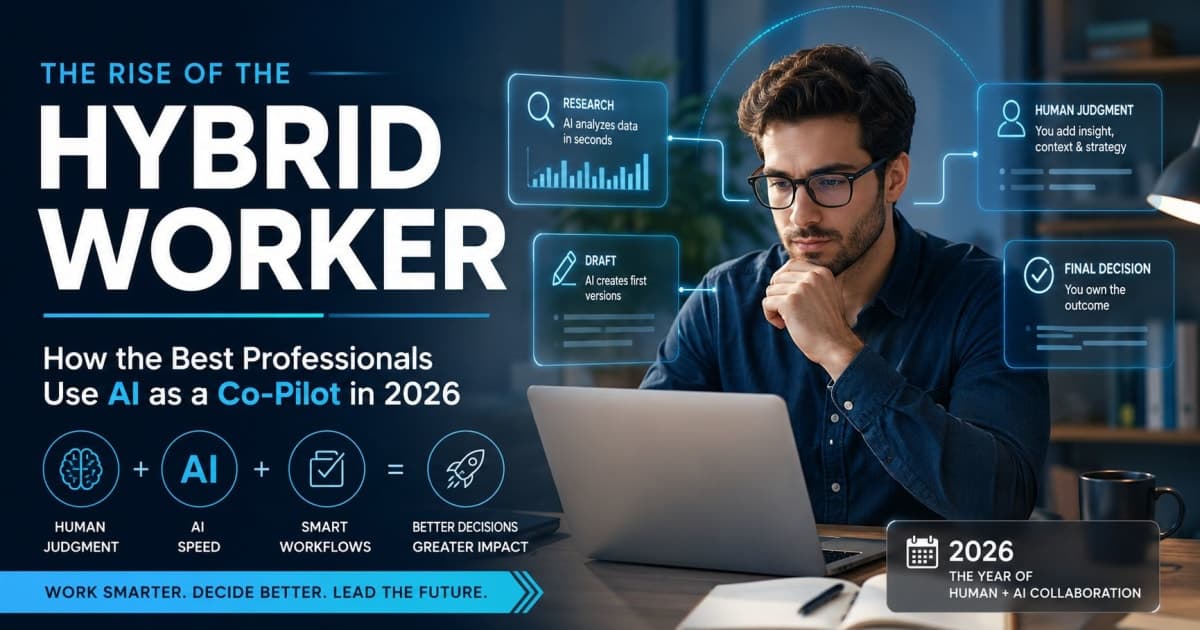
A hybrid worker combines AI speed with human judgment to produce work that neither could achieve alone.
AI should automate repetitive, pattern-based tasks—not critical decisions that require accountability.
Top professionals use AI as a collaborator and idea partner, not a replacement for their own thinking.
AI literacy is rapidly becoming a baseline workplace skill, much like digital literacy was a decade ago.
Human oversight remains essential for quality, ethics, context, and trust.
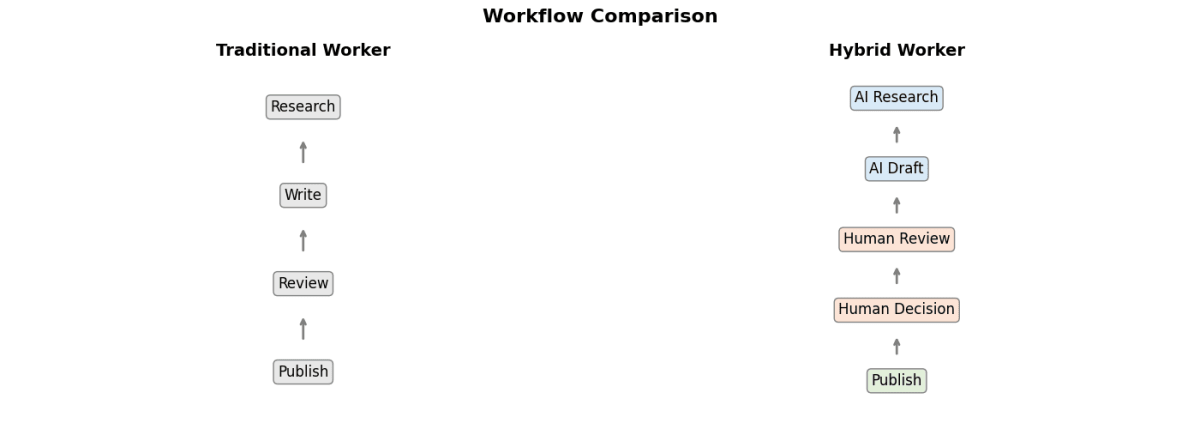
Table of Contents
What Is a Hybrid Worker?
A hybrid worker is a professional who deliberately weaves AI tools into their daily tasks while keeping human judgment at the center of decisions that matter.
Think of it as a permanent partnership, not a temporary experiment. The AI drafts the market analysis; the hybrid worker verifies the numbers, reshapes the argument, and adds the nuance that only comes from understanding a specific client’s history. The AI generates four logo variations; the designer selects and refines one based on cultural symbolism a machine can’t feel. It’s a relationship built on a simple rule: machine speed handles volume, human judgment handles value.
This isn’t about replacing people. Gartner predicts that by 2026, more than 80% of enterprises will have used generative AI APIs or deployed GenAI-enabled applications, and the World Economic Forum’s Future of Jobs Report 2025 emphasizes that the biggest competitive advantage will belong to workers who can collaborate with intelligent machines. The hybrid worker is the person already doing that today—editing what the AI outputs, directing where it should focus, and bearing the responsibility for what gets shipped.
Understanding the 2026 Hybrid Worker Model
Learning how to use AI as a co-pilot has become a core competency across industries. Rather than replacing human talent, human-AI collaboration in the workplace allows professionals to automate low-complexity tasks while focusing on high-value, strategic decisions. The hybrid worker model leverages AI productivity tools to optimize execution speed without sacrificing human oversight or accountability.
Why the Best Workers Aren’t Competing Against AI
The most damaging workplace myth of the early 2020s was that AI and humans were in a zero-sum race. Every headline about automation implied a finish line where one side loses. High performers never bought that framing. They saw something closer to a relay race, where the baton passes back and forth depending on the terrain.
Competing against AI on raw speed or recall is futile. A model like Anthropic Claude or Google Gemini can read thousands of documents in seconds and spot patterns a human would miss. But the moment you stop treating AI as an opponent and start managing it like a hyper-efficient junior colleague who lacks context, the dynamic flips. You stop being the person who churns through data and become the editor, the strategist, the one who asks the right questions.
While building AI-powered content and analytics workflows for Distrya’s editorial team, one pattern became obvious early: the speed gains only matter if someone with genuine expertise checks the output. An AI can summarize a dozen earnings calls in minutes, but it takes a human to recognize when a CEO’s careful phrasing hides trouble. That fusion—machine speed, human nuance—is the core of the hybrid model.
I watched a financial analyst friend make this shift over eighteen months. She used to spend Monday mornings manually pulling earnings call transcripts and highlighting risk factors. Now she feeds transcripts into an AI tool and asks for a table of forward-looking risk statements categorized by region. The output isn’t flawless—sometimes the model misses sarcasm or euphemism from executives—but her Monday morning is now 45 minutes instead of four hours. She’s not competing with the AI; she’s directing it. Her value moved up the stack from extraction to interpretation.
LinkedIn’s Workplace Learning Report 2025 shows that professionals who combine AI skills with strong interpersonal and strategic capabilities are getting hired faster than those who lean entirely on technical or AI-only strengths. They aren’t the people who know the most prompts; they’re the people who know when AI’s answer is wrong and why it matters.
“AI reduces effort. Human judgment creates value.”
Human Judgment + AI Speed: The Winning Formula
If you strip away the complexity, the hybrid worker’s advantage comes from a deceptively simple combination: let the AI move fast through work that requires scale, and let the human step in for work that requires meaning. Neither half works alone. AI without oversight hallucinates, misses cultural subtext, and doubles down on confident-sounding errors. Humans without AI get buried in busywork that dilutes their thinking time.
The table below captures where each side dominates.
AI Strengths | Human Strengths |
|---|---|
Processing large datasets instantly | Detecting nuance, sarcasm, and ethical landmines |
Drafting routine emails, reports, and code | Making strategic decisions under uncertainty |
Summarizing meetings and articles at scale | Building trust and rapport with clients and colleagues |
Spotting patterns across thousands of transactions | Understanding a team’s morale or a customer’s unspoken objection |
Running repetitive QA checks and automations | Designing creative campaigns and narratives that resonate emotionally |
Translating between languages at speed | Navigating political, cultural, or regulatory dynamics |
This isn’t a checklist where you pick one column. The winning formula always starts with an AI output that’s then filtered through human lenses: “Does this make sense for our specific context? What’s missing? Who could be harmed if we ship this as-is?” The hybrid worker treats AI as a first-draft machine. That single habit prevents most of the AI disasters you read about in post-mortems.
The Hybrid Worker Workflow Used by Top Performers
Through testing countless AI-assisted workflows on our own content and operations teams, we developed Distrya’s Hybrid Decision Matrix—a framework used by project leads, product managers, and consultants to decide in real time whether to delegate, collaborate, or take full control.
Imagine a 2×2 grid. The horizontal axis is task complexity (low to high). The vertical axis is risk of an error causing real damage (low to high). That gives you four zones:
Automate (Low Complexity, Low Risk): Let AI handle it completely. Think formatting meeting notes, generating weekly status summaries from templates, or transcribing a solo brainstorming session.
Augment (High Complexity, Low Risk): AI does the heavy lifting, human reviews. Example: generating 15 blog post outlines for a new content pillar. The AI handles the structural grind; the human picks the best angles and edits for voice.
Review (Low Complexity, High Risk): AI might draft, but human oversight is mandatory. Think a client-facing email about a billing error. A misphrased sentence could escalate tensions. The AI can suggest a draft, but a human must verify every word.
Escalate (High Complexity, High Risk): Human-led, AI optional. This is the territory of strategic pivots, sensitive negotiations, or crisis communication. The human relies on their own reasoning; AI might be used only to pull relevant precedent, but the final call stays firmly with the person.
When AI tools can execute actions as well as generate recommendations, evaluate both the complexity of the task and the consequences of an incorrect action. A workflow may be appropriate for automated drafting but unsuitable for automatically sending the resulting message. Likewise, AI may identify a potential financial anomaly, while investigating it and deciding how to respond remain separate responsibilities. Assign permissions and approval requirements to individual actions rather than treating an entire workflow as either fully automated or fully manual.
Most knowledge work sits in the middle two quadrants, which is why the hybrid model isn’t about full automation. It’s about knowing where to turn the dial. A consultant at a boutique firm told me he runs client deliverables through this matrix mentally during every project kickoff. It keeps his team from either over-relying on AI or refusing it out of fear. When everyone shares the same decision framework, collaboration stops being a tug-of-war.

What's Changing in AI at Work in Late 2026?
The hybrid worker model is moving beyond using AI to generate text, summarize documents, and answer questions. The next stage of workplace AI is about integrating assistance, reasoning, tools, and automation into repeatable workflows.
The pace of development varies by provider, product, and industry. Not every capability is available in every tool, and not every organization is ready to deploy autonomous systems. However, several technology shifts are important for understanding how professionals should adapt their workflows.
1. From AI copilots to AI agents
Traditional AI copilots primarily help users perform individual tasks. They answer questions, generate drafts, explain code, summarize documents, and suggest next steps.
AI agents extend this model by working toward a defined goal through a sequence of actions. Depending on the system and its permissions, an agent may gather information, use connected tools, process results, and complete parts of a workflow without requiring the user to provide a separate instruction for every step.
Consider a sales workflow. A conventional copilot might summarize a prospect's company and draft an outreach email. An agent-based workflow could potentially gather approved company information, organize relevant findings, prepare a personalized draft, and place it in a review queue.
The human remains responsible for checking the information, ensuring that the message is appropriate, and deciding whether it should be sent.
This distinction matters because the more actions an AI system can take, the more important its permissions, monitoring, error handling, and approval procedures become.
What hybrid workers should do: Learn to define clear objectives, specify permitted actions, set boundaries, and identify the points at which a person must approve or correct the workflow.
2. AI is becoming more integrated into everyday work
AI is increasingly being incorporated into the applications people already use for writing, research, software development, collaboration, data analysis, and project management.
This changes how professionals should think about productivity. The objective is not necessarily to open a separate AI chatbot for every task. It is to identify where AI can remove unnecessary steps from an existing process.
For example, a project manager might use AI to summarize project updates, identify delayed tasks, prepare a meeting agenda, and draft a status report. A developer might use an assistant to understand an unfamiliar codebase, generate test cases, and investigate potential bugs. An analyst might use AI to organize information before validating the results against the underlying data.
The greatest benefit comes when AI improves the complete workflow rather than producing an isolated output.
What hybrid workers should do: Identify one recurring process that consumes significant time. Determine which steps can be assisted or automated, which systems need to exchange information, and where human review should occur.
3. Software development is becoming more collaborative
AI coding assistants can help developers generate code, explain unfamiliar functions, propose tests, and investigate errors. More advanced workflows can support changes across multiple files and assist with longer development tasks.
However, producing code is not equivalent to producing reliable software. Generated code may contain security weaknesses, incorrect assumptions, inefficient implementations, or solutions that conflict with the architecture of an existing system.
Human developers remain essential for understanding requirements, evaluating trade-offs, reviewing changes, and protecting the integrity of the overall system.
The same principle applies outside software engineering. Whether AI produces a financial report, a marketing campaign, or an operational plan, output generation is only one stage of delivering a dependable result.
What hybrid workers should do: Measure AI-assisted work by quality, reliability, maintainability, and business outcomes rather than the quantity of material generated.
4. Human oversight is becoming a workflow design problem
Human oversight should not depend entirely on remembering to check an answer at the end. It should be built into the process.
An effective AI workflow defines which actions are permitted, what evidence must be checked, what happens when information is missing, and when the task must be escalated to a person.
For a low-risk task such as formatting internal notes, minimal review may be sufficient. A workflow that changes customer records, sends external communications, evaluates job candidates, or influences financial decisions needs stronger safeguards.
Organizations must also consider confidential information, access permissions, data retention, security, and the consequences of mistakes.
What hybrid workers should do: Establish review requirements before automating a task. Make sure that the person responsible can inspect the output, understand important actions, and intervene when necessary.
5. AI literacy now includes evaluating systems, not just prompting them
Knowing how to write a prompt remains useful, but effective AI collaboration requires a broader set of skills.
Professionals need to understand how to define a task, provide relevant context, evaluate output quality, recognize uncertainty, and determine whether a system is suitable for a particular purpose.
When an AI workflow uses tools or takes actions, users also need to understand its permissions and limitations. A system that performs well on routine tasks may still fail when instructions conflict, information is incomplete, or an unusual situation arises.
This makes verification, critical thinking, and workflow design important complements to technical AI knowledge.
What hybrid workers should do: Build a small collection of reliable AI workflows, test them against real tasks, document recurring failure patterns, and improve the process based on results.
6. The human advantage is shifting toward direction and accountability
As AI takes on more execution, professionals must become better at defining what good work looks like.
That includes setting priorities, understanding stakeholders, recognizing subtle risks, evaluating competing options, and deciding which outcomes matter most. These responsibilities cannot be reduced to generating a large volume of content or accepting the first plausible recommendation.
Human judgment is not automatically correct, and AI can sometimes identify patterns that people miss. The strongest approach combines machine-generated insights with independent verification, domain knowledge, and clear responsibility for the final outcome.
The practical lesson is simple: do not measure your value by how many tasks you personally execute. Measure it by how effectively you direct work, improve outcomes, and make sound decisions.
What this means for hybrid workers
The transition toward more capable AI assistants and agent-based workflows does not mean every task should be automated. It means professionals need to make better distinctions between assistance, automation, and delegated action.
Use AI for suitable repetitive work. Use structured collaboration for complex but manageable tasks. Introduce explicit approval and verification for sensitive actions. Keep consequential decisions under appropriate human control.
The hybrid worker of late 2026 is not simply someone who knows how to prompt an AI model. It is someone who can design a dependable human–AI workflow and take responsibility for the result.
Where AI Should Lead
There are entire categories of cognitive drudgery where AI should be the first responder. Handing these over isn’t laziness; it’s reallocating your finite attention to work that actually moves the needle.
Research and summarization. A hybrid worker rarely reads a 40-page industry report start to finish. They ask an AI co-pilot—whether that’s Microsoft Copilot in Edge, ChatGPT with browsing, or a specialized research tool—to extract the five trends relevant to their product line, cite the page numbers, and flag contradictory findings. They then read those sections critically. The AI does the foraging; the human does the thinking.
Meeting documentation. In 2026, sitting in a meeting without an AI notetaker feels like taking a college exam without a pen. Tools capture transcripts, action items, and decisions. The hybrid worker reviews the summary, corrects misattributions, and shares it. The value isn’t the transcript—it’s the mental freedom to stay engaged in the conversation instead of typing furiously.
First-draft creation. Whether it’s a marketing email, a Python script, a sales proposal, or a slide deck outline, AI is a phenomenal starting engine. The best hybrid workers write specific, context-rich prompts (“Act as a senior solutions engineer writing a follow-up to a CTO who showed interest but worried about integration complexity”) and then sculpt the output. Tools like GitHub Copilot auto-complete whole functions while the developer stays in architectural control; Jasper or Claude generate copy that a human editor tunes. The AI overcomes blank-page paralysis, nothing more.
Repetitive analysis. In finance, AI screens thousands of transactions for anomalies. In HR, it sifts through résumés to surface candidates who match nuanced criteria. In software, it runs unit tests and suggests bug fixes. Each time, the human sets the parameters and interprets the exceptions. The AI runs the miles; the human makes the calls.
From Individual Tasks to Connected Workflows
The next step in AI productivity is connecting tasks that previously required separate manual steps.
For example, an AI-assisted research workflow might collect approved source material, summarize the main findings, organize supporting evidence, and prepare a report for human review. A project workflow might summarize updates, flag potential delays, draft a status report, and prepare proposed changes to a task-management system.
Depending on the tools available, permissions, and safeguards, some of these steps may be automated. Others may require a person to review the results or approve an action.
The objective is not to eliminate every human interaction. It is to remove unnecessary repetition while making the process easier to inspect and correct.
Before automating a connected workflow, define its starting conditions, expected outputs, permitted actions, failure conditions, and human approval points. A well-designed workflow should make it clear what the AI did, what evidence supports the result, and what still requires a decision.
At this point, you might be wondering how to skill up quickly without getting lost in tool hype. Our AI upskilling roadmap for 2026 lays out a step-by-step path that many hybrid workers have used to build these exact competencies.
Where Humans Must Stay in Control
Some domains remain stubbornly, wonderfully human. Handing them to an algorithm isn’t just inefficient—it’s dangerous. The hybrid worker’s instinct is to redline these areas and refuse to delegate the final say.
Leadership and strategy. AI can suggest a strategic option, but it can’t take responsibility for the outcome. A CEO deciding to pivot a 200-person company can ask AI to model market scenarios, but the courage to make the call and the accountability that come after sit with a human. Leadership isn’t a data problem; it’s a trust, vision, and culture problem.
Negotiation and relationships. A procurement manager using AI to benchmark pricing is smart. Letting AI handle the back-and-forth with a long-term supplier is not. Negotiations hinge on reading the room, sensing when silence means anger rather than agreement, and building enough rapport to ask for a concession. Machines don’t build relationships; they optimize variables.
Ethics and fairness. AI models still amplify biases buried in their training data. Stanford HAI’s AI Index 2025 report highlights persistent issues with bias and lack of transparency in generative models. The hybrid worker treats every automated hiring filter, credit risk model, and predictive policing output as potentially flawed until proven otherwise. Human oversight here isn’t optional—it’s an ethical obligation.
Creative direction. AI can remix styles and generate hundreds of ideas, but it doesn’t know which one will haunt an audience. A film editor using AI to rough-cut scenes still makes the aesthetic choices. A copywriter uses AI to beat writer’s block, but the emotional hook that makes a campaign memorable? That’s human territory.
As AI becomes more capable of handling complex tasks, the human skills that guide and evaluate its work become increasingly important. Critical thinking, emotional intelligence, creativity, ethical judgment, adaptability, and relationship-building help professionals decide what should be done, what should be questioned, and when technology should not be trusted without further review. Explore our guide to human skills AI cannot replace in 2026 to understand the capabilities that complement AI and help professionals remain valuable as workplace technology evolves.
To make this concrete, I use a simple mental checklist with teams—the Human Override Framework. Whenever an AI recommendation could cause harm or carries significant risk, I ask three questions:
What assumption is this AI output making that I haven’t verified?
Who will be affected if this output is wrong, and how?
Does this recommendation align with the contextual knowledge only I possess?
If any answer makes me pause, I override the AI. Not because the machine is useless, but because it’s operating without skin in the game. Responsibility always stays on this side of the keyboard.
Human Oversight for AI Agents
When an AI system can take actions through connected applications, oversight must extend beyond checking the final text.
A responsible workflow should establish:
Permission boundaries: The system should have access only to the information and actions required for its assigned task.
Approval requirements: Important external communications, sensitive record changes, and consequential decisions should have appropriate human approval.
Traceability: Where possible, keep records of important actions, decisions, and the information used to produce them.
Error handling: Define what happens when the system encounters missing data, conflicting instructions, unexpected results, or low confidence.
Data protection: Avoid exposing confidential, personal, or commercially sensitive information to tools that are not approved for that use.
Human intervention: Ensure that a responsible person can pause, correct, or stop the workflow.
The level of control should match the level of risk. An automated formatting task does not require the same safeguards as a workflow that affects employment, healthcare, financial decisions, or customer rights.
AI autonomy should be earned through testing and monitoring, not assumed because a system successfully completed a few routine tasks.
Real Examples Across Different Industries
The hybrid worker model isn’t confined to tech companies. It’s playing out in cubicles, clinics, and classrooms. Here’s what it looks like in practice across eight fields.
Marketing
Challenge: A content team needed to launch a product campaign in two weeks with only three writers.
AI Role: Generated 20 ad copy variants, social captions, and A/B test hypotheses based on past engagement data.
Human Role: Selected the messaging that aligned with the brand’s newly refined tone of voice, rewrote emotional hooks, and approved final assets.
Outcome: Campaign shipped on time with 30% higher early click-through than the previous launch. The humans spent their energy on creative direction, not word-churning.
Software Development
Challenge: A mid-stage startup’s engineers were bogged down writing boilerplate code and debugging routine issues.
AI Role: GitHub Copilot and Claude generated function scaffolds, suggested test cases, and explained legacy code snippets in plain English.
Human Role: Architected the system, reviewed pull requests for security and performance, and made trade-off decisions the AI couldn’t balance.
Outcome: Feature velocity increased without a drop in code quality. Junior developers onboarded faster because the AI acted as a 24/7 tutor.
Sales
Challenge: Account executives spent too much time researching prospects and writing tailored outreach.
AI Role: Compiled prospect dossiers from LinkedIn, news, and earnings calls, then drafted personalized opening emails.
Human Role: Refined the tone, added a specific trigger event insight, and handled the live conversation.
Outcome: Pipeline grew while call time stayed flat. The AI didn’t sell—it gave reps a sharper spear.
Finance
Challenge: A corporate FP&A team produced monthly variance reports but suffered from late data and formula errors.
AI Role: Pulled data from multiple systems, identified anomalies, and generated a narrative draft of the variance explanation.
Human Role: Investigated flagged anomalies by talking to department heads, contextualized the numbers with market knowledge, and advised leadership.
Outcome: Reporting cycle cut from five days to two. The analysts became strategic advisors rather than spreadsheet mechanics.
HR
Challenge: An HR team in a growing firm was overwhelmed by screening 800 applications per role.
AI Role: Ranked résumés based on required skills and redacted personally identifiable information to reduce unconscious bias.
Human Role: Reviewed the top 30 candidates, conducted interviews, assessed culture fit and potential.
Outcome: Time-to-hire dropped, and interviewers said they walked into conversations with sharper questions because they weren’t mentally fatigued from scanning résumés.
Healthcare
Challenge: A clinic’s physicians had paperwork bleeding into patient time.
AI Role: Drafted clinical notes from recorded consultations (with patient consent) and suggested possible diagnostic codes.
Human Role: Verified accuracy, added clinical nuance, and made the final diagnosis with the patient present.
Outcome: Face-to-face time with patients increased, and burnout indicators among physicians softened. The AI handled documentation; the human held the healing relationship.
Education
Challenge: A university lecturer needed to give meaningful feedback on 120 student essays in a week.
AI Role: Highlighted grammar issues, structural weaknesses, and citation errors.
Human Role: Provided substantive feedback on argument strength, originality, and critical thinking.
Outcome: Students got faster mechanical corrections and deeper intellectual guidance. The lecturer focused on ideas, not commas.
Customer Support
Challenge: A SaaS company struggled with first-response time during product outages.
AI Role: Handled tier-one queries, suggested knowledge base articles, and drafted responses for common bugs.
Human Role: Stepped in for escalated issues, emotionally charged complaints, and edge cases the bot flagged as low confidence.
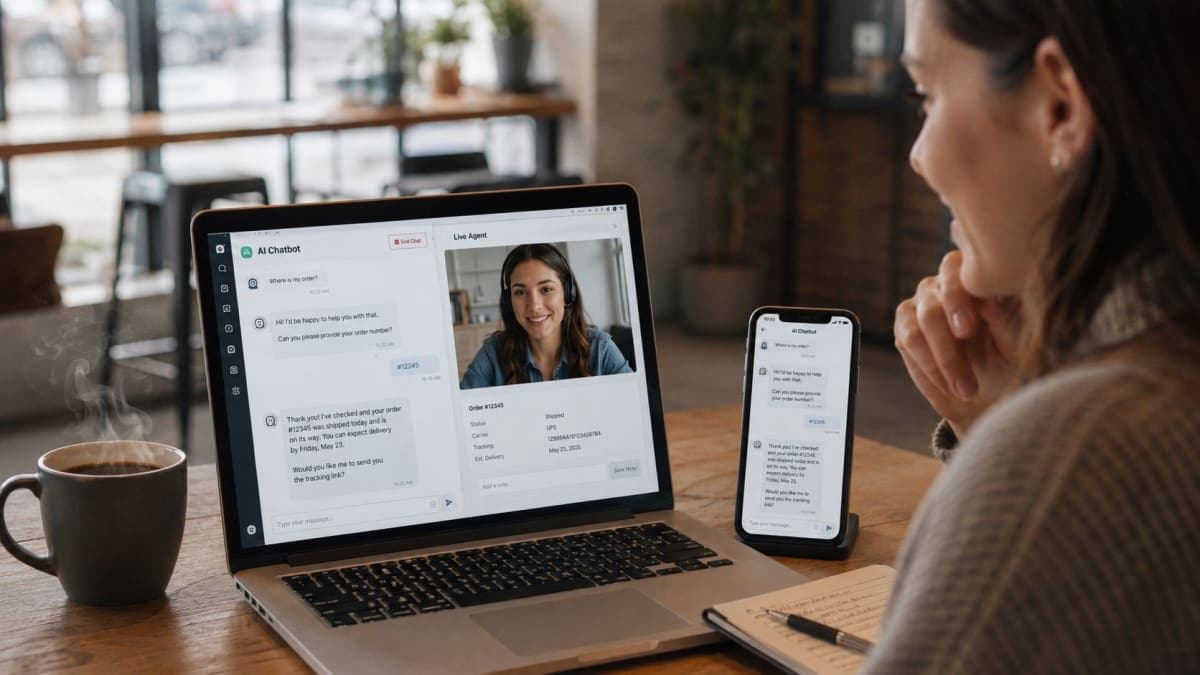
Outcome: Customer satisfaction held steady even as ticket volume doubled after a pricing change. The AI absorbed the volume; humans absorbed the empathy load.
A team doesn’t need to be massive to get results like these. In fact, we documented how a 10-person team cut overhead by 40% using AI automation—the same principles apply whether you’re a solo operator or part of a department.
Across these industries, the next stage of AI adoption is likely to involve more connected workflows rather than isolated content generation. Research may feed into reports, coding assistance may extend into testing and review, and customer-support systems may help route cases through several stages. The exact capabilities depend on the tools and safeguards available. In every case, the central question remains the same: which actions can be delegated safely, which results require verification, and which decisions need accountable human judgment?
How a Hybrid Worker’s Day Unfolds
To make the concept tangible, here’s what a typical morning looks like for a hybrid product manager in 2026. This isn’t a futuristic fantasy; it’s a composite of how several high performers I know structure their day.

text
8:30 AM – AI summarizes overnight emails and Slack messages, flags three urgent items.
8:45 AM – Human reviews the summary, adds missing context, and prioritizes the day.
9:00 AM – AI prepares a daily standup doc with yesterday's progress metrics pulled from Jira and GitHub.
9:15 AM – Human scans the doc, adjusts the narrative, and joins the standup ready to lead.
10:00 AM – AI drafts a product requirement document based on a voice memo the PM recorded the night before.
10:45 AM – Human edits the draft for tone, strategic alignment, and stakeholder-specific nuance.
11:30 AM – AI notetaker joins a cross-functional meeting; human focuses entirely on discussion.
12:00 PM – AI delivers a meeting summary with decisions and action items; human reviews and assigns owners.
The pattern is clear. AI absorbs the asynchronous information load; the human enters every interaction with a clearer mind and a stronger point of view. This daily rhythm isn’t about working less. It’s about spending more time in the high-leverage zone where judgment, creativity, and relationships live.
AI vs. Human: The Task Allocation Matrix
When teams first adopt the hybrid model, they often struggle to decide what to give the AI and what to keep. A simple matrix removes the guesswork.
Task | AI Leads | Shared (Human + AI) | Human Leads |
|---|---|---|---|
Data extraction & formatting | ✅ | ||
Initial draft of routine communications | ✅ | ||
Sentiment analysis of customer feedback | ✅ | ||
Editing for tone, brand voice, and sensitivity | ✅ | ||
Generating meeting summaries | ✅ | ||
Deciding product roadmap priorities | ✅ | ||
Writing code unit tests | ✅ | ||
Approving architectural decisions | ✅ | ||
Screening résumés for keywords | ✅ | ||
Conducting final interviews | ✅ | ||
Analyzing A/B test statistical significance | ✅ | ||
Designing creative campaign concepts | ✅ | ||
Handling a public apology or crisis response | ✅ |
This isn’t rigid. The matrix shifts depending on industry, regulation, and team maturity. But the principle holds: volume tasks lean left, value tasks lean right, and the messy, collaborative middle is where hybrid workers earn their reputation.
The 70–20–10 Hybrid Productivity Framework
As we observed teams that consistently outperform, a pattern emerged in how they split their effort. We started calling it the 70–20–10 Hybrid Productivity Framework.
70% AI Execution. The bulk of the initial work—data gathering, drafting, transcribing, coding scaffolding, analysis runs—is handed to AI. This isn’t because the work is unimportant. It’s because it’s time-intensive and pattern-based, exactly what machines do well.
20% Human Review. Every AI output gets a structured review. Hybrid workers check for factual errors, tone mismatches, missing context, and ethical flags. This phase is active, not passive. It’s where the human edits, redlines, and reshapes.
10% Critical Decisions. The final mile—choosing a strategic direction, deciding who to hire, determining if a sensitive communication should go out—sits entirely with the human. No AI gets a vote here.
Why does this ratio work? Because it protects the human’s cognitive bandwidth for the moments where it matters most. The AI does what feels like three hours of desk work. The human spends 45 minutes verifying and sharpening. Then they invest their clearest mental energy into the decision that will change the trajectory of a project. Most burned-out professionals have this ratio inverted. They spend 70% of their day on execution, and the decisions get made in a fatigued haze. The framework isn’t about getting lazier; it’s about getting more deliberate.
The 70–20–10 split is a practical editorial framework, not a universal scientific rule. The appropriate balance varies by profession, task complexity, risk, organizational policy, and the reliability of the AI system. Some workflows require extensive human verification; others may need very little review once they have been thoroughly tested and are demonstrably low-risk.
The objective is not to force every job into a fixed percentage. It is to reduce avoidable execution work while protecting the time and attention needed for quality control, judgment, and accountability.
A product manager I know applies this ratio to her weekly roadmap meetings. She uses AI to pull user feedback themes, competitive intel, and sprint metrics into a pre-read. Her review catches anything the AI misattributed. The meeting itself is pure decision-making. Her team has stopped spending meeting time staring at dashboards and started spending it debating trade-offs.
The Hybrid Worker Pyramid: From Execution to Leadership
To turn the 70-20-10 ratio into a growth path, we built a framework called Distrya’s Hybrid Worker Pyramid. It maps how professionals move from basic AI use to strategic mastery.

Level 1 – AI Execution
You consistently hand off repetitive, high-volume tasks to AI. Drafting, summarizing, and formatting become automated enough that you reclaim hours each week. At this stage, you’re learning to trust the tool without being careless.
Level 2 – Verification
You build a sharp instinct for fact-checking, tone alignment, and bias detection. The AI output rarely ships without your fingerprints on it. This is where many hybrid workers plateau, but it’s also where the most disastrous errors are caught.
Level 3 – Creative Enhancement
You stop using AI just for drafts and start using it to explore. The AI generates 50 taglines; your judgment picks the one that fits. It suggests three data-visualization styles; you choose the one that tells the clearest story. The relationship becomes genuinely collaborative.
Level 4 – Strategic Judgment
AI informs your decisions, but you own the call. You can run scenario models, red-team a strategy with an AI sparring partner, and still walk into the boardroom ready to defend a decision based on factors no model can weigh. This is where you become promotion material.
Level 5 – Ethical Leadership
You design the guardrails for others. You set AI usage policies, catch systemic biases before they scale, and teach junior colleagues not only how to prompt, but when not to. At this level, you’re shaping how your organization thinks about human-machine collaboration.
The pyramid isn’t about climbing as fast as possible. Most high performers spend a long time at Level 3 and 4, deepening their taste and contextual intelligence. The key insight: every level still requires the one below it. An executive who stops verifying AI outputs will eventually make a catastrophic error of judgment.
Common Mistakes Hybrid Workers Make
No workflow emerges without bruises. The most effective hybrid workers I’ve met talk openly about the mistakes they made early on.
Over-trusting AI outputs. There’s a phase—usually a few weeks in—where the AI seems so competent that you stop checking. Then it invents a citation, or confidently tells a client something dangerously wrong. Smart hybrid workers develop what we call Distrya’s AI Confidence Ladder, a five-level way to calibrate trust:

Level 1 – Verify Everything: You check every claim, number, and name. Used when the task is brand new or the AI model has just been updated.
Level 2 – Spot-Check Patterns: You verify a sample of outputs. If the pattern holds across several tasks, trust grows slightly.
Level 3 – Trust Structure, Verify Facts: You rely on the AI’s format and organization but still fact-check specifics manually.
Level 4 – Trust Facts, Verify Nuance: For well-practiced workflows where the AI consistently sources correctly, you focus your review on tone, alignment, and context.
Level 5 – Autonomous Execution with Audit Trail: The AI runs freely for low-risk, high-volume work, but logs everything. You review randomly and retrospectively.
Most mistakes happen when someone acts at Level 5 trust while the task actually requires Level 2. Climbing the ladder isn’t about blind faith; it’s about earned consistency.
Poor prompting. Vague inputs yield vague outputs. Hybrid workers learn to write prompts that include role, audience, format, and explicit constraints. They treat the prompt as a specification, not a wish.
No workflow integration. Adopting AI without changing how you work is like buying a dishwasher and still washing dishes by hand. If you don’t redesign the steps—brief, AI draft, human edit, final polish—you add overhead instead of removing it.
Ignoring context. An AI can write a pitch deck that’s factually accurate but tone-deaf to a client who just went through a merger. The hybrid worker’s edge is knowing things the data doesn’t capture: a tense relationship, a cultural taboo, an unspoken goal. Failing to inject that context is a fast way to lose credibility.
Treating AI Agents as Unsupervised Employees
A system that can execute multiple steps may appear more capable than a conventional chatbot, but the ability to take action does not guarantee that every action is appropriate.
An agent may follow an incomplete instruction, rely on incorrect information, misunderstand an exception, or make a change that produces unintended consequences. When connected to business systems, these errors can affect more than the quality of a written response.
Avoid granting broad permissions before the workflow has been tested. Start with limited access, define explicit boundaries, inspect important actions, and require approval for consequential operations.
Increase automation only when the workflow demonstrates reliable performance under realistic conditions. Keep a clear process for intervention and recovery.
The goal is controlled delegation, not blind trust.
The Hybrid Worker’s Verification Checklist
Before any AI-assisted work leaves your hands, run through these eight questions. I’ve seen this checklist catch errors that would have cost teams weeks of trust-rebuilding.
Did I define the task clearly for the AI, including format, audience, and constraints?
If the prompt was sloppy, assume the output is too.Have I verified all names, dates, statistics, and citations?
If a number matters, trace it to its source.Does the tone match the recipient and the situation?
Read it aloud. If it sounds off, it is.Is there any risk of bias or misrepresentation?
Could this output harm someone if taken at face value?Have I injected context the AI could not possibly know?
If not, the work will feel generic and detached from reality.Am I comfortable putting my name on this?
This single question eliminates most premature sends.If the task is high-risk, have I applied the Human Override Framework?
Don’t skip the three override questions when the stakes are real.Is there a human approval step for sensitive communications?
When in doubt, get a second pair of human eyes.If the AI can take actions, are its permissions limited to what the task requires?
Have I defined what happens if the system encounters missing information, conflicting instructions, or an unexpected result?
Can I inspect the important actions and correct the workflow if something goes wrong?
Does this task require approval from a responsible human before an external or consequential action is taken?
Print this. Stick it on your monitor. Use it until the questions become automatic.
Building Your Personal AI Co-Pilot Stack
The tool landscape in 2026 is noisy. Rather than chasing every new launch, hybrid workers curate a stack around how they actually think and work. The categories below aren’t about specific brand names; they’re about the jobs to be done.
Research & Knowledge Synthesis
Tools that ingest documents, URLs, or search queries and return cited summaries and contradiction analyses. Models like ChatGPT, Claude, Gemini, and Perplexity dominate here. The purpose is to collapse hours of reading into minutes of critical review.
Writing & Editing
Whether you need a draft of a tough email, a white paper structure, or a slide narrative, writing copilots are the most common entry point. Microsoft Copilot, Jasper, Notion AI, and the built-in assistants in Google Docs are all competing here. The key is to use them as a thinking partner, not a publisher. You talk through ideas with the AI, pull out the best bits, and rewrite in your voice.
Meeting Intelligence
Tools that capture transcripts, summarize decisions, and surface forgotten promises. Fireflies, Otter, and the AI features in Zoom and Teams fall into this bucket. The best setups integrate directly with project management tools so action items don’t evaporate.
Workflow Automation
For the repetitive digital chores—moving data between apps, sending reminders, generating recurring reports—platforms like Zapier or Make let hybrid workers build simple logic without coding. The goal isn’t to eliminate human involvement; it’s to stop you from manually doing something a machine should handle.
Coding & Technical Assistance
GitHub Copilot, Cursor, and other AI pair-programming tools have moved from suggestion engines to near-collaborators. They explain codebases, propose architectures, and write tests. The human sets the design constraints, reviews for security, and ensures the output fits the broader system.
Data Analytics
Instead of writing SQL queries from scratch, hybrid workers describe the question in plain language and let AI generate and explain the query. They still need to understand statistics to spot when the output misleads, but the grunt work shrinks.
Design & Creative Exploration
Generative design tools like Midjourney, DALL·E, and Adobe Firefly produce multiple concepts from a text description, helping designers explore wider idea spaces faster. The human curator’s taste becomes the differentiator.
Knowledge Management
A second brain that re-surfaces your old notes, connects ideas across projects, and answers questions based on your personal archive. Tools like Mem, Notion AI, or the retrieval features inside ChatGPT and Claude provide this. The AI helps you think across time.
AI Agents and Workflow Orchestration
A growing category of AI tools combines models with connected applications, data sources, and workflow automation. Depending on the implementation, these systems can help perform multistep tasks such as gathering information, organizing records, preparing reports, or coordinating work across applications.
Before choosing an agent-based tool, evaluate the specific tasks it supports, its integration requirements, access permissions, data-handling policies, reliability, monitoring capabilities, and approval controls.
Start with a narrow workflow that is easy to evaluate. Measure the quality of the result, the time saved, the frequency of errors, and the effort required for human supervision. Expand only when the benefits justify the additional complexity and risk.
A useful AI stack is not the one with the most products. It is the one that makes important work easier, more reliable, and easier to manage.
The stack doesn’t need to be complete on day one. Most hybrid workers start with a writing co-pilot and a meeting assistant, then add layers as they spot friction. The rule is simple: every tool must solve a real daily time sink, not add another inbox.
Skills Every Hybrid Worker Needs in 2026
The tools change. The underlying skills do not. Here’s what separates strong hybrid workers from people who merely use AI.
Critical Thinking. The ability to question an AI’s assumptions, spot logical gaps, and resist the seduction of a well-phrased but wrong answer. This is the meta-skill that makes every other skill work.
AI Literacy. You don’t need to understand transformers, but you do need to know what large language models are likely to be good at, where they fail, and how to construct a prompt that gets you closer to a useful output.
Verification Instinct. A reflex to cross-check names, dates, statistics, and sources before they leave your hands. The best hybrid workers treat an unverified AI output the way a journalist treats a single anonymous tip.
Communication. Writing with clarity, editing for tone, and structuring arguments remain squarely human strengths. AI can polish; it cannot feel the emotional weight of a sentence.
Prompt Engineering (as structured thinking). This isn’t about memorizing magic phrases. It’s about thinking with precision: defining the desired output, the audience, the format, and the constraints. Good prompters are just clear thinkers who write their thinking down.
Systems Thinking. The ability to see how a small AI automation in one part of a workflow affects downstream stakeholders. Hybrid workers design processes, not isolated tasks.
Learning Agility. The tool that’s dominant today might be an afterthought in eighteen months. The willingness to unlearn and relearn, without clinging to a favorite platform, determines long-term relevance.
Decision-Making Under Uncertainty. AI gives probabilities and patterns; it doesn’t handle ambiguity well. The hybrid worker’s job is to make a call when the data is incomplete and the stakes are high. That’s not codeable.
AI Workflow Design
The ability to break a process into clear steps, determine where AI can contribute, define expected outputs, and establish appropriate review and approval points.
Workflow design turns isolated AI experiments into repeatable processes. It also helps professionals identify unnecessary steps, measure outcomes, and improve reliability over time.
Agent Supervision and Evaluation
The ability to evaluate AI systems that use tools or take actions, monitor their performance, understand their permissions, and intervene when results are unreliable or inappropriate.
Professionals should know how to test a workflow against realistic examples, identify recurring failure patterns, and determine which tasks are safe to automate. As AI becomes more integrated into workplace systems, evaluating the entire process becomes as important as evaluating an individual answer.
These skills complement, rather than replace, critical thinking, verification, communication, and domain expertise.
For a fuller map of how to build these skills, our future of work 2026 analysis walks through what AI is actually changing—and what remains untouched.
What Employers Will Expect by 2026
Job postings are already shifting. The phrasing varies, but the signal is consistent: “We’re looking for someone who can work with AI, not someone who will be replaced by it.” That’s not a tagline; it’s a filter. McKinsey’s research on the future of work indicates that demand for social, emotional, and higher cognitive skills will rise alongside AI adoption.
By mid-2026, employers will expect:
AI literacy as a baseline. Not “knows Python,” but can articulate how they’ve used AI to speed up research, writing, coding, or analysis in their previous role. Expect behavioral questions that probe this.
Demonstrated problem-solving with AI. Candidates who explain how they designed a prompt to solve a messy, ambiguous business problem will stand out. Listing “ChatGPT” on a résumé is now as meaningless as listing “Google.”
Strategic thinking, not just speed. Hiring managers aren’t looking for people who use AI to do more busywork. They want people who use AI to buy time for deeper work. The interview question might be: “Tell me about a decision you made because AI freed up your schedule.”
Responsible AI use. Companies are terrified of lawsuits and reputation damage from unchecked AI outputs. They want people who can talk about verification, bias, and when not to use AI. The professional who says, “I didn’t use AI for this because the risk of error was too high” demonstrates more maturity than someone who AI-washes everything.
Workflow design ability. The most compelling hybrid workers don’t just use tools; they stitch them together into repeatable systems and teach others. That skill—making an entire team more productive through better AI integration—is becoming a promotion accelerant.
LinkedIn’s workplace data shows that roles requiring AI collaboration skills are growing faster than those requiring traditional technical skills alone. The hybrid worker isn’t a niche; it’s becoming the new floor.
From Tool Familiarity to Demonstrable Results
Professionals should be prepared to explain how they used AI to improve a real workflow, what responsibilities they retained, how they verified the results, and what limitations they encountered.
A strong example describes the original problem, the AI-assisted process, the human review steps, and the measurable outcome where one is available.
For instance, a candidate might explain how they created a research workflow that reduced preparation time while preserving source verification and human approval. The example is valuable because it demonstrates practical judgment, not simply familiarity with a tool.
Professionals should also be able to explain why they chose not to automate certain tasks. Recognizing when automation is inappropriate is part of responsible AI competence.
Frequently Asked Questions
What is a hybrid worker?
A hybrid worker is a professional who combines human judgment with AI tools to get work done faster and more thoughtfully. The term refers to cognitive partnership, not a mix of remote and in-office work.
Can AI replace professionals entirely?
No. AI can automate tasks—especially repetitive, pattern-based ones—but it cannot replicate accountability, ethical reasoning, deep contextual understanding, or genuine relationship building. The risk isn’t wholesale replacement; it’s that professionals who refuse to collaborate with AI will be outperformed by those who do.
What jobs benefit most from the hybrid worker model?
Any knowledge work that involves a mix of research, writing, analysis, coding, or design can benefit. Marketers, consultants, lawyers, doctors, engineers, financial analysts, HR professionals, and educators are all seeing significant productivity gains.
How are companies using AI as a co-pilot right now?
Companies are using AI to draft internal and external communications, summarize meetings, analyze data, write code, screen résumés, generate creative concepts, and handle tier-one customer support. In each case, a human remains in the loop for review and final decisions.
What's the difference between an AI copilot and an AI agent?
An AI copilot primarily assists a person by generating suggestions, answering questions, analyzing information, or helping complete tasks. An AI agent can go further by using tools and performing a sequence of actions toward a defined objective, subject to its capabilities and permissions.
For example, a copilot might draft a project update, while an agent-based workflow could potentially gather approved project information, prepare the update, and submit it for review.
The distinction is not absolute because products offer different levels of automation. Both approaches can make mistakes, and agent-based systems require particular care when they interact with external services or business records. Human approval should remain in place for actions whose consequences justify it.
How can someone become a hybrid worker?
Start by integrating AI into one specific task you already do repeatedly—summarizing research, writing a daily report, or drafting emails. Focus on learning how to prompt clearly, verify outputs rigorously, and gradually build a workflow where AI handles execution and you handle review and decisions. Expand to other areas over time and build a personal stack that fits your work.
Conclusion
The hybrid worker isn’t a label you earn once. It’s a daily practice of choosing where to speed up and where to slow down, where to trust the pattern and where to protect the exception. The professionals doing this best in 2026 didn’t get there by reading about AI trends. They started small, made plenty of errors, and built the muscle memory of collaborating with a machine that is fast, flawed, and endlessly useful.
If you take one thing from this, let it be this: AI has changed the economics of knowledge work, but it hasn’t changed the source of value. The professionals who thrive won’t be those who know the most or work the longest. They’ll be those who know when to delegate to machines and when to rely on uniquely human judgment. In 2026, competitive advantage belongs to people who can orchestrate both.
The rise of more capable AI assistants and agent-based workflows makes this principle even more relevant. As machines take on additional steps of research, drafting, analysis, and execution, the value of a professional increasingly depends on setting the right direction, recognizing exceptions, evaluating evidence, and taking responsibility for the outcome.
The most effective hybrid workers will not automate everything indiscriminately. They will build dependable workflows, grant only the permissions required, verify results in proportion to risk, and preserve human decision-making where the consequences demand it.
These capabilities work best alongside the human skills that support good judgment, effective collaboration, creativity, and trust. Read our related guide to human skills AI cannot replace in 2026 for a complementary perspective on the qualities that help professionals work effectively with increasingly capable AI systems.
The future of work is not simply about using more AI. It is about combining technological capability with sound judgment, responsible execution, and meaningful human contribution.
“The future of work isn’t Human vs AI. It’s Human + AI + Better Judgment.”
Start with one task tomorrow morning. Use AI to clear the underbrush, then bring everything you’ve got to the part only you can do. If you’re building AI skills, continue with our AI Upskilling Roadmap for 2026. If you’re planning your career, read Future of Work 2026: What AI Is Changing and What It Isn’t. And if you’re looking for practical business results, see how a 10-person team reduced overhead by 40% using AI automation.
Last updated: July 2026. This guide is reviewed regularly to reflect changes in AI tools, workplace trends, and enterprise adoption.