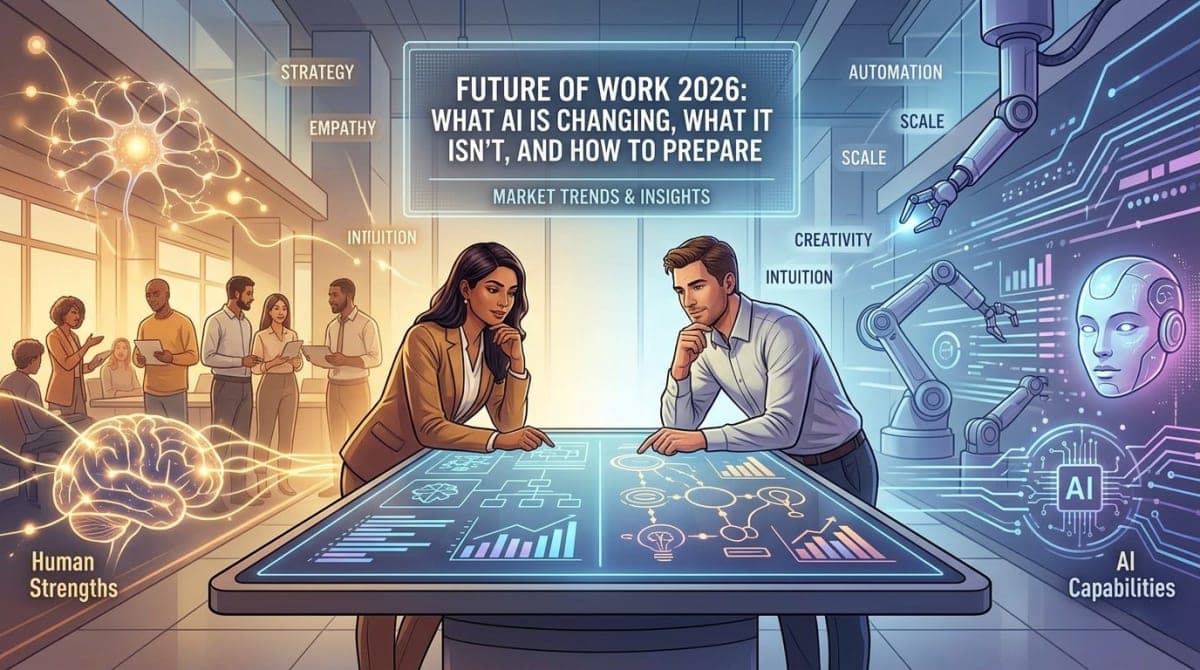
TL;DR: By 2026, the AI conversation has matured from pure automation panic to a grounded focus on operational maturity. AI tools now let solopreneurs match enterprise output and small teams slash overhead by 40%. But here's what's not in the headlines: strategic intuition, complex negotiation, and genuine human connection remain completely irreplaceable. This article maps the new hybrid frontline, explains the quiet shift from AI prototypes to reliable production tools, identifies the careers and skills staying firmly human, and walks you through a practical, step-by-step roadmap to adapt—without losing what makes your work actually matter.
1. Introduction: The 2026 Reality Check
Let's skip the breathless predictions. You've heard them all already.
If 2023 was the year you first played with ChatGPT and felt the ground shift beneath your feet, and 2024 was the year every company scrambled to add "AI-powered" to their pitch deck, 2026 looks refreshingly different. The hype hangover has cleared. The panic-tweeting about mass job obsolescence has quieted. What's left is something far more practical—and honestly, more interesting.
We've entered the era of AI integration and operational maturity. The question in boardrooms and coffee shops alike isn't "What can AI do?" anymore. It's "How do we actually use this stuff in our daily work without breaking the things that already function perfectly fine?"
According to the World Economic Forum's Future of Jobs Report 2025, technology adoption remains a primary driver of business transformation—but here's the nuance that gets missed: the conversation has shifted from displacement to task reconfiguration. We're not watching robots take jobs wholesale. We're watching the granular, often tedious parts of our daily responsibilities get quietly automated away. The parts that require judgment, creativity, and genuine human warmth? Those are sticking around—and their value is climbing fast.
This article isn't about dystopian futures or uncritical techno-optimism. It's a grounded look at what's actually changing, what stubbornly refuses to be automated, and the concrete steps you can take to build a career and a business that thrive in the reality of 2026.
2. What AI Is Changing: The Shift in Efficiency & Scale
The most tangible shift in 2026 isn't flashy. You won't see it in a demo video. It's the quiet, relentless reduction of friction. AI has fundamentally rewritten the economic math of effort, and the biggest winners are the ones who were previously outgunned.
The Solopreneur Explosion
A single freelance strategist now fields a marketing operation that would have required a copywriter, a graphic designer, a media buyer, and a project manager in 2022. This isn't science fiction—it's happening right now, and it's reshaping entire industries from the ground up.
The "one-person unicorn" is real. Individual creators, consultants, and boutique founders are stacking AI co-pilots to handle the operational sludge that used to eat 80% of their time: drafting campaign variants, generating on-brand visual assets, managing client communications pipelines, handling bookkeeping queries. What's left over is pure strategic and creative energy. The solopreneur isn't doing five people's jobs; they're doing their job, and the drudgery has been automated into the background.
But here's the catch: the tool stack matters enormously. Picking the wrong tool is worse than picking none at all—it introduces complexity without payoff. If you're building or scaling a solo operation, understanding the landscape of essential AI tools for solopreneurs is no longer optional. It's the price of entry.
Team Automation & Overhead Reduction
For established small and medium businesses, the impact shows up as cold, hard margin.
We're long past the era of "hey, we added a chatbot to our website." In 2026, deep workflow automation is the real game. AI agents now parse incoming invoices, cross-reference them against project budgets in real time, and flag anomalies before a human ever opens a spreadsheet. Tasks that previously consumed a part-time bookkeeper and a weekly review meeting now resolve silently in the background. The operational lean that used to require an expensive ERP implementation and a six-month consulting engagement can now be assembled from modular, AI-native tools.
The numbers back this up. Real businesses are seeing real structural change. A compelling case study shows how a 10-person team cut overhead 40% using AI automation by building a custom internal tool that connected their CRM, billing, and project delivery systems into a single intelligent backbone. Not offshoring. Not layoffs. Just smarter workflow architecture. This lean operating model—not cost-cutting theatrics—is the genuine driver of modern SME profitability.
Customer Operations & Hybrid Frontlines
The customer service desk of 2026 is a hybrid organism, and the division of labor is remarkably clean.
AI handles volume. Humans handle complexity.
Generative AI agents now deflect upwards of 70% of Tier-1 support tickets—password resets, order tracking, basic troubleshooting—instantly and without queue wait times. This has fundamentally changed the nature of the human agent's job. They're no longer running through scripts. They're high-touch specialists who parachute in for escalated, emotionally charged, or strategically vital accounts. A customer who's just lost a major shipment doesn't want a polite bot; they want a human who can make a judgment call, authorize a remedy, and genuinely hear the frustration.
The seamlessness of the handoff between bot and human is where companies win or lose. When a conversation escalates and the human agent has zero context—forcing the customer to repeat everything—trust evaporates instantly. As more businesses navigate this tricky terrain, the interplay between AI customer service chatbots vs human agents has become a deciding factor in customer retention and lifetime value. Get the handoff wrong, and no amount of chatbot efficiency will save the relationship.
3. From Prototype to Production: The Technical Reality
Here's a quiet truth that the 2024-2025 "vibe coding" hype wave didn't prepare anyone for: a prototype is not a business tool.
Vibe coding—the joyful practice of describing an app idea to a large language model and watching functional code materialize—was genuinely revolutionary. It democratized software creation. Non-technical founders built demos that would have cost $50,000 just a few years prior. But then reality set in.
A production-grade internal application isn't a demo. It needs security compliance, predictable outputs, database integrity, and consistent uptime under concurrent users. It can't hallucinate a client's financial figure. It can't quietly break when an API endpoint changes. The journey from an exciting prototype to a boring, reliable, indispensable business tool is the defining technical challenge of 2026.
This transition requires wrapping brilliant-but-erratic AI cores in layers of deterministic logic: guardrails, structured output formatting, API orchestration, and testing pipelines that would feel familiar to any traditional software engineer. The process of scaling from vibe coding to production tools is where the real engineering work lives. It's unglamorous. It doesn't make for viral tweets. But it's the difference between a cool internal experiment that breaks under ten simultaneous users and a boring-but-critical tool that processes thousands of transactions without flinching.
4. What AI Isn't Changing: The Unreplaceable Human Element
Amid all this acceleration, something counterintuitive has happened. The premium on distinctly human attributes hasn't gone down. It has soared.

In a content environment flooded with competent-but-soulless AI synthesis, the bottleneck has shifted. The scarce resource is no longer output volume. It's judgment, accountability, and genuine interpersonal warmth.
The High-Value Human Skillsets
The market is sending an unmistakable signal. When you strip away the tasks that AI can execute, here's what's left—and here's what's commanding a premium:
Empathy and Emotional Regulation: De-escalating a terrified client. Motivating a burned-out team through a difficult quarter. Reading a room and adjusting your approach in real time. No language model, however sophisticated, can genuinely care about the outcome.
Strategic Intuition: The most consequential business decisions are made with incomplete information. If the data were clean and complete, the decision would be automatable. The C-suite exists precisely because the data is never clean and complete. Making a high-stakes call with ambiguous inputs and owning the consequences—that's a human act.
Complex Negotiation: Multi-party deals hinge on unspoken dynamics, non-verbal cues, relationship history, and trust. An AI can optimize a contract clause. It cannot read a tense silence across a negotiating table.
Cross-Disciplinary Synthesis: The creative leap that connects an insight from behavioral psychology to a problem in supply chain logistics—an intellectual move no current AI can independently originate. This is pattern recognition across domains that don't normally touch.
When you look at these skills collectively, a clear pattern emerges. Deep strategic decision-making consistently demonstrates that human skills beat AI in any arena requiring genuine responsibility for an outcome. Accountability cannot be automated.
Career Paths Insulated from Automation
The most resilient careers share a common thread: they're high-touch, high-variability, or both.
We see this durability in professions that demand fine motor dexterity and adaptive physical problem-solving—advanced electricians, surgical nurses, physical therapists. A robot cannot rewire an unpredictable 1940s building's electrical system or adjust a rehabilitation exercise in real time based on a patient's subtle wince of pain.
We also see it where legal accountability or deep human trust are non-negotiable: judges, clinical psychologists, crisis negotiators. The cost of an AI error in these fields isn't a misformatted email; it's a catastrophic legal precedent or a human health emergency.
A thorough exploration of these roles reveals a consistent truth: any job where the "doing" involves unpredictable physical interaction with the messy real world remains robustly insulated. For anyone mapping out a long-term career path, understanding these 7 AI-proof careers offers a clear-eyed lens on where durable professional value actually lives.
5. Actionable Roadmap: How to Prepare for the Future of Work
Reading about trends is easy. Reconfiguring your daily work is hard. Here's a concrete, step-by-step plan you can start executing this week—no massive budget or technical degree required.
Step 1: Audit Your Workflows with a Task-Level Lens
Spend one week documenting every micro-task you perform. Yes, every single one. Open a simple spreadsheet with two columns: Routine & Digital and Variable & Physical.
Answering the same client FAQ for the tenth time? Routine and digital. That's your automation target. Mediating a tense disagreement between two stakeholders about project priorities? Variable and deeply human. That's where your energy should be concentrated. Most people discover that 30-40% of their daily tasks fall squarely into the automation-ready bucket. The goal isn't to eliminate those 30-40%—it's to reclaim them for higher-value work.
Step 2: Build an AI/Human Hybrid Skillset
Stop thinking of yourself as a "doer" and start operating as an "architect" and "editor." This is a mental shift with enormous practical consequences.
Being an architect means learning to scope a project for an AI collaborator: defining clear boundaries, specifying the output format you need, anticipating edge cases. Being an editor means rigorously critiquing and refining what the AI produces. Your value is no longer in generating the first draft—a machine can do that in seconds. Your value is in the 20% refinement that makes the output genuinely excellent, strategically sound, and appropriate for the specific context.
Step 3: Focus on Data and Prompt Literacy
Here's something nobody tells you: an AI model is only as good as its context window.
If you feed a model messy, disorganized company data, you get messy, unreliable outputs. The unsung hero skill of 2026 is information architecture—learning how to structure your meeting notes, process documentation, and client histories so they can be efficiently ingested by AI tools. This isn't glamorous work, but it's the difference between an AI assistant that constantly misunderstands you and one that feels almost telepathic. Organize your internal knowledge base as if a brilliant but literal-minded new hire will need to consult it. That new hire is AI, and the quality of its work depends entirely on the quality of its inputs.
6. Conclusion: Volume for Machines, Meaning for Humans
The future of work in 2026 isn't a dramatic showdown between humans and machines. It's a continuous, granular re-bundling of tasks, happening quietly inside thousands of companies and solo operations every single day.
The people and organizations winning in this environment share a common trait: they've stopped asking what AI can replace and started asking what AI can handle—so they can focus on what only they can do. The technology handles the volume. You handle the meaning. That's the deal, and it's a remarkably good one for anyone willing to adapt.
The tools will keep evolving at a blistering pace. But the principle holds steady: every hour you reclaim from routine digital drudgery is an hour you can invest in strategic thinking, genuine human connection, and the kind of creative synthesis that no model can replicate. Don't spend 2026 worrying about being replaced. Spend it getting ruthlessly intentional about where your irreplaceable value actually lives.
Frequently Asked Questions
How is AI actually changing the workforce in 2026?
AI is changing the workforce through task-level automation, not wholesale job replacement. Routine digital tasks—data entry, report drafting, Tier-1 customer support—are being quietly absorbed by AI agents. This shift is freeing human workers to focus on higher-value activities like strategic planning, complex negotiation, and relationship management. The net effect is a reconfiguration of roles, not an elimination of them.
What skills are safe from AI automation?
Skills that remain firmly human include empathy and emotional regulation, strategic intuition in high-stakes ambiguous situations, complex multi-party negotiation, and cross-disciplinary creative synthesis. Any skill requiring genuine accountability, physical dexterity in unpredictable environments, or deep interpersonal trust is insulated from automation. Machines can optimize a contract clause; they can't read a tense silence across a negotiating table.
Which careers are most AI-proof in 2026?
The most resilient careers combine high-touch human interaction with high-variability physical or cognitive demands. Examples include surgical nurses, physical therapists, advanced electricians, clinical psychologists, judges, and crisis negotiators. These roles share a common trait: the cost of an AI error is catastrophic—whether legally, medically, or emotionally—which keeps the final decision-making authority firmly in human hands.
Can a solopreneur really compete with large companies using AI?
Yes, and it's happening right now. Solopreneurs are stacking AI co-pilots for marketing, design, coding, and back-office operations to match output levels that previously required teams of five or more. The key is selecting the right tool stack. Picking the wrong tools introduces complexity without payoff, while a well-chosen stack eliminates operational bottlenecks and frees up pure strategic and creative energy.
How can small businesses reduce overhead with AI automation?
Small businesses are seeing 30-40% overhead reductions by automating workflows that were previously manual: invoice parsing, budget cross-referencing, anomaly flagging, and client communications routing. Real-world case studies show teams of ten building custom internal tools that connect CRM, billing, and project management systems into a single intelligent backbone—no offshore teams or layoffs required.
What is vibe coding, and is it ready for business use?
Vibe coding is the practice of describing an app idea to a large language model and having functional code generated automatically. While revolutionary for prototyping, vibe-coded applications aren't ready for production use without significant hardening. Production-grade tools need security compliance, predictable outputs, structured error handling, and consistent uptime—none of which a raw prototype provides. The journey from prototype to reliable business tool is the defining technical challenge of 2026.
How do AI customer service chatbots and human agents work together?
In the 2026 hybrid frontline, AI handles volume (Tier-1 issues like password resets and order tracking) while human agents handle complexity (escalated, emotionally charged, or strategically critical accounts). The critical success factor is seamless handoff. When a human agent receives a transferred conversation with full context—no repeated information—trust is maintained. Companies that get this handoff right see measurable improvements in retention and lifetime value.
How do I start preparing for the AI-driven workplace today?
Start with a one-week workflow audit: document every micro-task and sort them into "routine/digital" (automation-ready) and "variable/physical" (human-essential) categories. Then, build an AI/human hybrid skillset by learning to act as an architect (scoping projects for AI) and editor (refining AI outputs). Finally, invest in data and prompt literacy—structuring your internal knowledge so AI tools can ingest it effectively. Most professionals find they can reclaim 30-40% of their workweek for higher-value activities.
Is AI going to replace human jobs entirely?
No. The data from 2025-2026 consistently shows task reconfiguration, not job elimination. While some routine-heavy roles are contracting, new roles in AI orchestration, prompt engineering, and hybrid system design are expanding. The broader pattern is a shift in what humans spend their time on—away from repetitive execution and toward judgment, creativity, and interpersonal connection.
About the Author
This article was produced by the Distrya Team, a group of business automation specialists, digital strategists, and workforce researchers committed to helping professionals and small businesses adapt to the rapidly evolving relationship between artificial intelligence and human work. Our insights are drawn from practical implementation, real-world business challenges, and emerging industry trends—not just theoretical concepts.
The article was reviewed and edited by Suman Basnet, Founder of HamroLink, a platform dedicated to making digital transformation accessible for entrepreneurs and small businesses. With extensive experience in digital strategy, content development, and technology adoption, Suman focuses on translating complex technological advancements into practical solutions that drive measurable business growth.
Ready to audit your own workflows? Start with our guide to essential AI tools for solopreneurs and see what 30-40% of your week could look like when the routine work runs itself.