Most solopreneurs aren’t limited by skill. They’re limited by bandwidth. The modern internet rewards consistency, speed, distribution, and rapid iteration—all things traditionally dependent on teams. That used to be a structural disadvantage for solo operators. AI changed that equation.
Today, a single founder can handle content creation, customer support, design, research, automation, and operations with workflows that previously required a dedicated team. The internet used to reward scale. Now it rewards speed. And AI compresses the distance between idea and execution.
This isn’t a list of “cool AI tools.” It’s a practical system—an operational blueprint for AI-native solopreneurs. You’ll find tools, real workflows, cost breakdowns, maintenance habits, and the connective logic that prevents your stack from becoming expensive noise.

What Changed for Solopreneurs in 2026?
In 2026, the competitive advantage is no longer access to tools. Everyone has tools. The advantage is workflow design and execution speed.
Several forces converged:
AI agents moved from hype to practical orchestration. They plan, self-correct, and route tasks without hand-holding.
Software costs collapsed—the average full AI stack for a solo founder now runs under $300/month while delivering the throughput of a junior team.
Distribution became asynchronous. AI repurposes content across channels in parallel. You publish everywhere in the time it once took to write a tweet.
Solo SaaS and AI-first micro-businesses proved that one person can build, market, and support profitably without funding.
Content velocity competition means sustained high-quality output wins. AI makes that possible for a team of one.
The result? A solo founder in 2026 doesn’t just work faster. They operate with a different operational gravity. The question is no longer “Can I do this alone?” It’s “How do I design my system to outrun funded teams?”
Why AI Is the Ultimate Leverage Tool for Solopreneurs
Most solopreneurs fail because of execution bottlenecks. Context switching is the hidden killer. According to productivity research, it takes an average of 23 minutes to refocus after a single interruption. For a solo founder juggling marketing, sales, support, and ops, that’s a full day lost each week to switching costs alone.
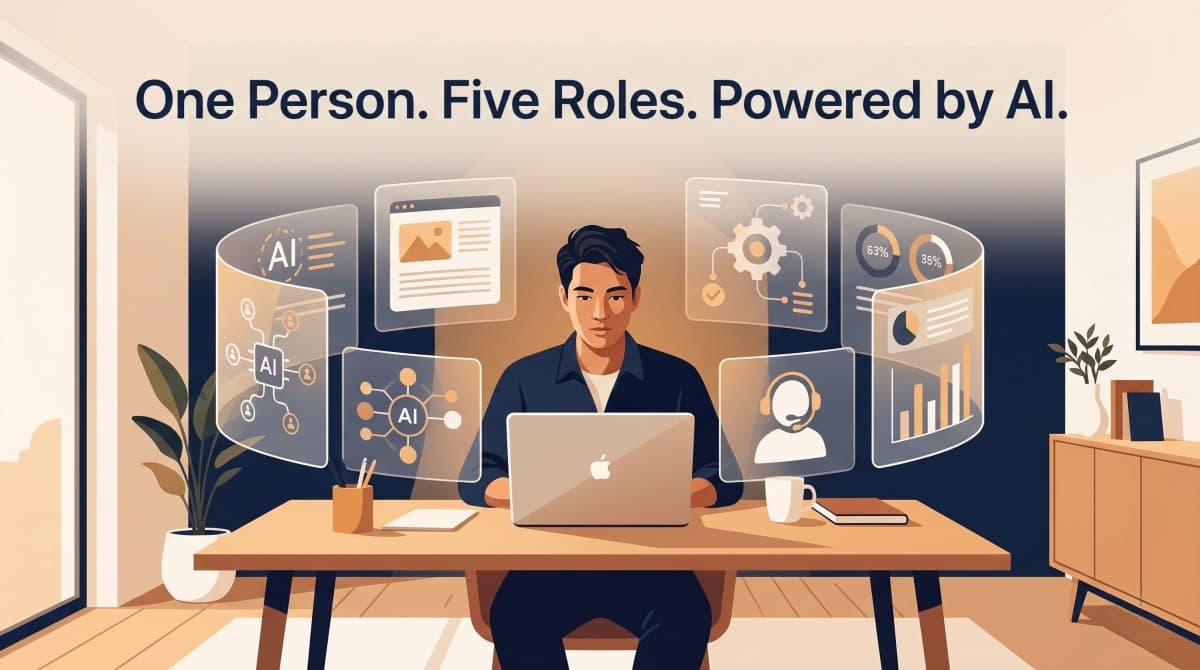
AI gives you digital employees:
AI writer = content assistant that drafts, edits, and repurposes across channels.
AI chatbot = 24/7 support rep that escalates only what needs you.
Automation platform = operations assistant moving data between tools while you sleep.
AI designer = junior designer for brand-consistent graphics in minutes.
AI researcher = analyst summarizing markets, competitors, and trends with citations.
The solopreneur’s real cost isn’t money—it’s cognitive load. And AI reduces that friction at every layer.
Pro Tip: The goal is not maximum automation. The goal is operational clarity. Three reliable automations outperform fifteen unstable ones. Most founders discover the hidden cost of automation only after workflows silently fail for days. Reliability beats volume.
The Best AI Stack for a One-Person Business
This is your core operating system. For each tool: what it does, why it matters, use cases, workflow, and pricing. I’ve included specific metrics and failure points to make this lived-in, not theoretical.
Best AI Tools for Solo Founders: Writing & Content
Content remains the primary growth lever. AI writing tools solve throughput without sacrificing voice—if used as accelerators, not replacements.
Primary Tool: Clarity Writer
Built for founders needing SEO-optimized drafts quickly. Compresses a 6-hour process (research, outline, draft, SEO tweak, formatting) into roughly 45 minutes of focused editing time.
Why solopreneurs need it: The gap isn’t writing speed; it’s the entire production pipeline from research to publish-ready draft.
Workflow:
Input keyword and audience.
Refine AI-generated outline.
Generate SEO-optimized draft.
Inject personal experience, specific stories, and opinions—this is what outranks generic AI content.
Generate social variants.
Pricing: Subscription tailored for solo operators.
Alternative tools: ChatGPT, Claude, Jasper.
Affordable AI Stack for Startups: Automation
Primary Tool: Zapier
Connects apps and moves data automatically. A lead captured should automatically ripple through CRM, email, and task manager without your fingers touching it.
Why solopreneurs need it: Manual data transfer is invisible time drain. One HubSpot study found that businesses responding to leads within 5 minutes are dramatically more likely to convert. Automation makes that possible while you sleep.
Workflow: Typeform submission → HubSpot contact → Gmail welcome email → Slack alert → Notion task.
Pricing: Free tier available, paid plans ~$20/month.
Alternatives: Make (more visual), n8n (self-hosted).
Operational Reality: A prototype that works in a demo is not a reliable business system. Most solopreneurs discover hidden costs only after workflows silently fail. That transition—adding monitoring, fallback paths, and team permissions—is detailed in this guide on scaling AI prototypes into real business tools. If workflows touch customers or revenue, this isn’t optional reading.
Can AI Run a One-Person Business? Support & Research
Customer Support: Tidio AI
Handles first-line queries 24/7, escalating only complex edge cases. Feed it your actual language so it mirrors your tone—then customers often can’t distinguish it from you for tier-1 questions.
Pricing: Free tier for basic chat; AI features ~$29/month.
Research & Productivity: Perplexity & Notion AI
Compresses hours of market analysis into cited briefs. Perplexity acts as an always-on analyst; Notion AI handles internal docs.
Time-to-value: A market landscape query that would take 2–3 hours manually finishes in 8 minutes with Perplexity.
Design: Canva AI
Maintains brand-consistent visuals across five channels without a freelancer. Pro plan ~$13/month.
Video Repurposing: OpusClip
Turns one 30-minute video into 5–8 formatted short clips in minutes. ~$19/month.

A Real AI Workflow for a Solo Founder
Scenario: Launching a new service. Here’s the actual stack in motion, with time markers:
Market Research (Perplexity) – 8 min vs 2–3 hrs.
Draft Content (Clarity Writer) – 45 min editing vs 4–5 hrs.
Create Visuals (Canva AI) – 20 min vs 1.5 hrs or freelancer wait.
Lead Capture Automation (Zapier) – built once, runs forever.
Support Configuration (Tidio AI) – populate with FAQs, train tone.
Repurpose Video (OpusClip) – 5 min review vs hours of editing.
Total time investment: ~2–3 hrs. Equivalent output without AI: 15–20 hrs + coordination. This is how solo operators compete with companies 10x their size.
The SOLO Framework: How to Think About Your AI Stack
After working with hundreds of solo founders, a pattern emerged. I codified it as the SOLO Framework:
S – Simplify: Cut tasks that don’t drive revenue or value.
O – Orchestrate: Connect tools so data flows without manual hand-offs.
L – Leverage: Use AI for what you can’t scale alone—24/7 support, simultaneous repurposing, instant research.
O – Optimize: Weekly 15-minute review of what’s working, what’s breaking, and where human intervention is still needed.

New Micro-Concept: Workflow Debt
The hidden operational complexity caused by too many disconnected automations. Each new tool that doesn’t integrate adds debt. The interest payment is your attention. Reduce workflow debt aggressively, just like financial debt.
Why Most Solopreneurs Will Use AI Wrong (The Contrarian Take)
Most solopreneurs will buy AI tools and still fail to scale. Why? They’ll chase tools instead of systems. They’ll over-automate shallow tasks while ignoring revenue-driving workflows. They’ll copy competitors’ stacks without understanding their own operational architecture.
Common failure patterns:
Tool addiction: 12 subscriptions, 4 actually used.
Prompt-chasing: Endlessly tweaking prompts instead of building reliable pipelines.
Shallow content: Publishing AI drafts without experience signals, guaranteeing they never rank.
Zero maintenance: Assuming automations run forever, then discovering a silent failure 10 days later.
The future belongs to founders who can design systems faster than competitors can hire teams. Not those with the most AI logos in their tech stack.
What AI Still Can’t Do Well
To balance the picture, there are areas where AI falls short—and understanding them prevents operational mistakes:
Emotional nuance in complex customer conflicts.
Brand intuition—knowing when a tone or visual feels “off” for your audience.
Strategic prioritization under extreme uncertainty.
Relationship building that requires genuine trust transfer.
Complex negotiation where creative deal structuring matters.
Use AI for what it’s brilliant at (scale, speed, consistency). Protect your human edge for these domains. The best solo operators are not “AI-managed”—they’re AI-augmented.
The Minimal AI Stack Under $100/Month
For bootstrapped founders, here’s a lean stack covering 80% of needs:
Tool | Function | Cost |
|---|---|---|
ChatGPT Plus | General writing, brainstorming | $20 |
Canva Pro | Visual design | $13 |
Zapier Starter | Core automations (20 Zaps) | $20 |
Tidio Starter (Chat) | Live chat & basic automation | $0–29 |
Perplexity Pro | Cited research | $20 |
Total | $73–102 |
Start here. Master integrations. Only upgrade when a bottleneck is painfully obvious.
How Solopreneurs Automate Their Business: The First 3 Automations
Content Publishing Pipeline: Clarity Writer → Canva → Social Scheduler. One asset spawns blog, email, and social.
Lead Capture → Welcome Sequence: Form → Zapier → CRM → email. Immediate response, zero manual work.
Support Triage: Tidio AI → Knowledge Base → Your email for escalation only. 70–80% of queries handled automatically.
For a deeper audit of high-ROI processes, see 7 business processes you should automate first.
AI Workflow Examples for Small Businesses: Implementation Roadmap
Phase 1 (Week 1): Set up writing tool, basic chatbot, Perplexity research.
Phase 2 (Week 2-3): Build first Zap, create brand kit, set up repurposing.
Phase 3 (Month 2): Review chatbot transcripts, cut failing automations, add monitoring, expand to video if needed.
This phased approach prevents tool fatigue. For a complete ROI-focused adoption path, see this roadmap.
Maintaining an AI System Over Time
AI stacks are living systems, not set-and-forget. Weekly maintenance habits:
Review automations: Check for failed runs, lag, or unexpected behavior.
Update prompts and knowledge bases as your offerings evolve.
Monitor costs: API usage can creep; set alerts.
Reduce workflow debt: Remove or consolidate tools that aren’t pulling their weight.
Adapt to API changes immediately—a broken integration can cascade.
Aim for operational maturity, not tool accumulation.
Who This Isn’t For
This stack is ideal for solo operators and micro-teams. It’s not for heavily regulated enterprises needing air-gapped AI, large support teams with complex workforce management, or those needing custom AI infrastructure. If you’re a founder unwilling to spend a few hours monthly on maintenance, this approach won’t work.
Frequently Asked Questions (mid-article and end)
Can AI really replace a small team?
AI replaces tasks, not judgment. It handles content drafting, first-line support, data entry, and design production at scale. The founder still directs vision, strategy, and high-stakes relationships. It’s about throughput, not headcount.
How much time do solopreneurs actually save?
Aggregated observations from solo founders show that an integrated AI stack can reclaim 15–25 hours per week—time previously lost to context switching, manual data movement, and repetitive creation.
What's the best AI stack for a solopreneur in 2026?
The optimal AI stack depends on your business model, but a proven foundation includes Clarity Writer for content, Zapier for automation, Canva AI for design, Tidio AI for customer support, and Perplexity for research. For video-focused businesses, add OpusClip. The stack that works best is the one you actually integrate — a small set of deeply connected tools consistently outperforms a large collection of disconnected subscriptions. Start with the function that creates your biggest bottleneck, solve it completely, then expand.
How much does an AI stack cost for a solo founder?
A comprehensive AI stack covering content, support, design, automation, and research typically costs 120–255permonth.Aminimalbutfunctionalstackcanbeassembledfor120–255permonth.Aminimalbutfunctionalstackcanbeassembledfor73–102 per month using ChatGPT Plus, Canva Pro, Zapier Starter, Tidio chat, and Perplexity Pro. By comparison, the equivalent human-delivered output — part-time content writer, junior designer, support staff, and analyst — would cost $5,000–11,000 monthly. The key is to measure cost against hours reclaimed, not just against zero.
How do I avoid AI tool fatigue as a solopreneur?
Tool fatigue is real and often kills AI adoption before it delivers results. Prevent it by starting with a minimal stack of 3–4 deeply integrated tools rather than 12 disconnected ones. Add a new tool only when the absence of that tool is demonstrably costing you more time than the integration effort required. Review your subscriptions quarterly and cut anything not actively pulling its weight. The goal is operational clarity, not tool accumulation. Think of unused tools as workflow debt — they cost attention even when you're not logging in.
Can I run customer support entirely with AI as a solo founder?
You can handle 70–80% of support volume with AI, but not 100% — and you shouldn't try. AI excels at tier-1 queries: pricing questions, refund policies, order status, basic troubleshooting. It works best when fed your actual language from real customer conversations, not generic FAQ text. However, AI still struggles with emotionally charged situations, complex edge cases, and relationship-sensitive conversations. The winning setup is AI for first response and triage, with a clear escalation path to you for the exceptions. This captures the time savings without sacrificing trust.
How often should I update my AI workflows and tools?
Treat your AI stack as a living system, not a set-and-forget installation. Weekly: review automation logs for silent failures, monitor cost-per-run, and check that integrations haven't broken. Monthly: update knowledge bases and prompt libraries as your offerings evolve, and evaluate whether each tool is still earning its place. Quarterly: reassess the broader tool landscape — AI tools evolve fast, and a better option may have emerged. The maintenance overhead is modest (roughly 1–2 hours per month) but skipping it leads to silent decay and eventual workflow collapse.
What's the difference between AI tools and AI agents for solopreneurs?
AI tools perform single tasks when prompted: write a draft, generate an image, answer a question. AI agents orchestrate multi-step processes with some autonomy: they plan, use multiple tools, self-correct, and route tasks without continuous human hand-holding. For solopreneurs, agents represent the next level of leverage — they can research a topic, draft content, generate visuals, and schedule publication across channels as a connected sequence, not a series of separate commands. In 2026, the most efficient solo operators are shifting from tool-by-tool workflows to agent-orchestrated systems.
Final Thoughts
AI is not replacing entrepreneurship. It’s compressing the operational gap between small teams and large ones. The modern solopreneur is becoming less like a freelancer and more like an orchestrator of AI systems.
The future belongs to founders who can design systems faster than competitors can hire teams.
Start with one bottleneck. Solve it completely with a reliable AI workflow. Prove the value. Then layer on the next piece. The winners aren’t those with the most tools. They’re the ones who build the most resilient, integrated systems—and then execute relentlessly.
Your move: Don’t try to automate everything this week. Pick the time drain that hurts most: content creation, support, admin, lead follow-up. Use the relevant tool from this guide. Run it for a week. Measure the hours returned. Then build the next layer. That’s how modern solopreneurs scale without hiring prematurely.
Ready to build your content engine? Start with Clarity Writer and publish your first AI-assisted, SEO-optimized article this week.