
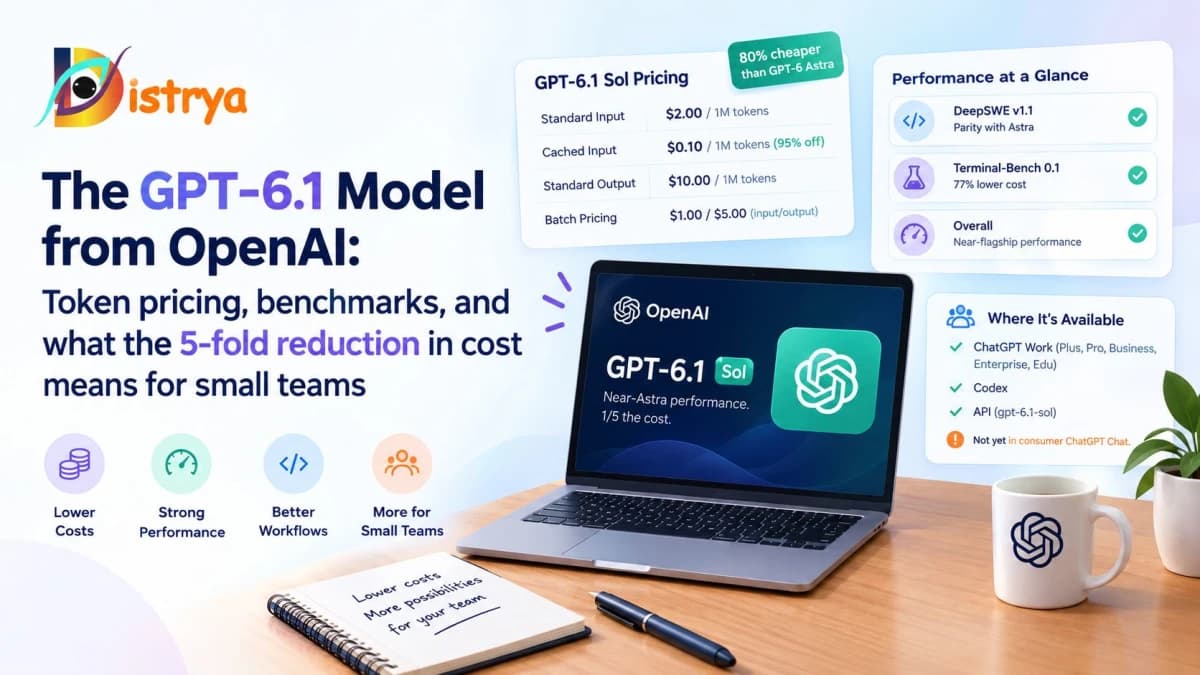
At OpenAI's DevDay in 2026 the pricing for GPT-6.1 and token discounts was announced
At DevDay, which took place in San Francisco on September 29, 2026, OpenAI launched GPT-6.1 Sol. The main announcement was that this new model achieves performance which is almost equal to that of GPT-6 Astra — OpenAI's most powerful model — yet costs only one-fifth of the price.
An overview of GPT-6.1 Sol pricing
Pricing Tier | Cost |
|---|---|
Model ID |
|
Standard Input | $2.00 per 1M tokens |
Cached Input | $0.10 per 1 million tokens (95% discount) |
Standard Output | $10.00 per 1M tokens |
Batch Pricing | $1.00 for input and $5.00 for output (50% discount on the standard rate) |
Flagship Comparison | 80% cheaper than GPT-6 Astra ($10 in / $50 out) |
Even better, the cost of cached input tokens is only $0.10 per million—which represents a 95% discount compared to standard input pricing. For a business that carries out repetitive tasks or uses the same context in multiple requests, this feature alone could greatly reduce your AI expenses.
OpenAI stated in its announcement that the Near-Astra intelligence would cost only one-fifth of the price.
Important access note: GPT-6.1 Sol is now available via ChatGPT Work and Codex for Plus, Pro, Business, Enterprise, and Edu users. Developers can use it through the API by entering gpt-6.1-sol. It has not yet been made available in the standard consumer ChatGPT Chat, and therefore Plus users should not expect to see it in their usual prompt bar.
A comparison of the costs and benchmarks of GPT-6.1 Sol and GPT-6 Astra
This price reduction alters the calculations involved in adopting AI for small businesses. In the past, if you had used a top-tier AI model for coding, for analysing documents, or for carrying out multi-step workflows you had to accept substantial expenses. For example, a single complicated coding task on Astra could cost $23 or more.
GPT-6.1 Sol reverses that equation. The comparison between the two models is as follows:
Metric / Feature | GPT-6.1 Sol | GPT-6 Astra | Claude Opus 5.5 | Impact for Small Teams |
|---|---|---|---|---|
Input / Output (per 1 million tokens) | $2.00 / $10.00 | $10.00 / $50.00 | about $15.00 / $75.00 | a 80 per cent reduction in direct costs compared to Astra |
Cached input (per 1 million tokens) | $0.10 | $1.00 | Varies | Agents get 90% cheaper context reuse |
Batch API Pricing | $1.00 to $5.00 | $5.00 to $25.00 | 50% discount | Best suited for asynchronous, overnight jobs |
Software Dev (DeepSWE v1.1) | Parity with Astra | Baseline Frontier | Competitive | Astra-level code refactoring carried out at mid-tier rates |
Science (Terminal-Bench 0.1) | $5.47 per task | $23.80 per task (68.1% of the top score) | $23.21 per task | A 77% reduction in cost for empirical workflows |
Availability | API, ChatGPT Work, Codex | Full rollout (All tiers + Chat) | Full rollout | Not yet in consumer ChatGPT Chat tab |
Is Sol from GPT-6.1 as good as Astra from GPT-6?
The result varies according to the task; on DeepSWE v1.1, the benchmark for real-world software engineering, GPT-6.1 Sol achieves the same performance as Astra at one-fifth of the cost. It is at this point that the "Astra parity" claim is valid.
On Terminal-Bench Science 0.1, GPT-6 Astra still has a significant performance advantage, achieving a highest score of 68.1 per cent. The average task cost for GPT-6.1 Sol on this benchmark is $5.47 as compared to $23.80 for Astra — this representing a 77% reduction for similar, though not identical, capabilities.
Artificial Analysis's independent testing verifies the general value proposition; GPT-6.1 Sol obtains a score of only one point less than Astra and costs less than a quarter per task. This is precisely the ideal balance for teams which need good performance without having to pay premium prices.
Which of the ChatGPT tiers feature GPT-6.1 Sol?
GPT-6.1 Sol can be accessed by Plus, Pro, Business, Enterprise, and Edu users via ChatGPT Work and Codex, but it is not currently available in the standard ChatGPT Chat interface for consumers. All developers have access to its API.
Cached input pricing is especially important for companies that use AI agents or automated workflows; if you reuse the same system prompts, tool definitions, or context in a number of calls then the rate of $0.10 for cached inputs means that you can carry out more agent runs and on a greater variety of tasks.
What does this mean in practice? Tasks which you previously restricted yourself to carrying out 'only when necessary' can now be carried out on a routine basis. For example, code reviews, the analysis of documents, and the processing of customer inquiries all become economically viable when done on a large scale.
How small businesses should transfer their workflows to GPT-6.1 Sol
Here is what you should do this week:
1. Try out GPT-6.1 Sol on the workloads you actually use. Should you already be using ChatGPT Plus or Pro, you can get access to it through Work and Codex right now. Use it on the tasks for which you currently pay with other tools and compare the quality of the output to see whether it meets your requirements. For a practical example of putting a single AI model to work across an entire company, see this guide to building a solo founder AI workflow in 2026.
2. Work out how much you could save. You should look at the amount of money you are currently spending on APIs or subscriptions. In the case where you are paying for several AI tools, make an estimate of what percentage of those tasks GPT-6.1 Sol could carry out. Because of its $2/$10 pricing the calculation is simple.
3. You should consider switching to batch workflows. When carrying out non-urgent tasks such as overnight analysis or weekly reports, OpenAI provides batch pricing at $1 per input and $5 per output — that is half the normal rate. This makes it suitable for scheduled jobs where immediate results are not necessary.
4. Be aware of the Ultrafast version — but look at the price. OpenAI has stated that a faster version of GPT-6.1 Sol will be arriving within a few days and will generate tokens up to eight times more quickly in Codex. Nevertheless, the Ultrafast version has a 6x price multiplier compared to the standard rates. If speed is important to your workflows, you should take into account this extra cost before making a full commitment. For teams who are concerned about their budget, the standard version might still be the better option.
In summary, OpenAI has now made near-flagship AI performance available to small teams working with limited budgets. Rather than debating whether this will affect your AI economics, the issue is how fast you can make use of it.
Quick Reference Summary
Question | Answer |
|---|---|
What is the cost of GPT-6.1 Sol? | $2 per 1 million input tokens, $10 per 1 million output tokens, and $0.10 for cached input. |
Is it 80 per cent cheaper than Astra? | Yes, it is 80 per cent cheaper on standard pricing. |
Does it compare with Astra? | It has been tested using DeepSWE v1.1 and performs better than Astra on Terminal-Bench Science 0.1. |
Where can I use it? | Through the API, in ChatGPT Work, and in Codex (not in the consumer version of ChatGPT Chat). |
As for the faster version? | It will be available ultrafast soon, but at a price that is 6 times the standard rate. |