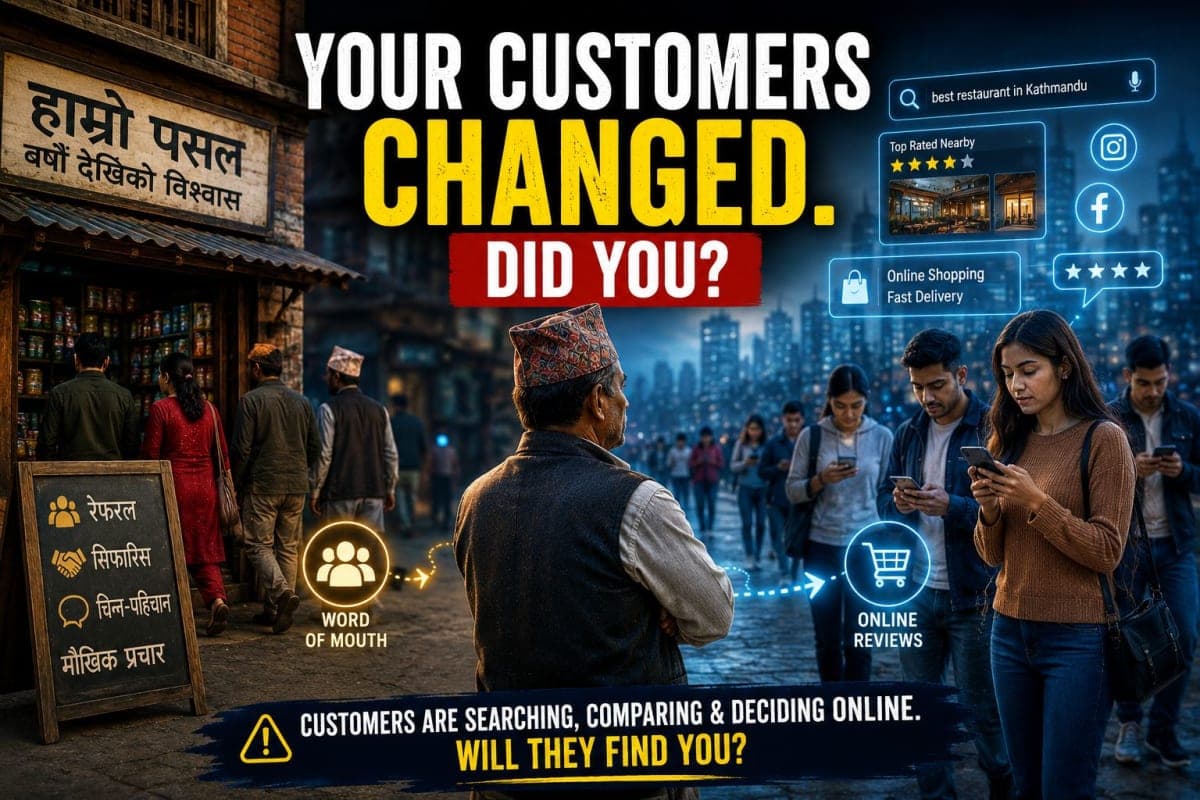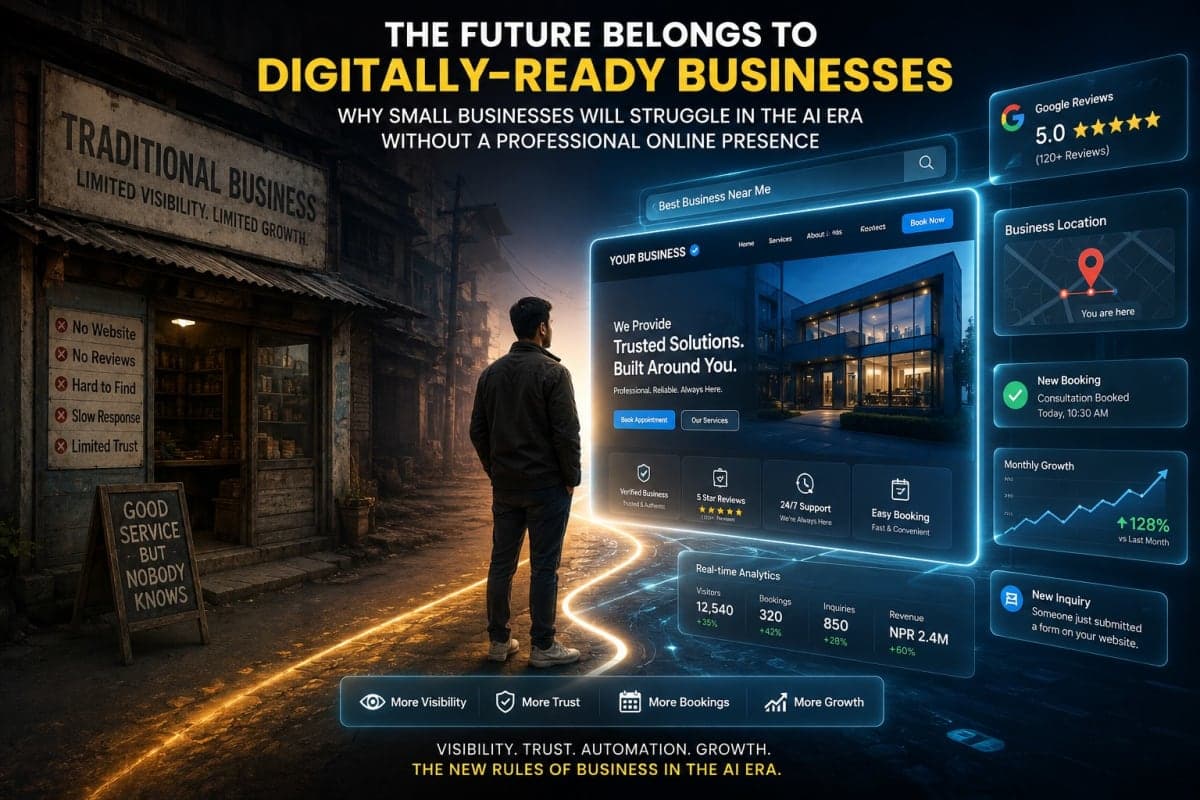
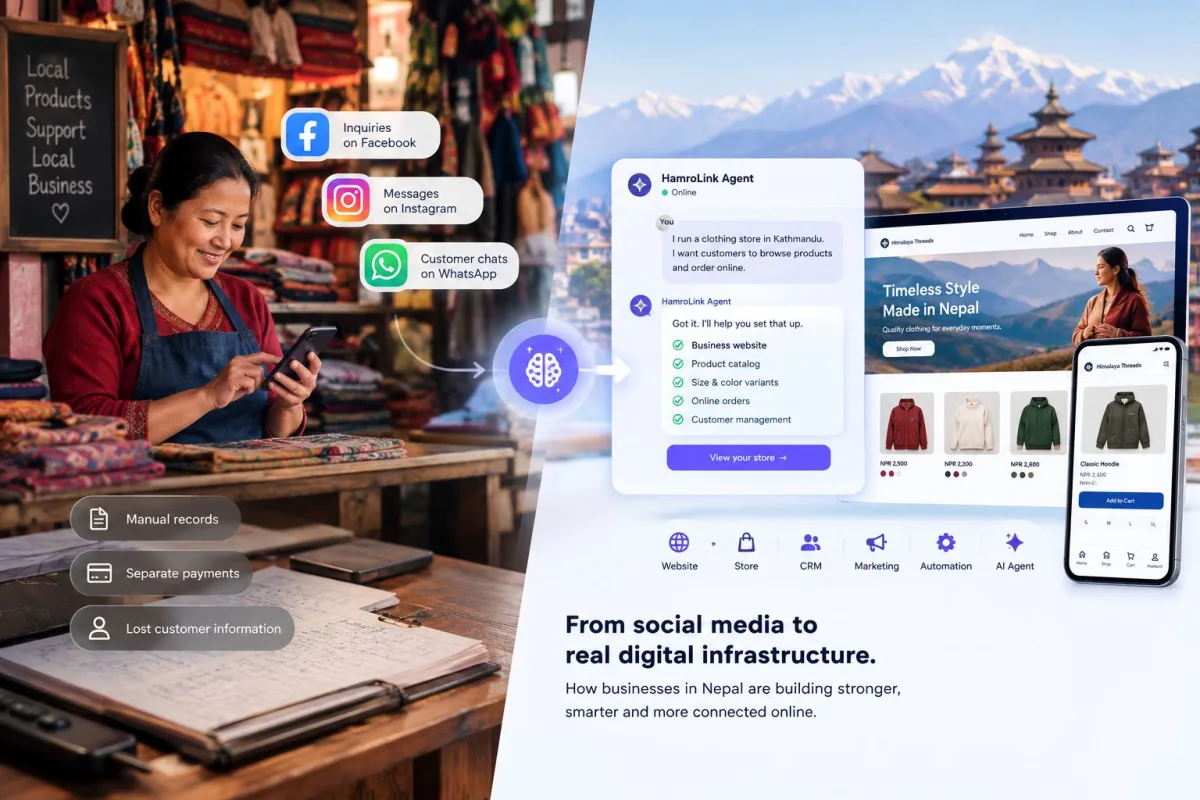
Over the last decade, the default entry point for entrepreneurship in Nepal has been a smartphone and a Meta business account. Whether it is an apparel boutique in Kupondole, a specialty bakery in Pokhara, or a custom furniture workshop in Butwal, the trajectory is familiar: set up a Facebook page, create an Instagram profile, run a few sponsored posts, and announce that the shop is open for business.
For initial brand discovery, this model works. It gives businesses immediate visibility and direct access to an audience that already spends hours a day inside social feeds.
However, a critical distinction is emerging across the local market: a social media presence is not digital business infrastructure.
Posting photos online is not the same as operating a digital enterprise. As consumer expectations mature and order volumes scale, businesses across Nepal are colliding with the structural limits of managing commercial operations inside direct messages. The landscape is gradually shifting from posting online to operating online—a migration toward connected systems, automated workflows, and foundational digital infrastructure.
Key Takeaway: Social Presence vs. Digital Infrastructure
Social Media Presence: Rented audience channels (Instagram, Facebook, TikTok) optimized for discovery, engagement, and top-of-funnel reach.
Digital Business Infrastructure: Owned digital systems (canonical website, catalog database, payment gateway, CRM, and order fulfillment) that automate operations, retain customer data, and secure commercial workflows.
The First Stage: Social Media as the Business Front Door
In the early lifecycle of a small enterprise, social platforms offer unparalleled convenience. They act as a low-friction storefront requiring zero upfront technical capital:
Product catalogs take the form of image posts, carousels, and short-form video reels.
Customer acquisition is powered by organic sharing and micro-targeted ad spend.
Transactions are initiated through Messenger conversations, Instagram DMs, and WhatsApp chats.
For a business processing three to five inquiries a day, this setup feels completely sufficient. Customer interaction is high-touch, the business owner can respond in real time, and the informal nature of the exchange mirrors the conversational commerce of traditional brick-and-mortar retail in Nepal.
The friction begins when success happens.
Social platforms were designed around engagement, media feeds, and interpersonal communication. They were fundamentally never architected to serve as an enterprise operating system.
Where the Real Problem Starts
As transaction volume grows, the chat-based commerce model begins to fracture under its own operational weight:
Scattered Product Information: Price lists, stock availability, sizing specifications, and terms of service get buried under chronological posts or highlight reels. Customers repeatedly ask, "Price please?" on items posted months ago, prompting redundant manual replies.
Unstructured Order Capture: Orders taken via DM are inherently unstructured text. Sifting through hundreds of chat threads to extract delivery addresses, contact numbers, and specific variations leads to human error, missed shipments, and delayed deliveries.
Data Loss and Disconnected History: Direct messages provide zero longitudinal customer data. When an order concludes, that customer's purchasing history, preferences, and aggregate lifetime value are effectively lost in an infinite message stream.
Disjointed Settlement and Fulfillment: The customer takes a screenshot of an eSewa, Khalti, or Fonepay QR transfer, uploads it to the chat, and the business owner must manually log in to a mobile banking app to verify the transaction before notifying a courier service.
At this inflection point, the business owner becomes the integration layer. Instead of running an automated business, the founder spends four to six hours every day acting as human middleware—manually copying names from DMs into notebooks or basic spreadsheets, cross-checking payment references, and texting delivery riders.
Operational Touchpoint | Social Commerce (DM/Chat Flow) | Connected Digital Infrastructure |
Catalog & Pricing | Dispersed across feed posts and story highlights; requires repetitive manual replies | Canonical web catalog; real-time SKU variations and live stock levels |
Order Intake | Unstructured chat messages prone to manual typos | Structured checkout forms capturing verified phone and location data |
Payment Verification | Manual verification of mobile banking and QR screenshots | Automated digital payment verification via eSewa, Khalti, or Fonepay gateways |
Customer Retention | Contacts buried in message logs; zero longitudinal data | Centralized customer profiles, purchase history, and automated remarketing |
AI Compatibility | Incompatible; AI cannot safely operate on fragmented chat screenshots | Ready for AI agents to query stock, automate support, and trigger actions |
From Website to Digital Business Infrastructure
To resolve this bottleneck, the conversation cannot simply be about "getting a website." A static brochure site changes very little if it sits isolated from how the business actually functions.
The progression toward real digital infrastructure follows an evolutionary stack:
[ Social Media ]
       ↓  (Discovery & Audience)
[ Central Website ]
       ↓  (Structured Information & Authority)
[ Commerce Layer ]
       ↓  (Catalog, Cart, Inventory)
[ Customer Records ]
       ↓  (Orders, Profiles, Purchase History)
[ Automation ]
       ↓  (Payment Verification, Dispatch, Invoicing)
[ Applied AI ]
          (Context-Aware Assistance & Proactive Workflows)
Social Media: Remains the engine for discovery, brand positioning, and customer acquisition.
Website: Establishes an owned canonical hub where product specifications, pricing, and policies are indexed, searchable, and controlled directly by the brand—free from third-party algorithm updates.
Commerce Layer: Standardizes purchasing. Buyers select variants, provide verified contact details, and create structured transaction records automatically.
Customer Records (Lightweight CRM): Aggregates repeat interactions. A business owner can now identify high-value repeat buyers, track churn, and reference past purchases instantly.
Automation: Connects the touchpoints. A verified digital payment automatically triggers an invoice, adjusts available stock, and generates a dispatch alert without manual intervention.
Applied AI: Sits atop clean data to handle natural-language queries, draft communications, and summarize daily business intelligence.
Infrastructure is defined by how well these individual components communicate with one another. When systems talk to each other, administrative friction drops exponentially.
What AI Changes for Small Businesses
Until recently, building a connected operational stack required significant engineering budgets, dedicated IT staff, or cumbersome enterprise software suites that were cost-prohibitive for Nepalese SMEs.
Modern AI workflows alter this equation. Rather than serving as speculative novelty, operational AI is acting as an interface accelerator across three distinct dimensions:
Instantaneous Asset Generation: High-quality storefront layouts, product copy, localized metadata, and structured FAQs can now be generated and deployed in minutes rather than weeks.
Intelligent Query Resolution: AI-assisted layers can digest an entire product catalog, store policies, and stock availability to handle inbound pre-purchase inquiries accurately, escalating to human operators only when nuance is required.
Orchestration Across Silos: Instead of navigating through multiple fragmented dashboards, operators can execute complex operational tasks—such as updating seasonal pricing across an entire inventory or generating sales summaries—via natural-language instructions.
Crucially, AI cannot operate effectively in a vacuum. It requires structured business data to act upon. An AI agent cannot help fulfill an order if the order only exists as a cropped screenshot inside an Instagram DM. Real infrastructure provides the clean relational baseline that allows AI tools to function safely and predictably.
What This Looks Like in Practice
Consider an independent apparel business operating out of Kathmandu:
The Fragmented Model: The owner posts a new winter jacket to Instagram. Over 48 hours, they receive 80 comments asking for pricing, 35 DMs asking for available sizes, and 12 potential buyers who drop off halfway through exchanging bank details. Two parcels are shipped to the wrong addresses due to transcription errors from chat messages.
The Connected Infrastructure Model: The business posts the same jacket on Instagram, but directs followers to a clean product link. The customer sees live stock levels, selects their size, enters their delivery address, and completes checkout via a local digital wallet or QR option. The order details are instantly compiled into the store's dashboard, the inventory count decrements automatically, and the customer receives an automated SMS or email confirmation.
The social channel continues to perform its best role—capturing attention and sparking interest—while the infrastructure handles the mechanics of commerce reliably.
Building Digital Infrastructure Without Starting from Scratch
Moving away from manual DM workflows does not require commissioning bespoke custom software from a software house or mastering complex international hosting configurations.
The global software ecosystem has long relied on modular platforms that consolidate front-end presentation with back-end utility. In the local ecosystem, platforms such as HamroLink's website builder are emerging to address this exact requirement—combining straightforward web creation tools with the localized operational plumbing, payment integrations, and product management features that small businesses require behind the scenes.
By adopting tools purpose-built to merge storefronts with operational utilities, businesses can deploy professional, search-indexed digital presences while establishing the operational backbone necessary to handle scale.
What Small Businesses Should Build First: A Pragmatic Roadmap
For founders preparing to transition away from purely conversational commerce, the migration does not need to happen all at once. A sustainable implementation roadmap focuses on fundamentals first:
Establish an Owned Business Domain: Secure an official web presence (such as a registered
.com.npor generic top-level domain) to build long-term search equity and brand credibility.Centralize Product and Service Catalogs: Move core offerings, dimensions, pricing, and availability out of static image posts into a structured, easily editable web catalog.
Deploy Standardized Checkout & Lead Capture: Replace free-form chat orders with dedicated forms or cart flows that collect complete delivery details upfront.
Consolidate Order & Customer Records: Keep a single source of truth for all customer transactions to enable post-sale support and repeat engagement.
Integrate Digital Payment Gateways: Reduce payment confirmation delays by embedding reliable local payment options directly into the transaction path.
Layer in Incremental Automation: Begin introducing automated customer receipts, stock notifications, and AI-assisted workflow tools once the foundational data pipeline is stable.
Frequently Asked Questions
Can a business in Nepal survive on social media alone?
For initial launch and brand awareness, social media is effective. However, scaling past 10–15 orders a day without dedicated systems creates shipping errors, lost customer records, and operational bottlenecks.
Does a small business need a full software development team to get online?
No. Modern website and business platforms integrate localized hosting, .com.np domain routing, and domestic payment options out of the box, removing the need for custom-coded systems.
How does digital infrastructure help with local delivery in Nepal?
Standardized web checkout forms require customers to provide exact delivery landmarks, municipalities, and verified phone numbers upfront, drastically reducing delivery failures compared to free-text chat messages.
Moving Beyond the Feed
Social networks are rented land. Algorithmic changes, shifting user demographics, account bans, or interface overhauls can disrupt customer acquisition overnight. More fundamentally, conversations inside messaging apps were never engineered to run supply chains, track balances, or retain institutional data.
The defining shift for modern businesses in Nepal is not simply to "get a website" as an aesthetic afterthought. It is about constructing resilient, connected digital infrastructure that reduces operational drag, protects customer relationships, and frees business owners to focus on sustainable growth.