
I. Introduction: The New Neighborhood Detective
For decades, the foundation of a successful local business—be it a charming cafe, a curated boutique, or a busy neighborhood hardware store—has rested on the owner’s intuition. This instinct, honed by years of customer interaction, guided decisions on everything from staffing levels to inventory stocking. However, the rapidly shifting retail environment demands a modern evolution. Today, for small businesses to thrive, they must adopt the mindset of the "Neighborhood Detective," leveraging data to confirm and amplify that instinct, not replace it.
The challenge for the local entrepreneur is often time and budget, leading to an avoidance of anything labeled "analytics." This is a mistake, as the power of basic analytics for a local store is not about "Big Data"; it is about achieving "Better Decisions" using information already collected daily. Relying solely on intuition inevitably leads to costly inefficiencies. For example, trusting a gut feeling on scheduling can result in overstaffing during slow hours, thereby bleeding payroll, or, conversely, understaffing during an unexpected rush, leading to slowed service, frustrated regular customers, and lost sales.
By adopting a data-driven approach, small businesses can reduce operational risks and confirm opportunities even before significant capital is committed. The systematic analysis of transaction timestamps and sales patterns allows managers to transform unpredictable, chaotic periods into predictable revenue wins by ensuring smoother service and happier customers. The goal is simple: to move beyond measuring what happened (total revenue) and start understanding the quantifiable customer behaviors—the why—that actually drove those results.
II. What "Basic Analytics" Really Means for a Small Store
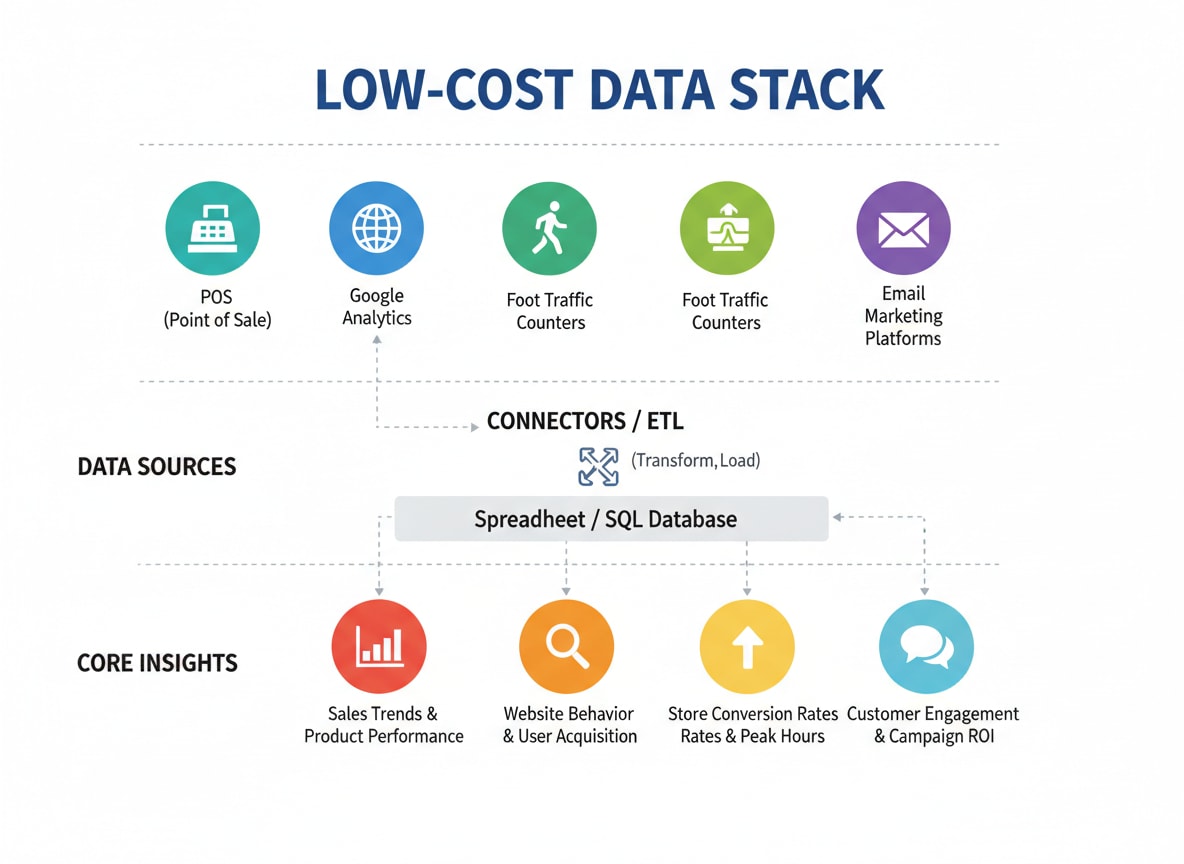
Basic analytics uses a streamlined set of tools, most of which are either already paid for or available for free, to extract actionable patterns related to customer preferences, spending trends, and operational timing. These tools collectively form a low-cost "data stack" that provides a clear, unified view of the business.
A. Defining the Toolkit: Activating Data You Already Own
Read article about best BI tools from Distrya.
The secret to basic analytics is realizing that the essential data is already flowing through existing systems. Small businesses do not need new software; they need new habits around the reports their current software can generate.
Source | Data Captured | Core Insight |
|---|---|---|
Point-of-Sale (POS) System | Sales Volume, Transaction Timestamps, Product Mix, Ticket Size | Best/Worst Sellers, Peak Staffing Hours, Inventory Gaps |
Google Analytics (GA4) | Website Traffic, Search Queries, Referral Sources | Online-to-Offline Traffic Source ROI, Digital Marketing Effectiveness |
Foot Traffic Counters | Physical Visitors (Passerby/Entrants) | Retail Conversion Rate (Transactions ÷ Visitors) |
Email Marketing Platforms/Social Insights | Open Rates, Click-Throughs, Unique Code Redemptions | Marketing Channel Effectiveness and Audience Engagement |
1. The Engine: Point-of-Sale (POS) System Data
The Point-of-Sale system represents the single most powerful, yet often underutilized, analytical engine for a small retailer. It automatically captures every sale, including the product sold, the ticket size, and the precise transaction timestamp. A POS report should be treated not as a tedious accounting task, but as the store’s financial narrative. By running reports, managers can immediately highlight peak sales times, identify best-selling products, and pinpoint underperforming items. This information provides the foundation for informed strategies regarding inventory and staffing. Crucially, managers must always use the most current data; relying on an outdated sales report (e.g., using last month’s report for this week’s inventory planning) can lead directly to overstocking fast-moving items or missing opportunities to promote or restock currently high-demand products.
2. The Digital Footprint: Google Analytics (GA4)
Even for businesses that rely primarily on physical foot traffic, the customer journey almost always begins with a digital interaction. Google Analytics is a free, powerful tool that tracks web performance and provides a comprehensive understanding of the customer journey across various devices . GA4 helps managers understand how customers find the store (e.g., through social media, search, or direct navigation) and which pages (e.g., product catalogs or location pages) drive the most interest. This knowledge is essential for fine-tuning the store's digital presence and improving the Return on Investment (ROI) of any online marketing efforts . Google also provides free courses to help small business owners learn how to navigate the interface and manage the data they send, lowering the barrier to entry.
3. Physical Scorecard: Low-Cost Foot Traffic Counters
A key operational metric historically reserved for large retail chains is now accessible to local shops: the Retail Conversion Rate. This is calculated by dividing the number of transactions by the total number of physical visitors. To measure physical traffic, businesses can install simple, low-cost devices like wireless infrared people counters . These devices, which can be highly affordable , project an infrared beam across the entrance to accurately count incoming traffic .
By integrating this visitor data with the transaction data from the POS, the owner gains instant diagnostic capability. If total sales decline, the owner can determine if the problem lies with reduced foot traffic (an external/marketing challenge) or a lower conversion rate (an internal problem related to merchandising, pricing, or customer service). This capability provides a foundational metric for connecting marketing efforts to in-store experience.
4. Customer Communication Channels: Social Media Insights and Email Platforms
Social media platforms and email service providers (like Mailchimp or Klaviyo) include integrated dashboard tools that offer immediate metrics on customer engagement, open rates, and click-through performance. These insights allow businesses to measure the value of their organic digital content—the "owned media value"—by calculating how much they would have spent on paid channels to achieve the same results. By tracking social-driven conversions, businesses can ensure that the time and effort invested in their digital presence translates directly into measurable results.
III. The Four Key Areas Where Analytics Drive Sales: A Framework
The shift from guessing to knowing delivers competitive advantage. Below is a framework detailing the four highest-impact areas where small-scale data analysis can immediately boost sales and protect margins.
Business Question | Data Source | Actionable Goal |
|---|---|---|
Who are my best customers? | Purchase History, Frequency, Average Spend (POS) | Targeted Offers & Loyalty Campaigns |
What should I stock/promote? | Sales Reports, Market Basket Analysis (POS) | Optimize Shelf Layout, Clear Dead Stock |
Is my marketing working? | Unique Coupon Codes, Tracked Clicks (Social/Email) | Calculate Channel ROI, Reallocate Budget |
Am I staffed correctly? | Transaction Timestamps (Hourly POS Data) | Reduce Idle Labor, Maximize Peak Throughput |
A. Boosting Revenue Through Customer Profiling and Personalization
Small businesses thrive on strong customer relationships, but treating every customer identically in marketing outreach limits efficiency. Analytics allows for market segmentation—dividing the customer base into distinct groups based on shared purchase behaviors—to tailor communications and offerings, thereby significantly increasing the likelihood of engagement and loyalty.
The most profitable area of segmentation often lies in customer retention. Analyzing purchase history and recency data identifies "inactive customers"—those who have shown interest but have not purchased in a certain timeframe (e.g., 90 days). Targeting this group is a low-cost strategy with a high potential Return on Investment (ROI) .
Case Study: The Book Nook's Fantasy Find
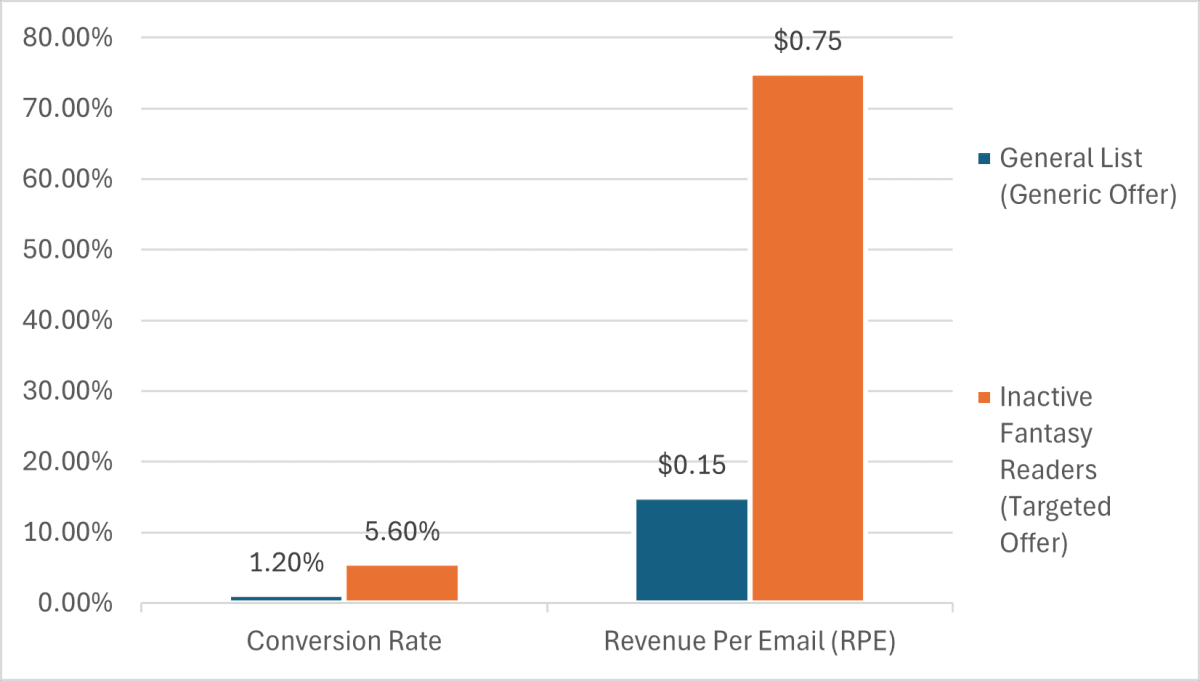
"The Book Nook," a local independent bookstore, used their POS and email data to identify a segment of 300 customers who had purchased at least two fantasy novels in the past year but hadn't purchased a book in the last 90 days. Instead of sending a store-wide coupon, they targeted this specific group with an exclusive "Monthly Fantasy Pick" email, offering a pre-order discount.This precision targeting, mirroring the success of others in retail , resulted in a substantial increase in pre-orders for that genre, proving that the deepest customer knowledge is now found in the data, not just across the counter.
B. Maximizing Cash Flow with Inventory Optimization
For a small store, cash flow is paramount, and excess inventory is essentially frozen capital. Inventory optimization is about reducing this risk by using sales data to align stock levels precisely with demand forecasts .
The immediate benefit of analysis is identifying "dead stock"—products consistently identified as underperforming by tracking sales trends over 90 days or more. Dead stock consumes storage space and ties up cash that could be used for faster-moving, more profitable items. A simple, regular audit of inventory against historical sales allows a manager to spot these items before they become worthless.
Small businesses can embrace the principles of Just-In-Time (JIT) inventory, which means ordering stock based on predictive sales data to minimize the quantity of unsold goods and reduce dead stock risks . The key metrics for optimization are the Inventory Turnover Rate and Dead Stock Percentage.
Case Study: Green Thumb Garden Center's Strategic Placement
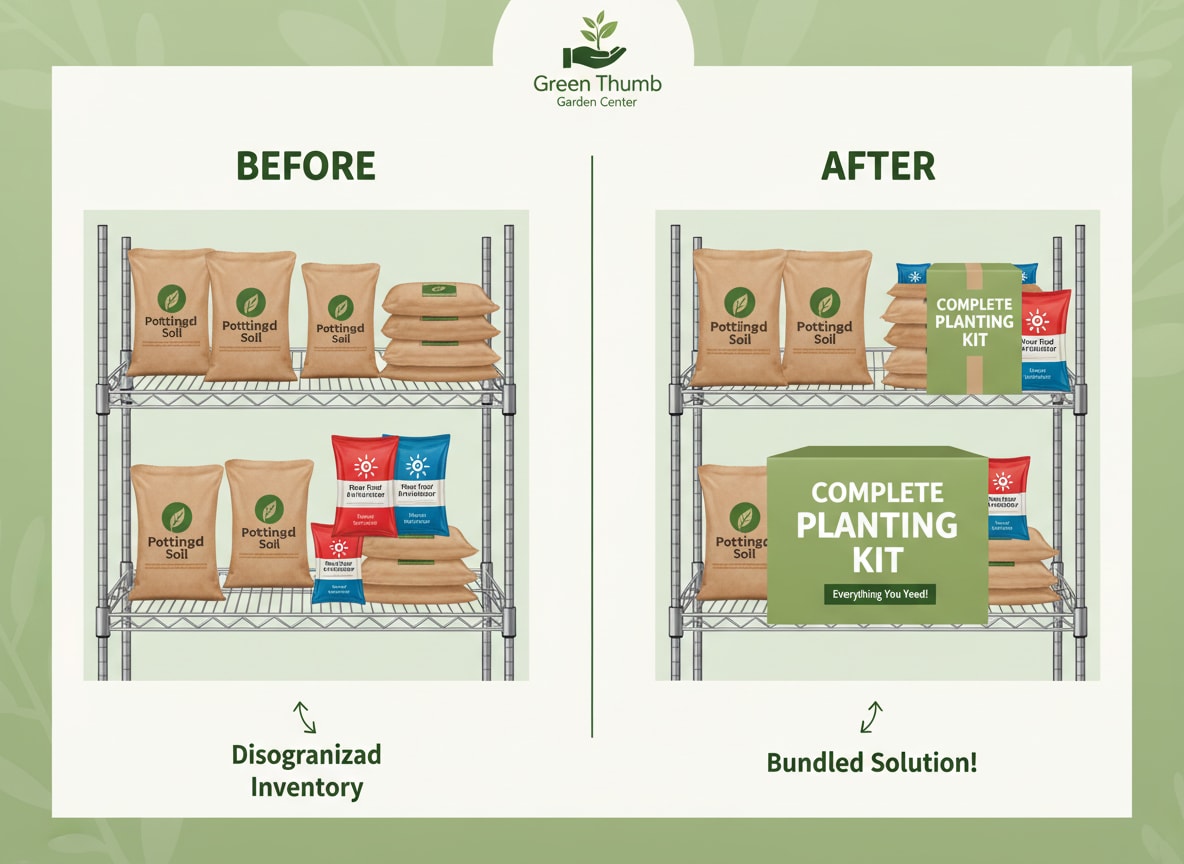
Green Thumb Garden Center analyzed its sales data and performed a simple Market Basket Analysis (MBA). The data revealed that customers buying potting soil had a very high correlation with the purchase of a specific brand of slow-release fertilizer.
Insight: When sold in separate areas, only 40% of customers bought both.
Action: They physically placed the high-margin fertilizer next to the large bags of potting soil (a low-margin, high-volume item) and trained staff to suggest the "Complete Planting Kit."
Result: Sales of the slow-release fertilizer increased by 30%, optimizing the shelf layout and increasing the average transaction value.
C. Proving Impact: Marketing Effectiveness and ROI
Marketing dollars should function as an investment, not a speculative expense. Analytics provides the framework for accountability, ensuring every dollar spent has a measurable return.1 Calculating Marketing ROI is essential for justifying budget allocations. The fundamental calculation is:

For example, if a digital campaign costs $1,000 and directly results in $4,000 in revenue, the ROI is 300%, or a 3:1 ratio.
The challenge of connecting digital advertisements to physical in-store sales is overcome by using trackable mechanisms. Every digital effort—whether an email promotion or a targeted social media post—must require a unique, campaign-specific code (e.g., “NEWS15” or “IGDEAL”).6 This practice allows the POS system to attribute sales revenue directly to the specific marketing channel that generated the lead. Furthermore, utilizing digital tools like QR codes can enhance the customer experience while simultaneously capturing valuable data.
Case Study: Threadbare Vintage's Social Pivot
"Threadbare Vintage" used a unique discount code for each social platform to track effectiveness. They spent 10 hours per week split between Instagram and TikTok.
Platform | Hours/Week | Campaign Code | Attributed Revenue | Marketing Time Investment (Cost) | Calculated ROI |
|---|---|---|---|---|---|
5 | IGFLASH | $600 | $150 (5 hrs @ $30/hr) | 300% | |
TikTok | 5 | TIKTOKDEAL | $1,800 | $150 (5 hrs @ $30/hr) | 1100% |
Based on the stark difference in ROI, the owner reallocated 80% of their marketing time to TikTok and reduced low-performing Instagram efforts, resulting in a significantly higher return on effort (ROE).
D. Protecting Margins with Operational Efficiency (Staffing and Merchandising)
1. Labor Optimization: Matching Staff to Demand
Labor is a dominant operational cost for small retailers. Relying on managerial instinct to schedule shifts often leads to inefficiencies—either paying staff to stand idle during off-peak hours or incurring the higher cost of losing sales and customer trust during peak chaos.
The most effective way to optimize labor is to analyze the POS system’s transaction timestamps over a period of weeks to forecast demand with precision. This process reveals specific, repeatable patterns that defy generalized assumptions about business flow, such as unexpected early morning rushes or after-school spikes.
Case Study: Brewed Awakening's Peak Coverage
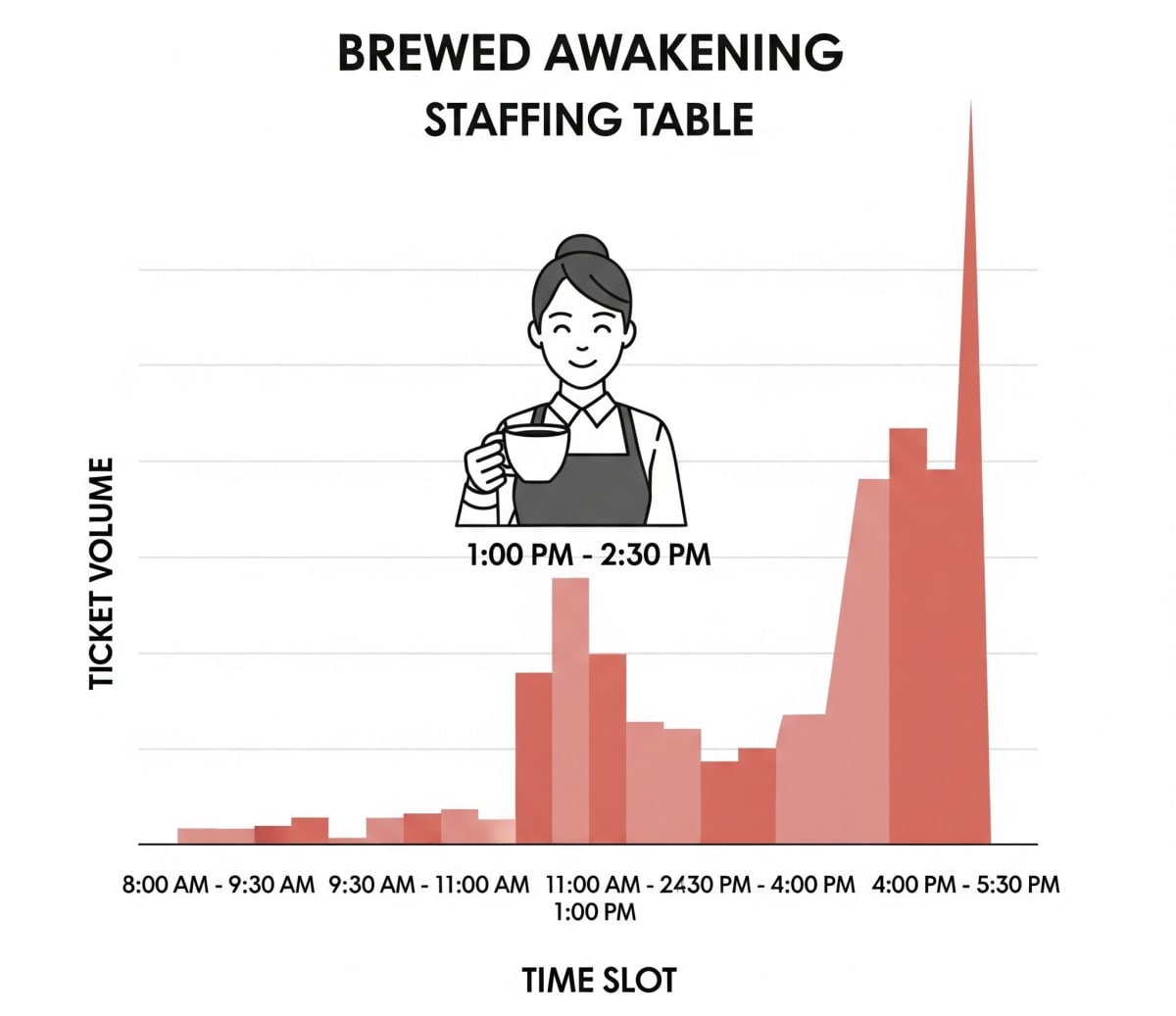
"Brewed Awakening," a bustling café, reviewed its POS data and found that its ticket volume reliably spiked by 30% during a specific 90-minute window every Tuesday and Thursday afternoon.
Time Slot | Expected Business Volume (Index) | Staffing Adjustment (vs. Standard) |
|---|---|---|
11:00 AM - 1:00 PM | 100 | Standard Staff |
1:00 PM - 2:30 PM (Confirmed Spike) | 130 | Add one 'Peak Coverage' Barista |
2:30 PM - 4:30 PM | 95 | Standard Staff |
Based on this specific data, the manager avoided scheduling an extra employee for an expensive full eight-hour shift. Instead, they scheduled one targeted, two-hour "peak coverage" barista for those specific, high-demand times. This targeted approach protects margins by minimizing idle labor time and simultaneously boosts throughput during the busiest hours, turning a traditionally stressful period into a structured revenue success.
2. Market Basket Analysis (MBA) for Merchandising
Beyond staffing, POS data can be leveraged for better physical merchandising through Market Basket Analysis (MBA). This technique identifies correlations between products purchased together in a single transaction (e.g., "Customers who buy X are also likely to buy Y"). These tools have become much easier for small and mid-size retailers to use, enabling them to compete effectively with larger chains.
MBA provides direct guidance for in-store displays and staff prompts. For a clothing retailer, if data shows that customers buying formal shirts frequently choose ties, the store should physically place the ties near the shirts and ensure checkout staff always offer the tie as an upsell option.
IV. Getting Started: A 30-Day Plan for Any Small Store
Adopting analytics does not require a large upfront investment; it requires a disciplined, systematic commitment. This 30-day plan focuses on delivering immediate, high-impact insights using tools the business already owns, treating the process as a high-value internal audit that strengthens the business foundation.
Table 1: The Small Store 30-Day Data Activation Checklist
Timeframe | Focus Area | Key Task (Action) | Goal & Sales Impact |
|---|---|---|---|
Day 1 - 7 | Inventory & Sales Health | Run a 90-day product sales report from the POS system. Clearly identify the Top 10 best-sellers and the Bottom 10 slow-movers (dead stock). | Achieve clarity on capital investment; identify immediate promotion targets for liquidating frozen cash. |
Day 8 - 14 | Customer Reactivation | Segment the email list into "active" (purchased in last 60 days) and "inactive" (purchased 90+ days ago). Design and send a targeted, special reactivation offer to the inactive group . | Drive immediate, high-ROI revenue by converting existing customers (potential for RPE surge). |
Day 15 - 21 | Operations Efficiency | Analyze POS transaction timestamps for the last 30 days. Identify the single quietest hour and the single busiest 90-minute window. | Optimize labor scheduling, reduce labor cost waste, and ensure maximum service speed during core peak hours. |
Day 22 - 30 | Marketing Measurement | Launch a single, small-budget social media promotion (e.g., $50 targeted ad). Require customers to use a unique, trackable discount code or QR code upon redemption. | Quantify Marketing ROI; establish data-backed justification for budget allocation and future campaign success. |
V. Conclusion: The Future is Informed
The data needed for profound sales growth is not locked away in inaccessible corporate servers; it is already being captured by the small business owner’s existing tools. The democratization of business intelligence means that small local stores can now access complex insights previously reserved for corporate analysts.
The evidence presented confirms that consistency in applying basic analytics—not complexity—is the true engine of growth. By adopting the discipline of a Neighborhood Detective, the entrepreneur gains the capability to test strategies, measure their financial impact, and quickly pivot away from ineffective spending. This systematic, evidence-based management reduces risk, clarifies investment decisions, and ensures that the innate expertise of the local store owner is maximally effective. The era of guesswork is over; the future of Main Street belongs to the informed and empowered retailer.